Key Points
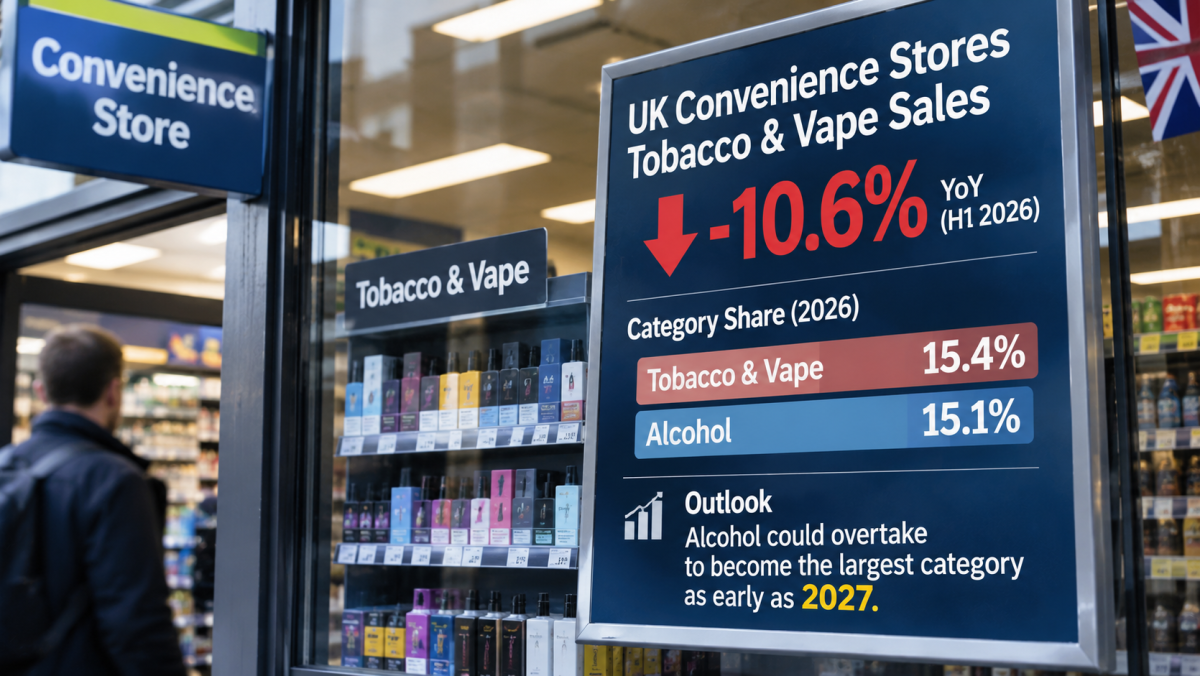
IGD reported a 10.6% decline in combined tobacco and vaping sales in UK convenience stores during H1 2026, compared with a 1.2% fall in total convenience sales. Other categories collectively grew 0.7%.
Tobacco and vaping accounted for 15.4% of convenience sales in IGD's 2026 category-share figures, versus 15.1% for alcohol. Alcohol could become the largest category by sales value as early as 2027.
IGD forecasts the convenience market will grow from £48.6 billion in 2026 to £54.9 billion in 2031, with a 2.5% annual growth rate. Major multiple convenience retailers are expected to grow by 3.9%.
Talysis separately reported a 12.7% decline in vaping sales value and a 20.8% decline in unit sales in sampled UK independent and symbol-group convenience stores over the 52 weeks ended January 4, 2026.
The UK's single-use vape ban took effect on June 1, 2025. Talysis said changes toward reusable devices, prefilled pods and larger-capacity products were affecting purchase frequency and retail merchandising.
2Firsts
November 11, 2026
Combined tobacco and vaping sales in UK convenience stores fell 10.6% year over year in the first half of 2026, making the category a major drag on channel performance, according to the latest figures from retail research organization IGD. Total convenience sales declined 1.2%, but sales excluding tobacco and vaping rose 0.7%.
IGD also reported that tobacco and vaping accounted for 15.4% of UK convenience sales in its 2026 category-share figures, narrowly ahead of alcohol at 15.1%.
If current trends persist, alcohol could overtake tobacco and vaping as the largest convenience-store category by sales value as early as 2027, IGD forecasts.
The findings come from IGD's The UK Convenience Market 2026–2031, published on September 30. UK trade publications reported the headline findings from November 5, with further coverage by The Grocer on November 10.
Tobacco and Vape Sales Fall 10.6% as Alcohol Nears Top Category
IGD reported that UK convenience-store sales declined 1.2% in the first half of 2026.
Combined tobacco and vaping sales fell 10.6%, making the category a major contributor to the decline. Excluding tobacco and vaping, sales across the remaining categories increased 0.7%.
IGD insight manager Patrick Mitchell-Fox said the first half of 2026 marked a low point for convenience-market performance in recent years.
Of the 17 categories tracked by IGD, 11 recorded sales growth, but only five grew by more than 2%.
Soft drinks generated the largest absolute increase in sales value, adding £99 million during the period. Chilled foods added £64 million.
| IGD Indicator | H1 2026 Year-over-Year Change |
|---|---|
| Total UK convenience sales | -1.2% |
| Combined tobacco and vaping sales | -10.6% |
| Sales excluding tobacco and vaping | +0.7% |
| Categories recording sales growth | 11 of 17 |
| Categories growing by more than 2% | 5 |
| Additional soft drink sales | £99 million |
| Additional chilled food sales | £64 million |
Tobacco has historically been an important contributor to convenience-store sales, particularly for independent retailers and symbol-group operators.
IGD's 2026 category-share data show that tobacco and vaping accounted for 15.4% of convenience sales, compared with 15.1% for alcohol.
The gap stood at just 0.3 percentage points.
IGD forecasts that alcohol could become the largest category by sales value as early as 2027 if the current trends continue.
The ranking is based on retail sales value.
The publicly reported IGD figures combine tobacco and vaping. They do not separately identify conventional tobacco and vape sales in H1 2026, changes in unit sales or the contribution of each subcategory to the overall 10.6% decline.
Convenience Market Forecast to Reach £54.9 Billion by 2031 as Major Chains Outperform
IGD forecasts that the UK convenience market will expand from £48.6 billion in 2026 to £54.9 billion in 2031.
That represents an additional £6.3 billion in sales, or approximately 13% cumulative growth over five years.
The projected compound annual growth rate is 2.5%.
Excluding tobacco and vaping, IGD expects the remaining convenience categories to grow at a compound annual rate of 3.4% from 2026 to 2031.
Growth is expected to vary across retailer types.
In its August 19, 2026, market analysis, IGD projected that major multiple convenience retailers would achieve annual growth of approximately 3.9%, ahead of the overall convenience channel.
According to IGD, major chains are less dependent on tobacco sales and have greater capacity to invest in foodservice, store improvements, digital operations and quick-commerce partnerships.
Independent and symbol-group convenience stores remain more exposed to declining tobacco and vaping sales and the associated changes in customer visits.
| IGD Forecast | 2026–2031 |
|---|---|
| UK convenience market, 2026 | £48.6 billion |
| UK convenience market, 2031 | £54.9 billion |
| Additional forecast sales | £6.3 billion |
| Overall convenience market CAGR | 2.5% |
| CAGR excluding tobacco and vaping | 3.4% |
| Major multiple convenience retailer CAGR | 3.9% |
IGD expects future convenience growth to be increasingly supported by food-to-go, chilled foods, beverages and shopping occasions linked to immediate consumption.
Competition from online retailers and discounters, higher operating costs and regulatory changes are expected to remain pressures on the channel.
These figures are forecasts rather than realized sales.
Vape Sales Value Falls 12.7% in Separate Study After UK's Disposable Ban
The UK banned the sale and supply of single-use vapes on June 1, 2025.
The ban applies to online and physical retail, including both nicotine-containing and nicotine-free single-use vaping products.
Reusable vaping products can still be sold if they meet the relevant product definitions and legal requirements.
Separately from IGD, UK retail data provider Talysis reported declining vaping sales value and unit sales in convenience retail data published on January 23, 2026.
Talysis's Clarity platform collects electronic point-of-sale data from thousands of independent and symbol-group convenience stores across the United Kingdom.
Its figures cover the 52 weeks ended January 4, 2026, compared with the preceding 52-week period.
Tobacco and Smoking Alternatives, a combined category in the Talysis dataset, recorded an 8% decline in sales value and a 13.4% decline in unit sales.
Within that dataset, vaping sales value fell 12.7%, while vaping unit sales declined 20.8%.
Talysis said conventional cigarettes and tobacco accounted for most of the decline in the broader Tobacco and Smoking Alternatives category.
| Talysis Category | Year-on-Year Change, 52 Weeks Ended Jan. 4, 2026 |
|---|---|
| Tobacco and Smoking Alternatives sales value | -8.0% |
| Tobacco and Smoking Alternatives unit sales | -13.4% |
| Vaping sales value | -12.7% |
| Vaping unit sales | -20.8% |
Talysis said that the single-use vape ban had been accompanied by changes in product formats and purchasing behavior.
Before the ban, customers commonly bought complete disposable devices containing approximately 2 ml of e-liquid. Sales have increasingly shifted toward reusable devices, prefilled pods and multipod kits.
Talysis said consumers could now buy two 2 ml pods for a price comparable to that previously paid for a single disposable vape.
Some larger-capacity kits combine a 2 ml pod with a further 10 ml of e-liquid capacity, offering more liquid per transaction at a higher purchase price.
The firm said larger purchase quantities could reduce repeat visits to convenience stores and affect transaction frequency and revenue.
Retailers also face a broader range of products to display and manage.
According to Talysis, more than 2,000 new vaping product barcodes entered its tracked retail dataset during 2025.
Its data for the period ended January 4, 2026, showed that small 2 ml prefilled pod kits accounted for 29.8% of vaping sales value. Larger 2+10 ml kits represented 28.2%, and separate pod products accounted for 28.3%.
Together, these three categories represented 86.3% of vaping sales value in the tracked outlets.
Talysis attributed some of the pressures on convenience-store revenue and footfall to changes in pack sizes and purchasing frequency.
Its findings do not establish that total UK vaping consumption fell by 20.8%, nor do they isolate the full contribution of the single-use vape ban to sales changes.
The Talysis dataset primarily covers independent and symbol-group convenience stores, while IGD's figures address the broader convenience market.
Talysis's data also cover the 52 weeks ended January 4, 2026, whereas IGD's latest reported sales changes relate to the first half of 2026. The two studies use different category definitions and cannot be directly compared.
IGD forecasts that declining tobacco and vaping sales could change the ranking of the UK's largest convenience-store categories by sales value in 2027. Talysis's separate retail data show how a shift toward reusable devices, prefilled pods and larger-capacity vaping products is also changing the sales mix within convenience stores.
Follow 2Firsts for coverage of global vaping regulation, tobacco retail channels, market data and developments in the next-generation nicotine industry.
Cover Image generated by AI