Key Points
- Patent owner: China Tobacco Hubei Industrial Corporation Limited (CTHB) is the patent owner of “Cigarette Paper and Cigarette for Microwave Heating.”
- Product form: The cigarette paper wraps around the aerosol-generating substrate, with the isolation heat-conducting layer directly contacting the substrate.
- Material design: The granted claims state that the heating layer includes tobacco-derived pyrolytic semi-coke powder, while the isolation heat-conducting layer may include graphite paper or aluminum foil paper.
- Industry relevance: The design suggests that microwave heated tobacco innovation may extend from device structures and substrates to cigarette paper materials and layered consumable design.
2Firsts
June 10, 2026
According to public records from China’s National Intellectual Property Administration, a patent owned by China Tobacco Hubei Industrial Corporation Limited (CTHB) was granted on May 19, 2026, under the title “Cigarette Paper and Cigarette for Microwave Heating.” The patent proposes a cigarette paper for microwave heating that uses a heating layer and an isolation heat-conducting layer to absorb microwave energy, convert it into heat and transfer that heat to the aerosol-generating substrate.
The public filing does not show that the technology has entered commercial application or disclose any productization progress. The technology remains at the granted patent disclosure stage, with its application path still subject to product development, material validation, process adaptation and regulatory determination.
CTHB Patent for Microwave-Heating Cigarette Paper Granted
According to the patent document, the application number is 202410413867.3, and the granted publication number is CN 118308912 B. The patent owner is China Tobacco Hubei Industrial Corporation Limited (CTHB), and the patent is titled “Cigarette Paper and Cigarette for Microwave Heating.” The patent was filed on April 8, 2024, published on July 9, 2024, and granted on May 19, 2026.
The patent falls within the field of heated tobacco. Its core proposal is a cigarette paper suitable for microwave heating. The filing states that the cigarette paper includes an outer wrapping layer, a heating layer and an isolation heat-conducting layer. The outer wrapping layer serves as the base; the heating layer absorbs microwave energy and converts it into heat; and the isolation heat-conducting layer transfers the heat generated by the heating layer to the aerosol-generating substrate while isolating permeating substances generated by the substrate.
In the granted claims, the cigarette paper also includes a thermal insulation layer placed on the surface of the outer wrapping layer, with the heating layer positioned on the side of the insulation layer facing away from the outer layer. The insulation layer is intended to reduce heat loss to the outside and direct more heat toward the aerosol-generating substrate.
Technical Mechanism: Turning Cigarette Paper Into a Microwave Heating Carrier
From a technical perspective, the patent turns cigarette paper from a conventional wrapping material into a functional heating carrier within a microwave heating system.
The background section of the patent states that microwave heating relies on an object absorbing microwave energy and converting it into heat. Heated tobacco products using microwave heating do not require heating needles or blades in the device, which may make the device structure simpler and easier to clean.
However, the patent notes that current reconstituted tobacco used in heated tobacco products mainly contains tobacco powder, glycerol and water. These components have limited microwave absorption efficiency, making it difficult for them to be heated above 300°C in a microwave environment. Changing the reconstituted tobacco formulation to improve microwave absorption may affect machine rollability and the taste profile of heated tobacco products, which may be unfavorable for product consistency.
The patent seeks to transfer microwave absorption and heating functions to the cigarette paper structure. The heating layer absorbs microwave energy and rapidly generates heat, while the isolation heat-conducting layer transfers that heat to the aerosol-generating substrate, enabling rapid heating of the substrate.
Product Form: Multi-Layer Composite Paper Around the Substrate
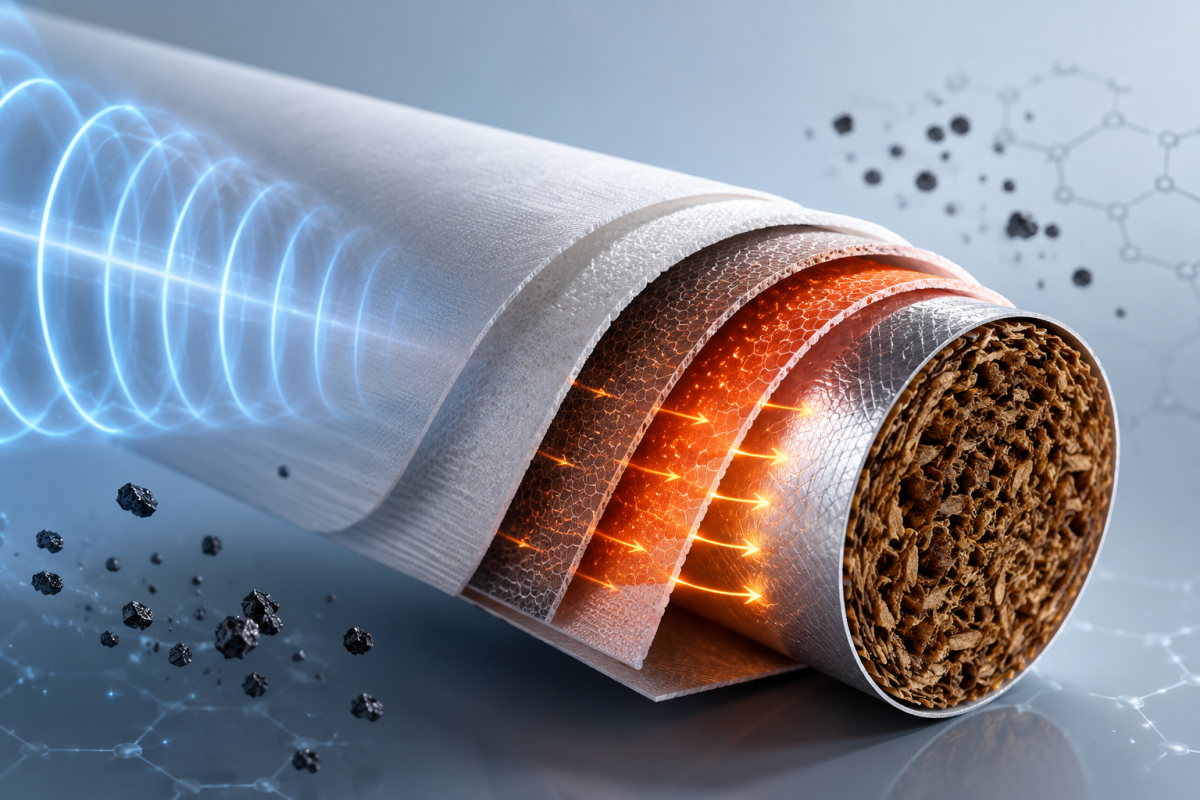
According to the granted claims, the microwave-heating cigarette paper includes an outer wrapping layer, a thermal insulation layer, a heating layer and an isolation heat-conducting layer.
The outer wrapping layer supports the overall cigarette paper structure. The thermal insulation layer is placed on the surface of the outer layer and may be fixed by spraying, pressing or bonding. The heating layer is positioned on the surface of the thermal insulation layer facing away from the outer layer and is used to absorb microwave energy and convert it into heat. The isolation heat-conducting layer is placed on the surface of the heating layer facing away from the outer layer. It transfers heat to the aerosol-generating substrate while isolating permeating substances generated by the substrate and separating the heating layer material from the substrate.
Figure 1 in the patent shows a three-layer cigarette paper structure consisting of an outer wrapping layer, a heating layer and an isolation heat-conducting layer. Figure 2 shows a four-layer structure with the added thermal insulation layer. Figure 3 shows the cigarette paper wrapping around the aerosol-generating substrate, with the paper surrounding the substrate.
In terms of product form, the patent does not simply modify the device structure or directly adjust the substrate formulation. Instead, it uses functional cigarette paper around the aerosol-generating substrate so that the paper performs microwave absorption, heat generation and heat transfer functions.
Material Design: Tobacco-Derived Pyrolytic Semi-Coke and Flexible Conductive Layers
The material design focuses on the heating layer, thermal insulation layer and isolation heat-conducting layer.
The granted claims state that the heating layer material includes pyrolytic semi-coke powder. The powder is a solid product obtained by pyrolyzing biomass material and is derived from tobacco. The specification further states that heating layer materials may include carbon-based materials such as activated carbon and pyrolytic semi-coke powder. Biomass materials may include tobacco materials such as tobacco leaves and stems, as well as aromatic biomass materials such as tea and coffee.
The isolation heat-conducting layer includes a flexible material with thermal conductivity of not less than 1 W/(m·K). The granted claims state that the layer may include at least one of graphite paper and aluminum foil paper. This layer needs to conduct heat generated by the heating layer while isolating permeating substances produced by the heated substrate, preventing damage to the heating layer and preventing heating layer material from mixing into the substrate.
The thermal insulation layer includes solid materials with thermal conductivity of not more than 0.1 W/(m·K), and the material should not change in properties under conditions not higher than 200°C. The granted claims state that the layer may include at least one of ceramic fiber and aerogel.
Process and Structure: Spraying, Pressing or Bonding Composite Layers
The patent discloses several methods for fixing the heating, insulation and isolation heat-conducting layers within the cigarette paper structure.
The heating layer may be fixed to the surface of the outer wrapping layer or thermal insulation layer through spraying, pressing or bonding. Under a spraying method, the heating layer material is sprayed onto the outer layer surface to form a layer of certain thickness. Under a pressing method, the heating layer material may be spread and then pressed into a layer. Under a bonding method, adhesive may be applied to connect a prepared heating layer to the outer layer.
The thermal insulation layer may also be fixed to the surface of the outer wrapping layer by spraying, pressing or bonding. The isolation heat-conducting layer may be bonded to the surface of the heating layer facing away from the outer layer, improving connection stability between the layers.
From a process perspective, the key lies in functional separation and interfacial stability between the layers. The heating layer must absorb microwaves effectively, the isolation heat-conducting layer must balance heat conduction and isolation, and the thermal insulation layer must reduce outward heat loss. If bonding between the layers is insufficient, actual heating efficiency and rollability may be affected.
Relationship With Existing Heated Tobacco Technologies
The patent differs from conventional heated tobacco approaches.
Existing heated tobacco products typically rely on heating needles, blades or peripheral heating structures in the device to heat the aerosol-generating substrate through contact or non-contact heating. Microwave heating uses electromagnetic energy acting on microwave-absorbing materials to raise their temperature. The patent states that microwave heated tobacco does not require heating needles or blades in the device, which may simplify the device structure and make cleaning easier.
However, this patent does not address microwave heating only from the device side. It designs cigarette paper as a microwave-absorbing and heat-transferring carrier. Compared with changing the reconstituted tobacco formulation to improve microwave absorption, this approach seeks to improve heating efficiency without changing other cigarette components.
Based on the patent design, the product appears to represent a reconfiguration of material structure for heated tobacco rather than a direct replacement of existing devices or substrates. It shows that microwave heated tobacco innovation may be extending from heater structures to consumable materials and multi-layer cigarette paper design.
Technical Effects: Rapid Heating and Isolation Protection
The patent states that the heating layer in the cigarette paper can absorb microwave energy and convert it into heat, enabling rapid heat generation. The isolation heat-conducting layer transfers that heat to the aerosol-generating substrate, enabling rapid heating and improving heating efficiency.
The patent also emphasizes that the isolation heat-conducting layer can isolate permeating substances generated by the substrate, such as tobacco oil and aerosol-forming agents, helping avoid yellow stains while preventing permeating substances from damaging the heating layer. It also prevents heating materials from being carried away by aerosol flow or mixing into the substrate.
In addition, the thermal insulation layer placed between the outer wrapping layer and the heating layer can reduce heat loss toward the outside of the cigarette paper, allowing more heat to be transferred to the substrate. The layer is designed with low thermal conductivity materials and may include ceramic fiber, aluminum silicate fiber or aerogel.
The public filing does not disclose experimental data on specific microwave power, heating time, aerosol yield or sensory evaluation. As a result, the heating efficiency and user experience would still need further validation through product development and system-level testing.
Industry Significance: Material-Side Innovation for Microwave Heated Tobacco
The significance of this patent lies in extending microwave heated tobacco development from devices and substrate formulations to cigarette paper structure.
For microwave heated tobacco, a key challenge is improving heating efficiency without significantly altering product style or processing compatibility. This patent proposes that cigarette paper itself perform microwave absorption and heat conduction, potentially offering a material-side solution for microwave heated tobacco.
If the design moves into product development, its potential value may lie in reducing the need to modify the aerosol-generating substrate formulation and lowering dependence on conventional heating needles or blades. Multi-layer composite cigarette paper may also become part of differentiated consumable design for heated tobacco products.
However, industrialization would still require several validations, including rollability of multi-layer paper, microwave heating consistency, material safety, durability of the isolation layer, uniformity of heat distribution and compatibility with the device system.
Regulatory and Application Considerations: Microwave Heated Tobacco Requires System Validation
The patent relates to heated tobacco, and its final application may depend on product definition, production licensing, material compliance and device-system compatibility.
First, the cigarette paper described in the patent is not a conventional wrapping material. It is a functional material that absorbs microwaves and generates heat in a microwave environment. If commercialized, the safety, stability and migration risks of its heating, isolation heat-conducting and thermal insulation materials may become key R&D and compliance concerns.
Second, the heating layer includes tobacco-derived pyrolytic semi-coke powder. The heating efficiency, particle stability and isolation performance of this type of carbon-based material in a microwave field would need to be verified in specific products.
Third, the technology is closely linked to the microwave heating device. The heating performance of the paper depends not only on its material structure but also on microwave frequency, power, cavity structure, stick dimensions and substrate parameters.
If related products enter commercial application, heating uniformity, temperature control, aerosol release stability, material reliability and consumer-use safety may become key evaluation areas.
Conclusion
Overall, CTHB’s microwave-heating cigarette paper patent shows that heated tobacco technology is extending from device heating elements and substrate formulations to cigarette paper materials and layered structural design. By setting a heating layer, an isolation heat-conducting layer and a thermal insulation layer in the cigarette paper, the patent seeks to enable faster heating of the aerosol-generating substrate in a microwave environment while reducing reliance on changes to the substrate formulation.
The technology remains at the granted patent disclosure stage. Whether it can enter product application will depend on material safety, process compatibility, microwave heating system validation and regulatory determination.
Cover image:generated by AI
Disclaimer
This article is provided solely for professional research, industry discussion, and informational purposes. Any references to brands, companies, products, technologies, or policies are made for factual reporting and analytical purposes only, and do not constitute endorsement, recommendation, promotion, or advertising by 2Firsts.
Nicotine-containing products, including but not limited to cigarettes, e-cigarettes, heated tobacco products, and nicotine pouches, carry significant health risks. Readers are responsible for complying with all applicable laws and regulations in their respective jurisdictions, including age restrictions and access limitations.
The information contained in this article should not be regarded as investment, legal, medical, regulatory, or commercial advice. While 2Firsts strives to ensure the accuracy and reliability of its content, it does not assume liability for any direct or indirect loss arising from errors, omissions, inaccuracies, or reliance on the information contained herein.
This article is not intended for individuals below the legal age for accessing tobacco or nicotine-related information in their jurisdiction.
Copyright Notice
This article is either original content produced by 2Firsts or content reproduced, translated, summarized, or adapted from third-party sources with attribution where applicable. The intellectual property rights of the original content remain with 2Firsts or the respective original rights holders.
No individual or organization may copy, reproduce, distribute, republish, modify, translate, or otherwise use this content without prior authorization. Any unauthorized use may result in legal action.
For copyright-related inquiries, corrections, or removal requests, please contact: info@2firsts.com.
AI-Assisted Translation and Editing Notice
Portions of this article may have been translated, edited, or reviewed with the assistance of artificial intelligence tools to improve efficiency and readability. Due to the limitations of AI-assisted translation and editing, discrepancies, omissions, or inaccuracies may exist when compared with the original source.
Where applicable, readers are advised to refer to the original source for the most complete and accurate information. If you identify any errors or believe that any content infringes upon your rights, please contact us at info@2firsts.com, and we will review and address the matter promptly.