Key Points
- Weighted HTP use prevalence among Japanese survey respondents aged 18–69 increased from 0.1% in 2015 to 14.9% in 2025, with annual growth slowing after 2018.
- In 2025, 6.5% used HTPs exclusively and 8.4% used both HTPs and conventional cigarettes, putting dual users at approximately 56% of current HTP users.
- The modelled mean annual contribution from previously non-current users increased from 0.34 percentage points in 2016–2018 to 1.40 points in 2019–2025, while cigarette-to-HTP switching remained substantial.
- Japan's HTP sales reached 73.4 billion units in fiscal 2025, equivalent to 93.9% of conventional cigarette sales.
2Firsts
November 10, 2026
Heated tobacco product (HTP) use in Japan rose from 0.1% to 14.9% over the past decade, with growth extending beyond the movement of conventional cigarette smokers into heated tobacco products, according to a study published in The Lancet Regional Health – Western Pacific.
The research, published online on September 25, 2026, found that HTP prevalence growth slowed markedly after 2018. Switching from conventional cigarettes remained an important source of uptake, while persistence within HTP-using states and increasing uptake among previously non-current users also contributed to changes in the market.
Dual use remained widespread. In 2025, approximately 56% of current HTP users in the surveyed population also smoked conventional cigarettes.
Conducted by Satomi Odani and Takahiro Tabuchi, the study analysed data from the Japan Society and New Tobacco Internet Survey (JASTIS) between 2015 and 2025.
It combined repeated cross-sectional surveys with longitudinal analysis and statistical modelling to examine HTP prevalence and transitions between different tobacco-use states.
HTP Prevalence Reaches 14.9% as Growth Slows After 2018
Weighted current HTP prevalence in Japan increased from 0.1% in 2015 to 7.5% in 2018, 10.6% in 2019 and 14.9% in 2025.
Based on sex- and age-standardised estimates, the researchers calculated an average annual increase of 3.33 percentage points during 2015–2018, compared with 0.92 percentage points during 2019–2025.
Prevalence varied substantially across demographic groups.
In 2025, HTP use prevalence was 22.2% among men and 7.7% among women. Among adults aged 18–54, estimates ranged from 14.7% to 18.0%, compared with 9.4% among those aged 55–69.
Prevalence was highest among current cigarette smokers, reaching 43.7% in 2025. The corresponding figures were 18.4% among former cigarette smokers and 1.4% among people who had never smoked conventional cigarettes.
The research analysed 161,583 annual survey observations among adults aged 18–69 and used longitudinal data from respondents participating in consecutive survey years to estimate changes in tobacco-use states.
More Than Half of HTP Users Also Smoke Cigarettes
The researchers classified respondents into five mutually exclusive states: Never, Non-current, Cigarette-only, HTP-only and Dual use.
In 2025, 10.9% of the surveyed population used conventional cigarettes only, 6.5% used HTPs only, and 8.4% used both products.
The figures indicate that dual users accounted for approximately 56% of current HTP users.
Longitudinal modelling found that during 2019–2025, the estimated probability of a Cigarette-only user moving to HTP-only use the following year was 2.7%, compared with 11.0% for moving to Dual use.
Another 64.4% remained Cigarette-only, while 22.0% moved to Non-current use, defined as having used neither cigarettes nor HTPs during the preceding 30 days.
Persistence within HTP-using states also increased.
During 2016–2018, the estimated probability that an HTP-only user would remain in the same state the following year was 43.1%. During 2019–2025, that probability increased to 67.9%.
For dual users, the probability of remaining in Dual use increased from 44.9% to 57.0%.
The findings indicate that HTP adoption in Japan involves continued movement between different tobacco-use states rather than a single direction of transition away from conventional cigarettes.
Switching Remains Important as Uptake From Non-current Users Rises
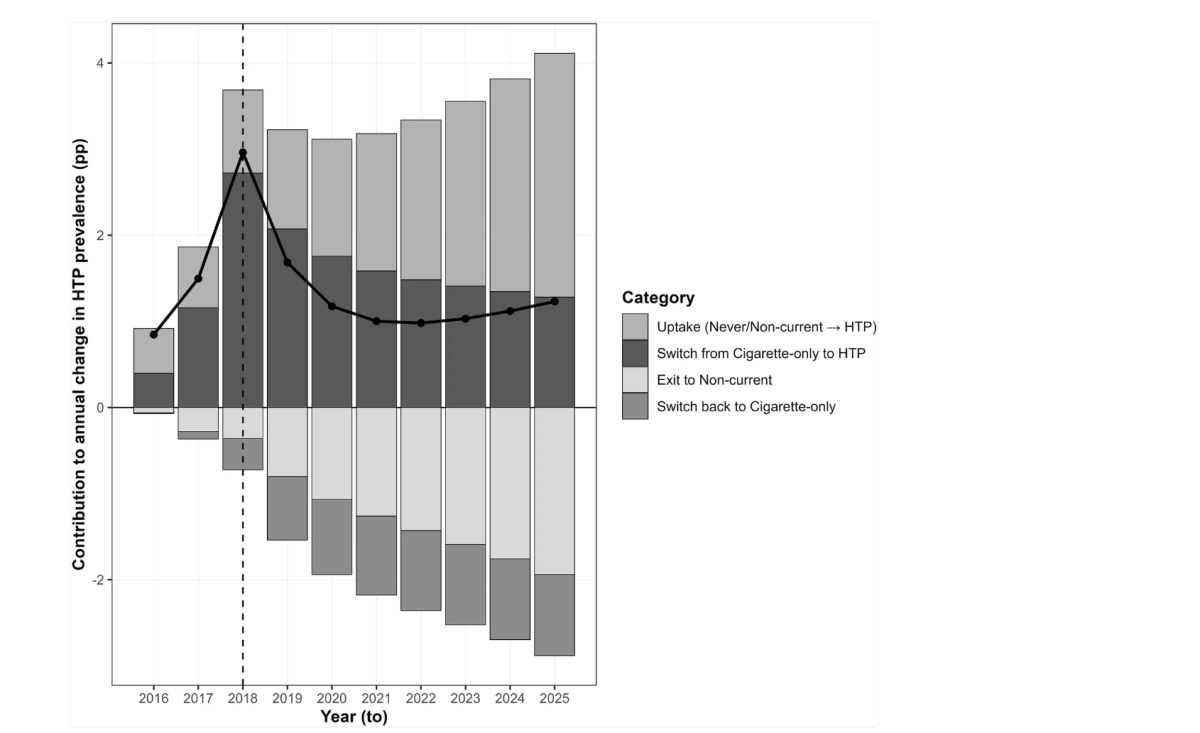
The researchers used a Markov transition model to estimate how different routes contributed to annual changes in reconstructed HTP prevalence.
During 2016–2018, movement from Cigarette-only to HTP use contributed an average of 1.43 percentage points annually to reconstructed prevalence. The corresponding figure was 1.56 percentage points during 2019–2025.
The contribution from previously non-current users increased more markedly.
In the study, Non-current refers to respondents who had previously used cigarettes or HTPs but had not used either product during the preceding 30 days.
The average annual contribution from this group increased from 0.34 percentage points in 2016–2018 to 1.40 percentage points in 2019–2025.
By comparison, the contribution from people who had never used either cigarettes or HTPs increased from 0.39 to 0.52 percentage points, remaining comparatively limited.
The analysis also showed increases in both entry into and exit from HTP use.
Average annual entry contributions rose from 2.16 percentage points during 2016–2018 to 3.48 points during 2019–2025. Over the same periods, exit contributions changed from minus 0.39 to minus 2.30 percentage points.
Exits included both movement to Non-current use and switching back to Cigarette-only use.
These contributions were derived from the model's reconstruction of changes in HTP prevalence within the longitudinal sample eligible for transition analysis. They do not represent the actual nationwide distribution of new HTP users.
The study found that conventional cigarette smokers continued to enter HTP use after 2018, while persistence within HTP-using states, transitions between products and renewed uptake among previously non-current users also shaped the market's development.
Japan's HTP Sales Approach Conventional Cigarette Volumes
Industry figures provide additional context for the long-term expansion of Japan's heated tobacco market.
According to figures compiled by the Japan Health Promotion & Fitness Foundation from Tobacco Institute of Japan statistics, HTP sales increased from 41.3 billion units in fiscal 2020 to 73.4 billion units in fiscal 2025, a rise of approximately 78%.
Over the same period, conventional cigarette sales fell from 98.8 billion to 78.2 billion units, a decline of around 21%.
HTP sales were equivalent to 93.9% of conventional cigarette sales in fiscal 2025, compared with 41.8% in fiscal 2020.
Combined unit sales of the two product categories increased from 140.1 billion to 151.6 billion. These industry unit measures do not directly represent the number of consumers or their nicotine intake.
Company disclosures also illustrate the competitive structure of Japan's HTP market.
Philip Morris International (PMI) reported that IQOS retained close to 70% of Japan's heat-not-burn category volume in 2025. PMI's adjusted in-market sales volume of heated tobacco units in Japan increased by an estimated 7.0% year on year.
Japan Tobacco (JT) reported a 35.0% increase in domestic Ploom sales volume during 2025. Ploom's share of Japan's Heated Products category reached 15.7% in the fourth quarter, up 3.2 percentage points year on year.
British American Tobacco (BAT), which introduced its glo Hilo range in Japan in 2025, cited intensified competition in the Japanese market among factors affecting its heated tobacco business.
The corporate figures reflect market scale and brand competition, but cannot establish how individual consumers moved between tobacco products or competing HTP brands.
Study Adds Consumer-Level Evidence to Japan's Tobacco Market Transition
Earlier research had documented the relationship between declining cigarette sales and growing HTP volumes in Japan.
A study published online in Tobacco Control in October 2024 examined Japanese tobacco sales between 2011 and 2023 and found that per-capita conventional cigarette sales declined by 52.6%.
The researchers concluded that HTP sales growth appeared to be one factor associated with declining cigarette sales, although aggregate sales data could not identify whether individual smokers had switched completely to HTPs, continued using both products or stopped tobacco use.
The new study in The Lancet Regional Health – Western Pacific adds longitudinal consumer-level evidence, estimating transitions between tobacco-use states and their contributions to longer-term HTP prevalence growth.
The research has limitations.
JASTIS is an internet-based survey rather than a nationally random population sample. Although the researchers applied statistical weights to cross-sectional prevalence estimates, longitudinal transition models covered only respondents eligible for consecutive-year analysis.
The estimated transition probabilities and decomposed contributions should therefore not be interpreted as nationally representative figures for all Japanese adults.
Current use was defined as using a relevant product at least once during the preceding 30 days, rather than daily use or sustained consumption.
The study examined patterns of cigarette and HTP use, not disease incidence, long-term health outcomes or the health consequences of switching between tobacco products.
It was funded by the Japan Society for the Promotion of Science. The authors disclosed consulting, advisory and research-funding relationships unrelated to the study and stated that the organisations involved were not part of the tobacco or nicotine industries.
The findings add consumer-level evidence to Japan's decade-long HTP market transformation. Cigarette switching, persistent dual use, continued exclusive HTP use and renewed uptake among previously non-current users represent distinct dimensions of market development and public-health evaluation.
Follow 2Firsts for timely updates on global tobacco and nicotine research, market developments and industry trends.
Cover Image:The Lancet Regional Health – Western Pacific