EU Tobacco Tax Reform Targets November Push as Sweden Holds Nicotine-Pouch Minimum at €20 per Kilogram

Market
Sep.17
EU Tobacco Tax Reform Targets November Push as Sweden Holds Nicotine-Pouch Minimum at €20 per Kilogram
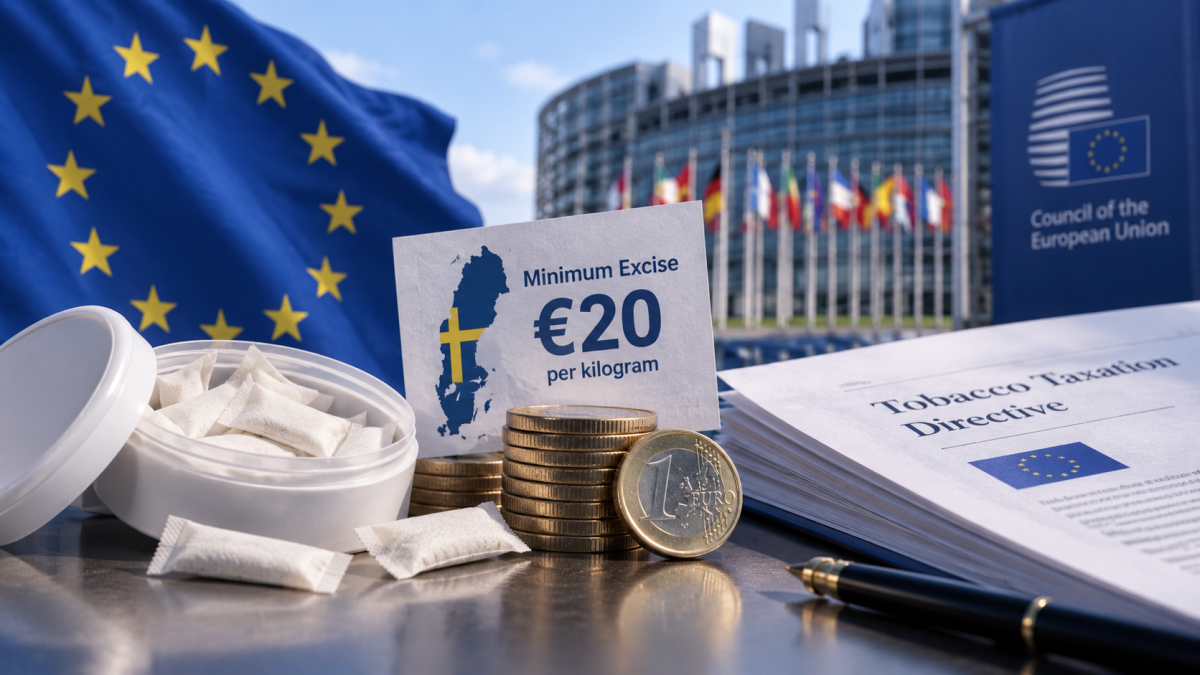
The Irish presidency of the Council of the European Union is using bilateral talks to push the bloc’s Tobacco Taxation Directive toward a political agreement in November. According to Law360, citing an EU official, Sweden is unwilling to accept a minimum excise threshold above €20 per kilogram for nicotine pouches. Council negotiations have already lowered the European Commission’s original proposal, but a May 2026 presidency compromise still set the minimum at 10% of the tax-inclusive retail price or €30 per kilogram in 2028-29, with higher levels later.

Key Points

  •  The Irish Council presidency is seeking to move the tobacco-tax proposal through higher-level negotiations in October and November and reach political agreement at Ecofin.
  •  Sweden is unwilling to accept a nicotine-pouch minimum above €20 per kilogram, according to an EU official cited by Law360.
  •  A May 2026 presidency compromise proposed minimums of 10% of the tax-inclusive retail price or €30 per kilogram in 2028-29, 25% or €50 in 2030-31, and 50% or €80 thereafter.
  •  The directive requires unanimity among EU member states in the Council, giving continued national objections significant weight.

2Firsts

September 17, 2026

According to Law360 on September 15, 2026, the Irish presidency of the Council of the European Union is using bilateral talks to advance a proposed overhaul of the bloc’s Tobacco Taxation Directive, with the aim of securing a political agreement before an Economic and Financial Affairs Council, or Ecofin, meeting in November. Sweden’s position on minimum excise duties for nicotine pouches remains one of the main unresolved issues.

The European Commission proposed a recast of the Tobacco Taxation Directive in July 2025 to raise minimum excise rates on traditional tobacco and extend the EU framework to newer products including e-cigarette liquids, heated tobacco and nicotine pouches. The proposal is a tax measure that requires unanimity among member states in the Council.

Sweden Resists a Threshold Above €20 per Kilogram

Sweden is currently unwilling to accept a minimum excise threshold for nicotine pouches above €20 per kilogram, according to an EU official cited by Law360. The position remains despite offers from the Irish presidency for more flexible phase-in arrangements.

That level is below the rates contained in an earlier public Council presidency compromise.

A compromise text dated May 29, 2026, proposed a minimum tax on nicotine pouches and other nicotine products of 10% of the tax-inclusive retail price or €30 per kilogram in 2028-29. The threshold would rise to 25% or €50 per kilogram in 2030-31, and then to 50% or €80 per kilogram after the transition.

The €30-per-kilogram starting amount in the May compromise remains above the €20 level attributed to Sweden by Law360.

Council Talks Have Already Reduced the Commission Proposal

The European Commission’s original 2025 proposal set higher monetary minimums.

Under that proposal, nicotine pouches would face a minimum excise duty of 25% of the tax-inclusive retail price or €71.5 per kilogram from 2030, rising to 50% or €143 per kilogram from 2032.

Council negotiations subsequently lowered the monetary thresholds and introduced transitional stages. The May 2026 compromise reduced the long-term monetary minimum to €80 per kilogram, with interim levels of €30 and €50.

The compromise text also introduced a mechanism allowing minimum rates to be adjusted according to member-state price levels, adding flexibility for countries with different economic conditions.

Reform Also Covers E-Cigarette Liquids and Other New Products

The proposed revision extends beyond nicotine pouches.

The Commission wants to bring e-cigarette liquids, heated tobacco, nicotine pouches and other newer nicotine products into a harmonized EU excise framework, while also raising minimum rates on some traditional tobacco products and strengthening controls on raw tobacco.

The May 2026 presidency compromise proposed the following minimum rates for e-cigarette liquids:

  •  20% of the tax-inclusive retail price or €0.20 per milliliter in 2028-29;
  •  20% or €0.25 per milliliter in 2030-31;
  •  30% or €0.36 per milliliter thereafter.

The rates would apply to e-cigarette liquids both with and without nicotine.

The reform also seeks to bring raw tobacco into the EU’s electronic excise movement and monitoring system to strengthen oversight of cross-border flows.

Irish Presidency Seeks November Political Agreement

According to EU officials cited by Law360, the Irish presidency wants the proposal to move to a high-level Council working party on October 26, then to the Committee of Permanent Representatives, or Coreper, on November 4, before a planned Ecofin discussion on November 9.

The timetable remains a presidency objective and depends on progress among member states.

Because the tax directive requires unanimity in the Council, a continuing objection from any member state could prevent adoption.

Law360 reported that Sweden is not the only country with concerns. Malta and other member states have also raised questions about whether rapid increases in minimum rates could contribute to illicit-market activity and tax avoidance.

Sweden Has a Distinct Oral-Tobacco Policy Background

Sweden occupies a distinct position in EU rules on oral tobacco. Traditional snus is generally prohibited from being placed on the market in other EU member states, but Sweden secured a derogation when it joined the bloc.

Traditional snus and tobacco-free nicotine pouches are legally distinct product categories under EU rules. The proposed tax directive separately defines nicotine pouches as tobacco-free, nicotine-containing products intended for oral use and would establish EU-wide minimum excise duties for the category.

The minimum tax on nicotine pouches remains one of the main unresolved issues in the negotiations.

The Irish presidency has said it will continue bilateral engagement with the aim of securing unanimous political agreement before the November Ecofin meeting.

Follow 2Firsts for timely updates on global tobacco and nicotine regulations, market developments and industry trends.

Cover Image generated by AI

Smoore Seeks to Toss CCELL Price-Fixing Claim as Court Weighs Vertical Distribution Versus Horizontal Conspiracy
Smoore and four authorized U.S. CCELL distributors are asking a California federal court to permanently dismiss a core antitrust claim brought by direct purchasers. Plaintiffs allege that Smoore coordinated minimum wholesale prices, customer allocation and limits on price competition among distributors, amounting to a per se unlawful horizontal conspiracy. The defendants say the alleged conduct reflects ordinary vertical relationships between a manufacturer and its distributors. The court previously dismissed a similar claim, and the latest dispute centers on whether the second amended complaint adds sufficient facts to establish a horizontal agreement.
Sep.14
Australia Adds 6-Methylnicotine to Schedule 9 Prohibited Substances, Effective October 1
Australia's Therapeutic Goods Administration published a final decision on September 25 to classify 6-methylnicotine as a Schedule 9 prohibited substance under the Poisons Standard, effective October 1, 2026. TGA said the chemical has been reported in e-cigarette liquids sold in Australia and marketed as nicotine-free or nicotine alternatives, while evidence also indicates its use in preparations such as oral pouches. The government originally proposed a Schedule 7 classification but ultimately adopted the stricter Schedule 9 designation, citing acute toxicity, dependence risk, use in unapproved consumer products and misleading marketing.
News
Sep.29 by 2Firsts Perspectives
Special Report | From New York to Washington: How FDA’s Tobacco Center Is Reworking Product Review
FDA’s Center for Tobacco Products is reshaping how it approaches tobacco product review. Based on 2Firsts’ on-site reporting in New York and Washington, this report traces CTP’s emerging direction: stronger links between PMTA and tobacco harm reduction, more category-specific review, greater emphasis on decision-relevant science, more predictable timelines and expanded use of sPMTA for product modifications. CTP also acknowledged major constraints, including just nine PMTA review teams, persistent backlogs and limits on hiring capacity.
Regulations
Oct.08
Philippines BIR Steps Up Illicit Vape Enforcement Ahead of Christmas Shopping
The Philippines’ Bureau of Internal Revenue is intensifying enforcement against illicit vape and tobacco products ahead of the Christmas shopping season, directing regional and enforcement offices to strengthen monitoring of production sites, warehouses, distribution channels and retail outlets. The BIR destroyed 240,550 illicit vape products in August with an estimated tax liability of about PHP1.53 billion. A nationwide tax-compliance operation in July also inspected 3,590 businesses involved in tobacco and vapor products.
Regulations
Sep.17 by 2Firsts Perspectives
FDA Revises Import Alert 98-07 Rules, Bringing May Enforcement Priorities Into Unauthorized ENDS Detentions
The U.S. Food and Drug Administration has revised the rules under Import Alert 98-07 to incorporate its May 2026 enforcement-priority policy for certain electronic nicotine delivery systems marketed without premarket authorization. The alert continues to allow detention without physical examination, or DWPE, for ENDS lacking required marketing authorization, while directing field divisions to apply the May risk-based framework. When necessary, detention or refusal decisions must also undergo review by the FDA's Center for Tobacco Products. Products including PACHA and Vuse Pro have already emerged as industry examples of the May policy, although enforcement discretion does not constitute FDA marketing authorization.
News
Sep.28 by 2Firsts Perspectives
JUUL Purchasers Ask Ninth Circuit to Preserve Antitrust Classes in Case Over Altria’s $12.8 Billion Investment
Private antitrust litigation stemming from Altria's 2018 $12.8 billion investment for a 35% economic interest in JUUL is advancing before the U.S. Court of Appeals for the Ninth Circuit. Direct purchasers, indirect purchasers and indirect resellers of JUUL products filed answering briefs this week seeking to preserve class certifications granted by a California federal court in February. Altria and JUUL argue that individual consumers and large distributors differ too much in purchasing terms to remain in a single direct-purchaser class, while a separate dispute concerns whether California antitrust law can apply to indirect purchasers across 27 jurisdictions. A September trial has been put on hold during the appeal.
Sep.23