KT&G Expands Sales Network for 'Lil Able 2.0'

Market by 2FIRSTS.ai
Aug.30.2024
KT&G Expands Sales Network for 'Lil Able 2.0'
South Korean tobacco company KT&G expands sales network of its HNB device "Lil Able 2.0" to 30,000 convenience stores.

According to a recent report by N.News, South Korean tobacco company KT&G announced that it will expand the sales network of its HNB device "Lil Able 2.0" to 30,000 convenience stores.


Previously, "Lil Able 2.0" was only sold in convenience stores in Seoul, 9000 LIL specialty stores, and online channels. The expansion of the sales network is aimed at meeting the demand of consumers outside of Seoul.


A person related to KT&G explained, "Considering the demand for 'Lil Able 2.0' in areas outside of Seoul, we have decided to expand our sales network.


It is expected that after September 11th, the number of sales points will expand to 40,000.


We welcome news tips, article submissions, interview requests, or comments on this piece.

Please contact us at info@2firsts.com, or reach out to Alan Zhao, CEO of 2Firsts, on LinkedIn


Notice

1.  This article is intended solely for professional research purposes related to industry, technology, and policy. Any references to brands or products are made purely for objective description and do not constitute any form of endorsement, recommendation, or promotion by 2Firsts.

2.  The use of nicotine-containing products — including, but not limited to, cigarettes, e-cigarettes, nicotine pouchand heated tobacco products — carries significant health risks. Users are responsible for complying with all applicable laws and regulations in their respective jurisdictions.

3.  This article is not intended to serve as the basis for any investment decisions or financial advice. 2Firsts assumes no direct or indirect liability for any inaccuracies or errors in the content.

4.  Access to this article is strictly prohibited for individuals below the legal age in their jurisdiction.


Copyright


This article is either an original work created by 2Firsts or a reproduction from third-party sources with proper attribution. All copyrights and usage rights belong to 2Firsts or the original content provider. Unauthorized reproduction, distribution, or any other form of unauthorized use by any individual or organization is strictly prohibited. Violators will be held legally accountable.

For copyright-related inquiries, please contact: info@2firsts.com


AI Assistance Disclaimer


This article may have been enhanced using AI tools to improve translation and editorial efficiency. However, due to technical limitations, inaccuracies may occur. Readers are encouraged to refer to the cited sources for the most accurate information.

We welcome any corrections or feedback. Please contact us at: info@2firsts.com

Russia Expands Temporary Administration of JTI Assets in Second Round: From Four to All Seven Russian Entities, With Approximately $9.5 Billion in Related Assets
Japan Tobacco Inc. (JT) confirmed on November 9, 2026, that all seven of its Russian entities had been placed under temporary administration after a second presidential decree added three companies to the four designated a day earlier. The additional entities are associated with importing, management, holdings and the former supply of Ploom heated-tobacco devices. JT disclosed approximately ¥1.5 trillion in Russian business-related assets as of September 30, including ¥360 billion in cash and deposits, and approximately ¥200 billion in liabilities. Under its revised FY2026 forecast, Russia accounts for about 25% of adjusted operating profit. JT said operations in Russia were continuing, while the financial impact remained under assessment.
company
Nov.09
Product | BAT Launches VELO WRKS Nicotine Pouches in Sweden, Introducing Dual-Compartment Cans With Two Flavours
British American Tobacco (BAT)'s VELO brand launched the VELO WRKS nicotine pouch range in Sweden on November 2, 2026. The initial release features three Dual Can variants, each containing two separate flavours in a dual-compartment container. Each can holds 20 slim pouches with 8mg of nicotine per pouch and retails for SEK 52.99. According to VELO, the first release, Drop 1, is limited to 75,000 cans and will remain available until February 2027 or while stocks last. VELO positions WRKS as a platform for testing new product concepts and has introduced an online consumer feedback survey. EU trademark records show BAT applied to register VELO WRKS in March 2026 under Class 34, covering nicotine pouches, e-cigarettes, heated tobacco products and other tobacco-related goods.
product
Nov.03
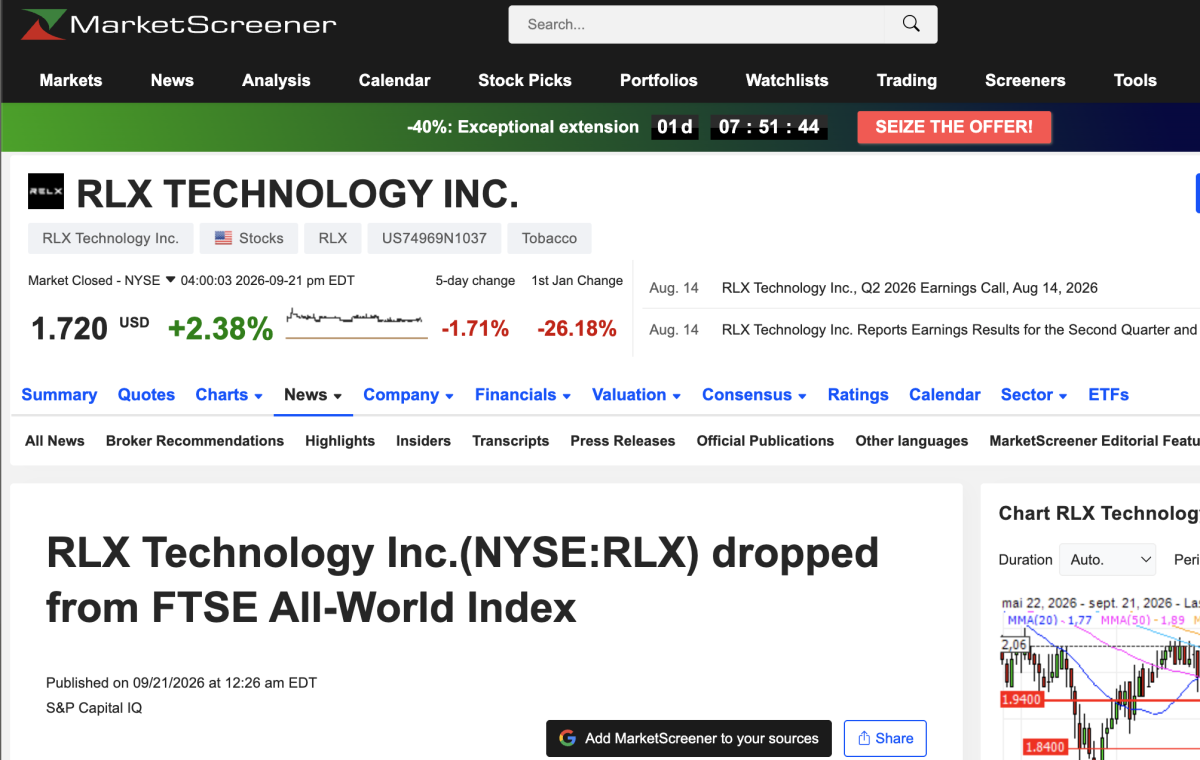
RLX Technology Dropped From FTSE All-World as International Business Reaches 68.5% of Q2 Revenue
RLX Technology (NYSE: RLX) has been removed from the FTSE All-World Index, effective September 21. FTSE Russell records show RLX was already part of its global equity index universe by 2022, when its American depositary receipts were classified as China Large Cap securities. Trading volume rose to about 44.77 million shares on September 18, roughly 23 times the previous session's volume. RLX reported RMB1.0105 billion in second-quarter revenue, up 14.8% year over year, with international operations contributing 68.5%. The company also acquired a 51% stake in one of Western Europe's largest distributors of next-generation smoke-free and FMCG products in July.
Sep.22
PMI Pushes Smoke-Free Business in Latin America as Argentina Lifts Heated Tobacco Ban, Mexico City Share Tops 7%
Philip Morris International (PMI) showcased IQOS heated tobacco systems and nicotine pouch products at Technovation 2026 in Buenos Aires on October 7–8, presenting research on consumer attitudes, regulatory developments and illicit cigarette trade across Latin America. PMI Chief Global Growth Officer Stefano Volpetti said smoke-free products accounted for more than 7% of the Mexico City market. Argentina repealed its heated tobacco ban in May 2026 and introduced registration requirements for tobacco and nicotine products, while local media reported nicotine pouch sales in Mendoza. A PMI-commissioned survey found that only 8% of respondents across four Latin American countries were familiar with nicotine pouches. A separate KPMG study estimated illicit cigarette consumption at 77 billion sticks across 11 markets in Latin America and Canada in 2025.
PMI
Oct.13
FDA Authorizes 24 VELO Nicotine Pouches, Increasing U.S. Authorized Total by 56%
The U.S. FDA authorized 24 VELO nicotine pouch products from a British American Tobacco subsidiary, raising the total number of authorized products from 43 to 67, a 55.8% increase. The newly authorized 4 mg products include lime and passion fruit flavors and feature certified child-resistant packaging. VELO's first FDA marketing authorization adds BAT to a list previously limited to PMI and Altria products, while bringing the agency's nicotine pouch review pilot total to 47 authorized products.
Oct.30
JUUL Purchasers Ask Ninth Circuit to Preserve Antitrust Classes in Case Over Altria’s $12.8 Billion Investment
Private antitrust litigation stemming from Altria's 2018 $12.8 billion investment for a 35% economic interest in JUUL is advancing before the U.S. Court of Appeals for the Ninth Circuit. Direct purchasers, indirect purchasers and indirect resellers of JUUL products filed answering briefs this week seeking to preserve class certifications granted by a California federal court in February. Altria and JUUL argue that individual consumers and large distributors differ too much in purchasing terms to remain in a single direct-purchaser class, while a separate dispute concerns whether California antitrust law can apply to indirect purchasers across 27 jurisdictions. A September trial has been put on hold during the appeal.
Sep.23