Malaysia to Enforce Public Health Anti-Smoking Products Act 2024

Aug.26.2024
Malaysia to Enforce Public Health Anti-Smoking Products Act 2024
Malaysia's "2024 Public Health Tobacco Control Act" is in final stages; Health Ministry to crackdown on e-cigarette sales.

According to a report by Bernama on August 24, the regulations and orders of the Malaysian "Public Health Tobacco Control Products Act 2024" (Act 852) are currently in the final stage. After obtaining final approval from the Attorney General's Office, the Ministry of Health will implement these regulations, including measures to combat the sale of e-cigarettes.


Health Minister Datuk Seri Dr Dzulkefly Ahmad stated that once the relevant regulations and orders are approved, the matter will be handed over to the Ministry of Health for implementation, including taking measures to crack down on the sale of e-cigarettes through vending machines.


With this bill, we will be able to more effectively address these issues. Previously, the Ministry of Health had announced that the bill would be implemented within this month, but not everything is within the control of the Ministry of Health.


Zoqui Fili stated that they are collaborating with other departments, such as the Office of the Attorney General, to carefully review regulations and orders to avoid any harm. He mentioned that "the devil is in the details.


He added:


We will continue to use the 2004 Tobacco Products Control Regulations (PPKHT) until the full implementation of the new law, ensuring there will be no gaps in enforcement.


At the same time, Zukeyfir called on local governments to actively cooperate in implementing smoke-free zone measures in crowded areas, such as the Terengganu Smoke-Free Zone (TBAR) initiative at Pantai Batu Buruk in Kuala Terengganu. He pointed out that besides Terengganu state, similar measures have also been implemented in Penang, Malacca, and Kelantan.


We welcome news tips, article submissions, interview requests, or comments on this piece.

Please contact us at info@2firsts.com, or reach out to Alan Zhao, CEO of 2Firsts, on LinkedIn


Notice

1.  This article is intended solely for professional research purposes related to industry, technology, and policy. Any references to brands or products are made purely for objective description and do not constitute any form of endorsement, recommendation, or promotion by 2Firsts.

2.  The use of nicotine-containing products — including, but not limited to, cigarettes, e-cigarettes, nicotine pouchand heated tobacco products — carries significant health risks. Users are responsible for complying with all applicable laws and regulations in their respective jurisdictions.

3.  This article is not intended to serve as the basis for any investment decisions or financial advice. 2Firsts assumes no direct or indirect liability for any inaccuracies or errors in the content.

4.  Access to this article is strictly prohibited for individuals below the legal age in their jurisdiction.


Copyright


This article is either an original work created by 2Firsts or a reproduction from third-party sources with proper attribution. All copyrights and usage rights belong to 2Firsts or the original content provider. Unauthorized reproduction, distribution, or any other form of unauthorized use by any individual or organization is strictly prohibited. Violators will be held legally accountable.

For copyright-related inquiries, please contact: info@2firsts.com


AI Assistance Disclaimer


This article may have been enhanced using AI tools to improve translation and editorial efficiency. However, due to technical limitations, inaccuracies may occur. Readers are encouraged to refer to the cited sources for the most accurate information.

We welcome any corrections or feedback. Please contact us at: info@2firsts.com

Japan's Heated Tobacco Use Rises From 0.1% to 14.9% Over a Decade as Growth Extends Beyond Cigarette Switching
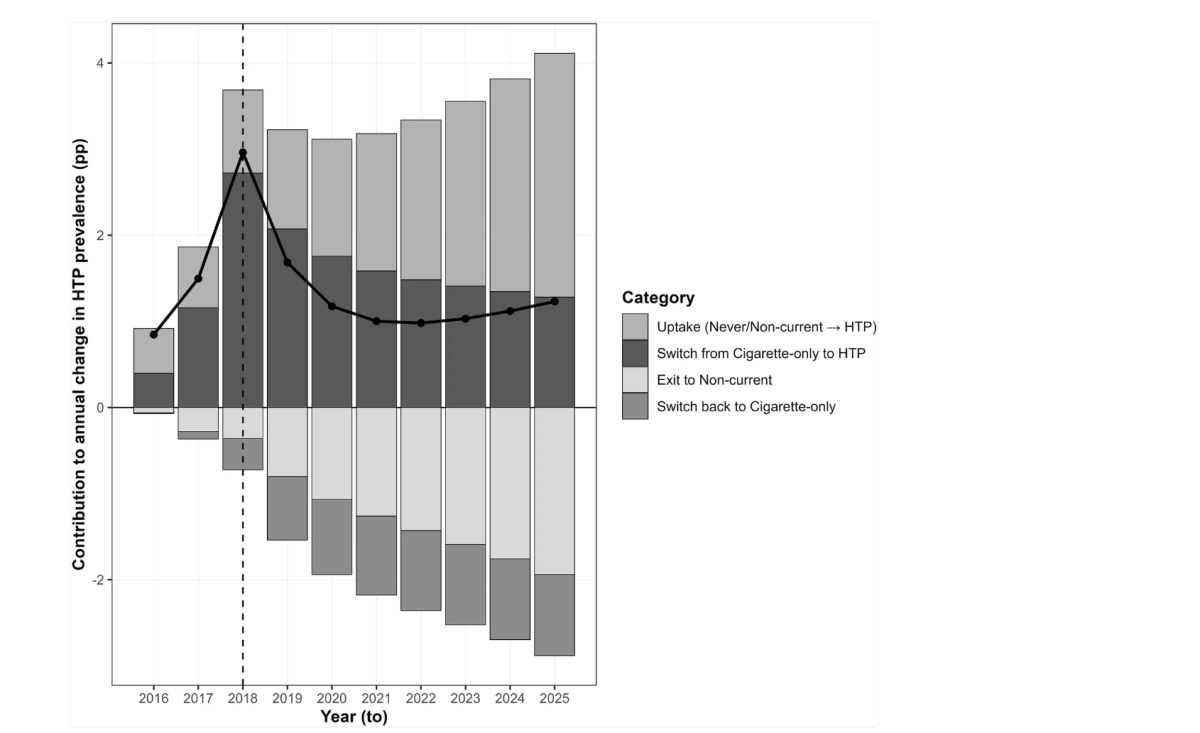
A decade-long study published in The Lancet Regional Health – Western Pacific found that heated tobacco product use in Japan increased from 0.1% in 2015 to 14.9% in 2025, although growth slowed after 2018. Switching from conventional cigarettes remained an important source of HTP uptake, while the contribution from previously non-current users increased. Approximately 56% of HTP users also smoked conventional cigarettes in 2025. Separate industry data show that Japan's heated tobacco sales reached 73.4 billion units in fiscal 2025, approaching conventional cigarette sales of 78.2 billion units.
SCIENCE
Nov.10
FRE and ALP Push Modern Oral to 48% of Q2 Sales as Turning Point Brands Changes CEO and Lowers Profit-Guidance Ceiling
Turning Point Brands said Executive Chairman David E. Glazek will become CEO on October 1, replacing Graham Purdy, who is stepping down for personal reasons. The company narrowed its 2026 adjusted EBITDA outlook to $70 million-$80 million from $70 million-$90 million while maintaining Modern Oral gross sales guidance of $330 million-$350 million and net sales guidance of $260 million-$270 million. In the second quarter, Modern Oral net sales rose 128% to $68.4 million and accounted for 48% of company-wide net sales. Adjusted EBITDA fell 50% year over year. TPB shares closed about 10% lower on September 21.
Market
Sep.22 by 2Firsts Perspectives
Arizona Turns to a 50% Retail Vape Tax as Tobacco Tax Revenue Falls 47% From 2008
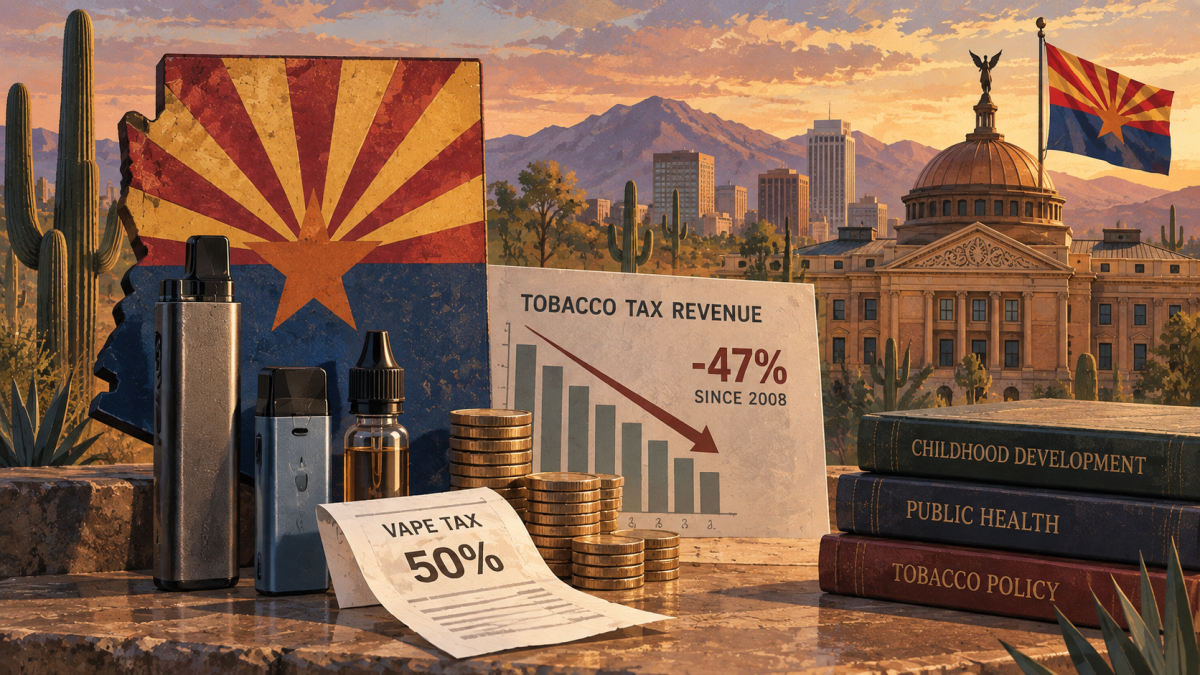
Arizona's First Things First is pushing for an excise tax equal to 50% of the retail price of vaping products, estimating that the measure could generate about $100 million annually. The agency says its tobacco-tax revenue has fallen 47% from 2008 levels. Arizona has attempted to broaden its nicotine tax base in each of the past two years: a 2025 bill proposed a 50% wholesale-price tax, while a 2026 measure shifted to a 50% retail-price tax covering alternative nicotine products and vapor products. Separately, the state enacted HB 4001 this year to establish a new licensing and sales framework for alternative nicotine products.
Sep.21
Wall Street Journal: U.S. FDA Plans Faster Vape and Nicotine Pouch Reviews, Revisit of 2021 PMTA Rule
The Trump administration is preparing changes intended to accelerate FDA market authorization reviews for e-cigarettes and nicotine pouches, according to The Wall Street Journal. The FDA is expected to revisit its 2021 PMTA rule and may simplify some scientific study requirements and shorten review times. The agency has not formally announced the changes. Over the past year, the FDA has already accelerated nicotine-pouch reviews, expanded ENDS authorizations and upgraded its CTP Portal NextGen application system. As of August 2026, 43 nicotine pouch products and 48 e-cigarette products had received FDA marketing authorization.
Sep.24
North Carolina Tightens Vape Product Directory Enforcement, Expands State and Local Powers as Violators Face Fines, Product Seizures and License Suspension or Revocation
North Carolina has expanded enforcement of its vapor product directory rules, authorizing more state and local law enforcement participation and establishing a task force led by the State Bureau of Investigation. The legislation requires at least one unannounced compliance inspection annually for retailers, distributors and wholesalers handling covered products. Penalties effective October 1, 2026, include civil fines of $500–$750 for a first violation and $1,000–$1,500 for repeated violations within 12 months, along with potential license suspension or revocation. Manufacturers may face penalties of $10,000 per unlisted product. The measures strengthen the product directory system established in 2024.
Regulations
Oct.28
Special report|Indonesia's Vape Industry Has 200 Manufacturers and $1.7 Billion in Investment. Could a Regulatory Divide Derail Its Rise as the World's No. 2 Manufacturing Hub After Shenzhen?
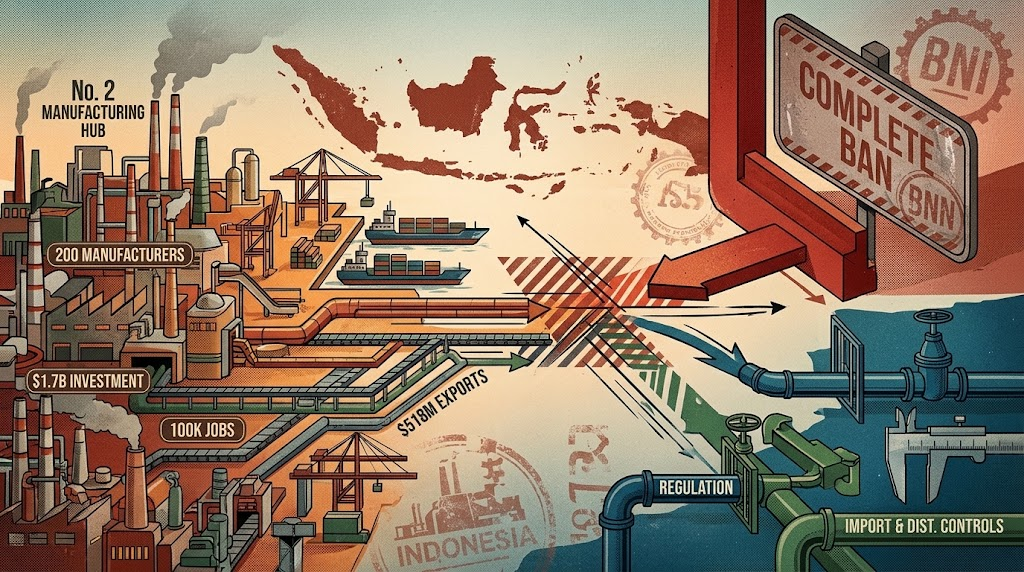
Indonesia's Ministry of Industry said at a November 3, 2026, policy forum that the country has about 200 electronic cigarette companies, Rp31 trillion (approximately $1.71 billion) in cumulative industry investment and around 100,000 jobs across the supply chain. The National Narcotics Agency is seeking a comprehensive ban on vape use and circulation, while the industry ministry favors tighter import, product-standard and distribution controls. Indonesia exported approximately $518 million in vaping products in 2025, and Chinese manufacturers including Smoore, GEEKVAPE and Jinjia Group have established local operations. An international logistics specialist interviewed by 2Firsts said more Chinese vape companies began production in Indonesia from the second half of 2025, accompanied by increased shipments of manufacturing equipment and investment in logistics facilities. The regulatory debate comes as Indonesia expands its role in international vaping manufacturing.
Special Report
Nov.05