Pakistan Federal Government Accused of Violating Tobacco Law by Farmers

Regulations by 2FIRSTS.ai
May.27.2024
Pakistan Federal Government Accused of Violating Tobacco Law by Farmers
Pakistani tobacco farmers accuse government of violating tobacco law by setting prices lower than previous year, according to Dawn News.

According to a report in Dawn newspaper on May 26, representatives of tobacco growers in Khyber Pakhtunkhwa Province of Pakistan have accused the federal government of violating the tobacco laws by setting the current price of tobacco leaves lower than the price of the previous year.


Regulation No. 487 requires that the weighted average price of tobacco crops in any given year must be equal to or higher than the weighted average price of tobacco crops in the previous year.


According to a representative for growers, the federal Ministry of Food Security and Research has set the minimum support price for Virginia tobacco at 505 Pakistani rupees (approximately $1.81) per kilogram this year. Last year, the weighted average price for Virginia tobacco was 709 Pakistani rupees per kilogram.


The growers stated that this action flagrantly violates the Tobacco Marketing Act and should be corrected immediately.


We welcome news tips, article submissions, interview requests, or comments on this piece.

Please contact us at info@2firsts.com, or reach out to Alan Zhao, CEO of 2Firsts, on LinkedIn


Notice

1.  This article is intended solely for professional research purposes related to industry, technology, and policy. Any references to brands or products are made purely for objective description and do not constitute any form of endorsement, recommendation, or promotion by 2Firsts.

2.  The use of nicotine-containing products — including, but not limited to, cigarettes, e-cigarettes, nicotine pouchand heated tobacco products — carries significant health risks. Users are responsible for complying with all applicable laws and regulations in their respective jurisdictions.

3.  This article is not intended to serve as the basis for any investment decisions or financial advice. 2Firsts assumes no direct or indirect liability for any inaccuracies or errors in the content.

4.  Access to this article is strictly prohibited for individuals below the legal age in their jurisdiction.


Copyright


This article is either an original work created by 2Firsts or a reproduction from third-party sources with proper attribution. All copyrights and usage rights belong to 2Firsts or the original content provider. Unauthorized reproduction, distribution, or any other form of unauthorized use by any individual or organization is strictly prohibited. Violators will be held legally accountable.

For copyright-related inquiries, please contact: info@2firsts.com


AI Assistance Disclaimer


This article may have been enhanced using AI tools to improve translation and editorial efficiency. However, due to technical limitations, inaccuracies may occur. Readers are encouraged to refer to the cited sources for the most accurate information.

We welcome any corrections or feedback. Please contact us at: info@2firsts.com

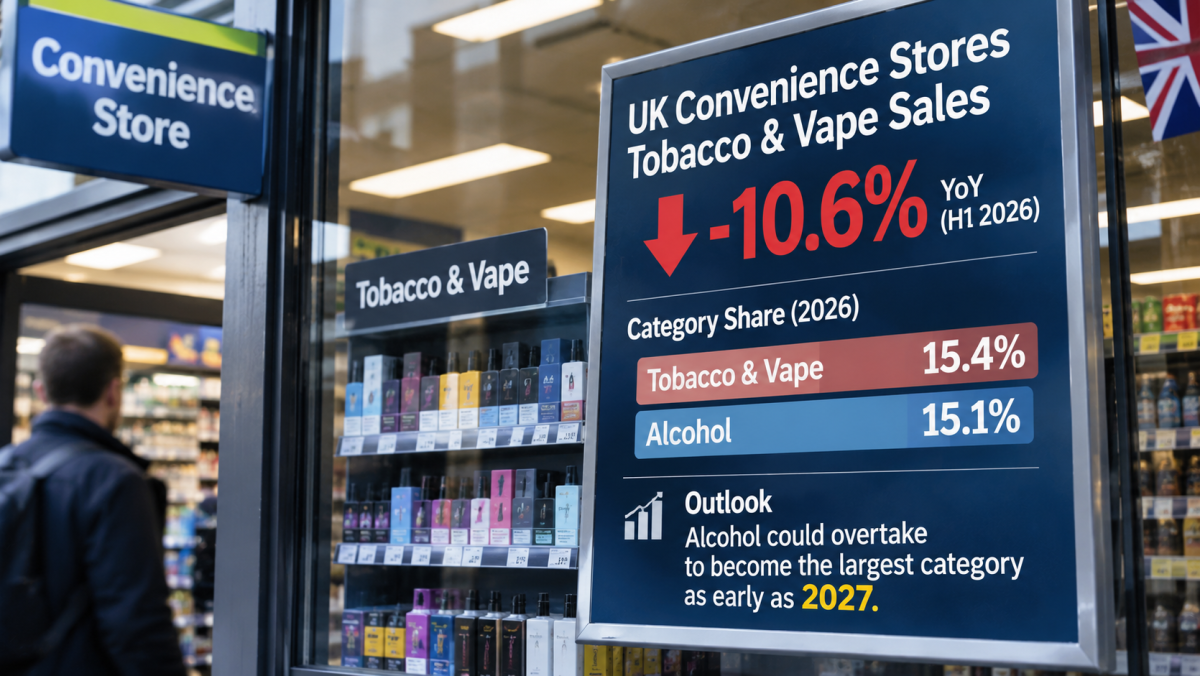
DATA|UK Retail Research Group IGD Says Convenience Tobacco and Vape Sales Fell 10.6%, With 15.4% Market Share Versus Alcohol's 15.1%; Top Rank at Risk in 2027
Combined tobacco and vaping sales in UK convenience stores fell 10.6% year over year in the first half of 2026, making the category a major drag on channel performance, according to retail research organization IGD. Total convenience sales declined 1.2%, while sales excluding tobacco and vaping increased 0.7%. IGD's 2026 category-share figures show tobacco and vaping accounting for 15.4% of convenience sales, compared with 15.1% for alcohol. The organization forecasts alcohol could overtake tobacco and vaping as the largest category by sales value as early as 2027 if current trends continue. IGD expects the convenience market to increase from £48.6 billion in 2026 to £54.9 billion in 2031, a 2.5% compound annual growth rate, or 3.4% excluding tobacco and vaping.
DATA
Nov.11
Product | PMI Launches TEREA Black Mint Pearl in Japan, Adding First Capsule Variant to Black Range With Nationwide Rollout From October 19
Philip Morris Japan (PMJ) launched TEREA Black Mint Pearl on October 15, 2026, introducing the first capsule-equipped heated tobacco stick in the TEREA Black range for IQOS ILUMA devices. The product combines a strong menthol profile with a crushable mint capsule and is priced at ¥640 per 20-stick pack, including tax. Sales began at four IQOS stores and selected retail partners on October 15, with distribution expanding to convenience stores and other tobacco retailers nationwide from October 19. The launch brings Japan's TEREA portfolio to 28 variants, including 21 menthol-related products, or 75% of the range.
product
Oct.16 by 2Firsts Perspectives
Zhang Xiaotang Appointed Deputy Director of China’s Tobacco Regulator, Adding Another Finance-Background Official to Top Leadership
China’s State Council has appointed Zhang Xiaotang as deputy director of the State Tobacco Monopoly Administration, with the regulator’s official website now listing him as a Party leadership group member and deputy director. Zhang previously led Hebei China Tobacco and earlier headed the STMA’s finance and audit department. His appointment follows the elevation earlier this year of former tax official Yao Laiying to head the STMA, adding another senior official with a strong fiscal or financial-management background to China Tobacco’s top leadership in 2026.
News
Sep.20
Special Report | Vape bans and tougher rules: the South Caucasus takes different paths
Azerbaijan's sweeping e-cigarette ban has raised concerns over enforcement errors and the emergence of illicit sales, while neighboring Armenia is tightening technical rules and preparing higher excise taxes. Georgia, meanwhile, has resisted calls for broader vape restrictions and introduced preferential taxes for some domestically produced cigarettes. The divergent approaches across the South Caucasus highlight a regional policy dilemma: how to curb nicotine use and protect public health without encouraging black markets or creating unintended economic consequences for businesses and consumers.
Nov.03
U.S. Military Could Test Nicotine Pouches and Vapes for Smoking Cessation as Washington Examiner Cites ZYN and Potential $4 Billion Reduction in Related Defense Costs
The House-passed FY2027 National Defense Authorization Act includes a provision authorizing the defense secretary to conduct a one-year smoking-cessation pilot for active-duty service members. Section 707 lists counseling, nicotine gum and patches alongside what the bill calls "electric nicotine delivery systems," nicotine pouches and heat-not-burn products. A recent Washington Examiner op-ed cited ZYN as an example in arguing for the provision, but the legislation does not name any commercial brand or supplier. ZYN is made by PMI-owned Swedish Match USA, with specified products holding FDA marketing authorizations and modified risk orders.
Sep.20
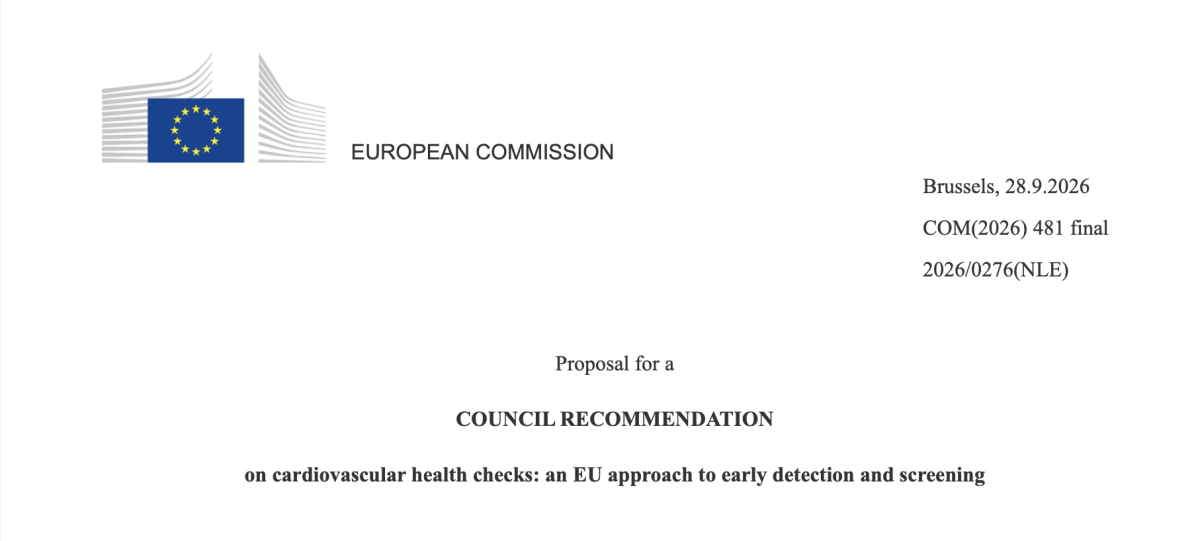
EU Commission Clarifies Vaping, Smokeless Nicotine Use in Proposed Cardiovascular Checks
The European Commission has clarified to 2Firsts that its proposed cardiovascular health checks would assess smoking, vaping and the use of smokeless nicotine products as part of patients’ medical histories. The Commission also said Member States may organise additional checks within their healthcare systems. In the same response, it pointed to JRC research on e-cigarettes, heated tobacco products and nicotine pouches that has fed into the evaluation of EU tobacco legislation.
Nov.09