Philippine Bureau of Internal Revenue struggles with declining tobacco revenue.

Oct.22.2024
Philippine Bureau of Internal Revenue struggles with declining tobacco revenue.
Philippine Bureau of Internal Revenue (BIR) fails to meet consumption tax target due to declining tobacco demand, report says.

According to a report from Bworld Online on October 20, the Philippines Bureau of Internal Revenue (BIR) will not be able to meet its consumption tax revenue target of 362.2 billion Philippine pesos (approximately 6.3 billion US dollars) this year due to a decrease in demand for tobacco products.


BIR Assistant Commissioner Jethro Sabariaga has stated that tobacco consumption tax accounts for over 40% of national consumption tax revenue. However, tobacco consumption has been steadily decreasing over the past decade.


Nowadays, it is rare to see someone smoking, and this shift in market demand can be felt intuitively.


He also added that the tax revenue growth from other taxable goods cannot make up for the decline in tobacco consumption tax.


Consumers switching to e-cigarette products has also affected government tax revenues. According to the commissioner, the consumption tax on one e-cigarette is equivalent to the tax on one pack of cigarettes, but e-cigarettes are often consumed more slowly.


A smoker who switches to e-cigarettes, typically someone who consumes 10 to 15 packs of cigarettes a month, may only purchase one e-cigarette product, or even worse, may only buy one every two months.


Previously, Bureau of Internal Revenue (BIR) Director Romeo D. Lumagui pointed out that illegal tobacco trade has also posed challenges for authorities in collecting consumption taxes. In the first half of 2024, the agency lost approximately 7.2 billion Philippine pesos (1.2 billion USD) in potential revenue due to seized tobacco and e-cigarette products.


As of the end of August, BIR collected 194.93 billion pesos (34 billion US dollars) in consumption taxes, with tobacco product revenue accounting for 844.2 billion pesos (15 billion US dollars), or 43.31% of the total consumption tax collected.


We welcome news tips, article submissions, interview requests, or comments on this piece.

Please contact us at info@2firsts.com, or reach out to Alan Zhao, CEO of 2Firsts, on LinkedIn


Notice

1.  This article is intended solely for professional research purposes related to industry, technology, and policy. Any references to brands or products are made purely for objective description and do not constitute any form of endorsement, recommendation, or promotion by 2Firsts.

2.  The use of nicotine-containing products — including, but not limited to, cigarettes, e-cigarettes, nicotine pouchand heated tobacco products — carries significant health risks. Users are responsible for complying with all applicable laws and regulations in their respective jurisdictions.

3.  This article is not intended to serve as the basis for any investment decisions or financial advice. 2Firsts assumes no direct or indirect liability for any inaccuracies or errors in the content.

4.  Access to this article is strictly prohibited for individuals below the legal age in their jurisdiction.


Copyright


This article is either an original work created by 2Firsts or a reproduction from third-party sources with proper attribution. All copyrights and usage rights belong to 2Firsts or the original content provider. Unauthorized reproduction, distribution, or any other form of unauthorized use by any individual or organization is strictly prohibited. Violators will be held legally accountable.

For copyright-related inquiries, please contact: info@2firsts.com


AI Assistance Disclaimer


This article may have been enhanced using AI tools to improve translation and editorial efficiency. However, due to technical limitations, inaccuracies may occur. Readers are encouraged to refer to the cited sources for the most accurate information.

We welcome any corrections or feedback. Please contact us at: info@2firsts.com

Japan Survey Finds 49.5% Would Cut Tobacco Use if Prices Rise, 64.6% Show Interest in Nicotine-Free Alternatives
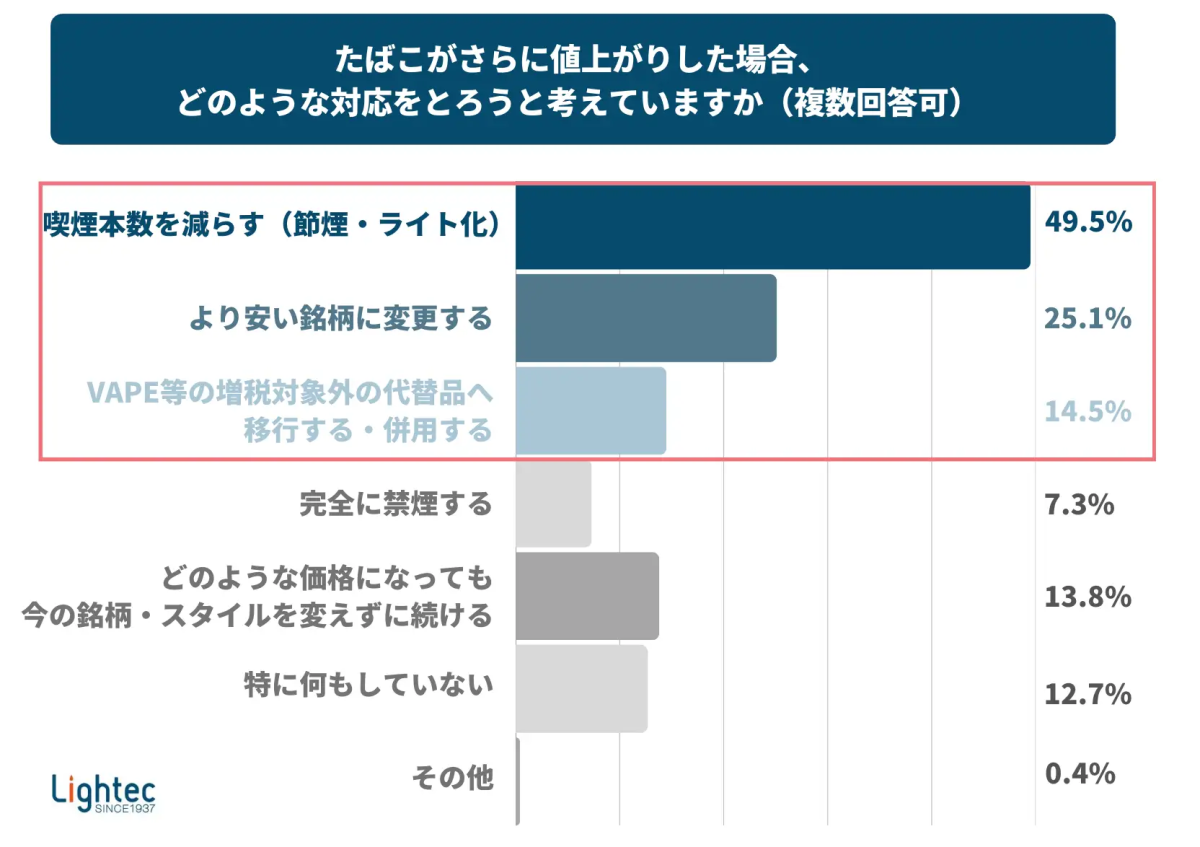
A September online survey commissioned by Japanese smoking-accessories company Lightec found that 49.5% of respondents would consider reducing tobacco use if prices rose further, while 25.1% would consider switching to cheaper brands and 14.5% would consider using or combining alternatives such as vapes and nicotine-free herbal sticks. Another 64.6% expressed some level of interest in such alternatives. The survey covered 1,088 respondents aged 20 to 70 and was conducted by a company that sells NICOLESS nicotine-free vaping and herbal-stick products, meaning its findings should not be treated as representative of Japan's smoking population.
DATA
Oct.12
Snowplus Enters Japan’s FamilyMart Network With Zero-Nicotine NEO Line and Kishidan Campaign
Snowplus distributor H&S said the zero-nicotine, zero-tar NEO vaping line will begin rolling out across FamilyMart stores in Japan from September 14, 2026, excluding some locations. The DASH line will also be sold at selected FamilyMart stores in southern Kyushu and Okinawa. Snowplus simultaneously named Japanese rock band Kishidan as a brand ambassador, combining convenience-store distribution with a broader consumer marketing push in Japan.
Sep.15
Sweden Finds ZYN Ingredient Labels Noncompliant Over Generic Flavoring Disclosure, Swedish Match Faces SEK 2 Million Monthly Penalty
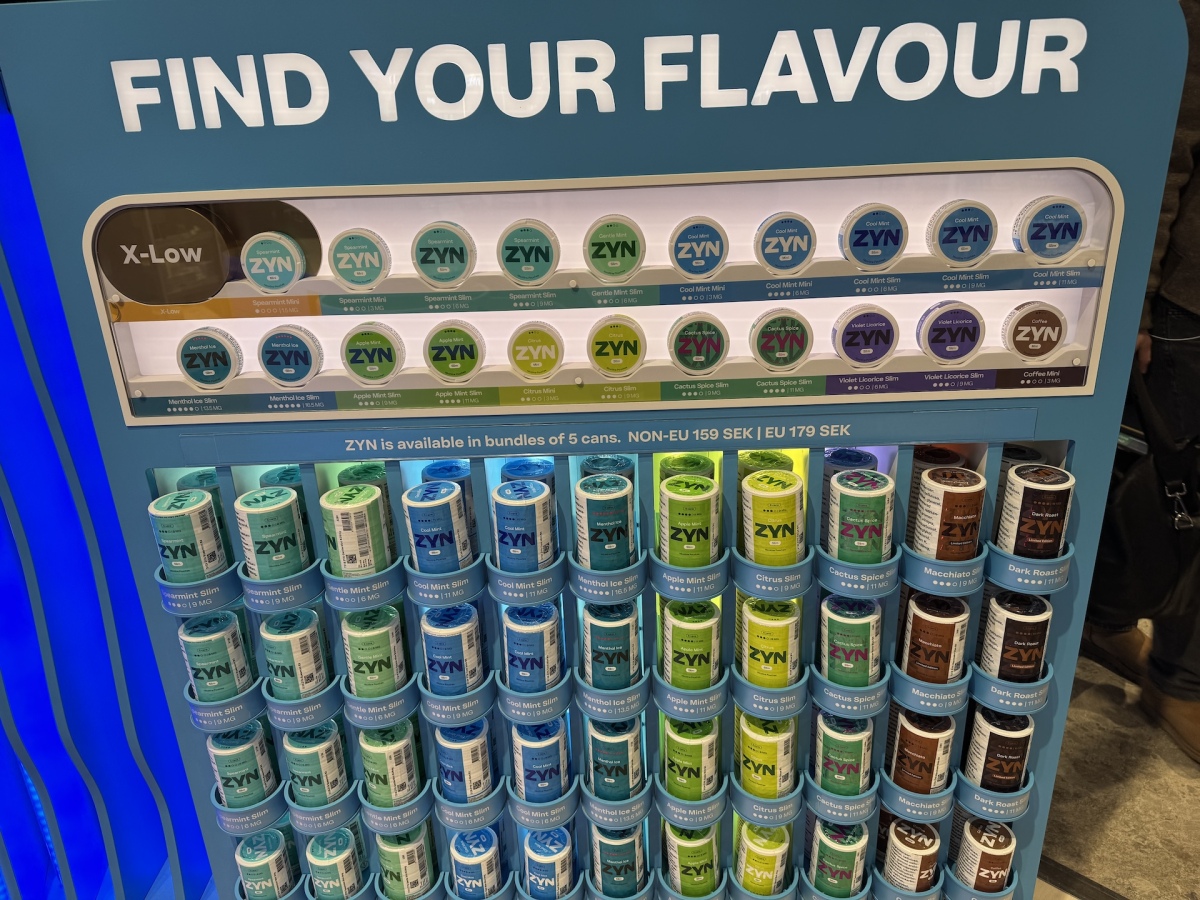
Sweden's Public Health Agency has found ingredient labels on ZYN nicotine pouches sold by Philip Morris International subsidiary Swedish Match to be noncompliant, according to Dagens industri. The products' packaging listed 10 to 13 ingredients, compared with 11 to 42 in regulatory submissions, with multiple flavoring ingredients grouped under the generic term "aromer." The agency ordered corrective action, warning of a conditional penalty of SEK 2 million per month for noncompliance. The order applies only to products manufactured after the decision becomes legally effective and does not require recalls. Swedish Match disputes the agency's interpretation and plans to appeal.
PMI
Oct.22
As Regulators Focus on Nicotine Pouch Child Safety, Safeguard Pursues an External Packaging Route
As regulators pay closer attention to child safety in nicotine pouches, manufacturers face a practical challenge: how to strengthen child-resistant packaging without unnecessarily reworking products, production lines and regulatory submissions already in place. In a written interview with 2Firsts, Chemular detailed Safeguard’s external packaging approach, its customer-specific testing requirements and possible PMTA pathways. The model remains early-stage, but it offers a new way to think about an increasingly important regulatory and manufacturing issue.
Industry Insight
Sep.19
Special report|Indonesia's Vape Industry Has 200 Manufacturers and $1.7 Billion in Investment. Could a Regulatory Divide Derail Its Rise as the World's No. 2 Manufacturing Hub After Shenzhen?
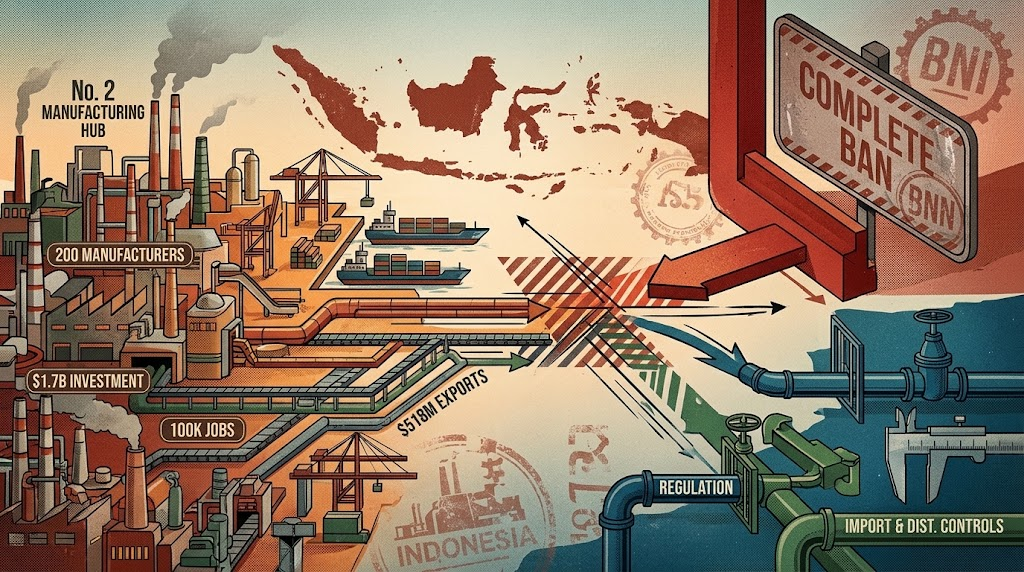
Indonesia's Ministry of Industry said at a November 3, 2026, policy forum that the country has about 200 electronic cigarette companies, Rp31 trillion (approximately $1.71 billion) in cumulative industry investment and around 100,000 jobs across the supply chain. The National Narcotics Agency is seeking a comprehensive ban on vape use and circulation, while the industry ministry favors tighter import, product-standard and distribution controls. Indonesia exported approximately $518 million in vaping products in 2025, and Chinese manufacturers including Smoore, GEEKVAPE and Jinjia Group have established local operations. An international logistics specialist interviewed by 2Firsts said more Chinese vape companies began production in Indonesia from the second half of 2025, accompanied by increased shipments of manufacturing equipment and investment in logistics facilities. The regulatory debate comes as Indonesia expands its role in international vaping manufacturing.
Special Report
Nov.05
NATO Executive Director David Spross Sees U.S. Vape Regulation Improving, Calls for More PMTA Authorizations and Warns of 2027 State Tax Pressure
The National Association of Tobacco Outlets is calling for more FDA marketing authorizations, greater transparency in the PMTA process and continued enforcement against unauthorized e-cigarettes, even as its executive director, David Spross, points to recent regulatory developments as signs of progress. At the state level, excise taxes, flavor restrictions and vapor product directories remain major issues for tobacco retailers. By August 2026, 17 states had enacted laws establishing state-managed e-cigarette directories or similar systems.
Innovation
Sep.29 by 2Firsts Perspectives