US FDA Report: E-cigarettes Top Youth Tobacco Use for 11th Year, Nicotine Pouches Rise to Second

Oct.18.2024
US FDA Report: E-cigarettes Top Youth Tobacco Use for 11th Year, Nicotine Pouches Rise to Second
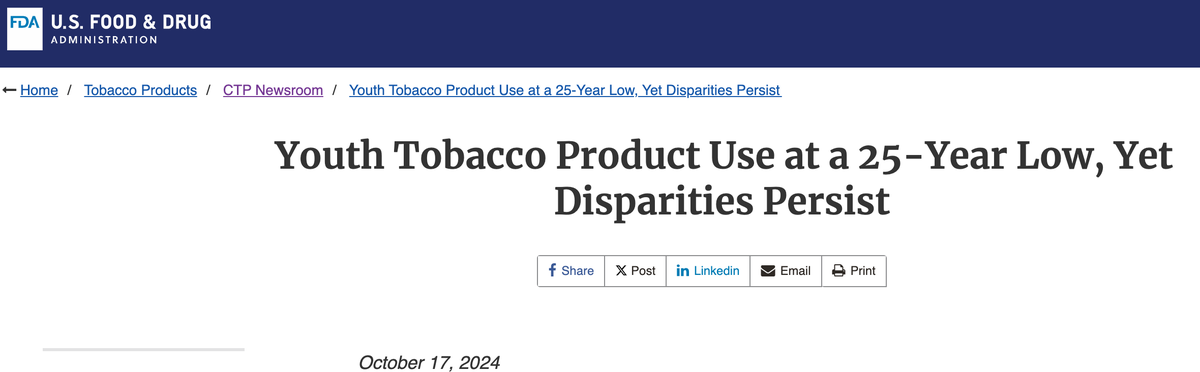
The 2024 National Youth Tobacco Survey reports U.S. youth tobacco use at a 25-year low. E-cigarettes remain the top product (5.9%), with nicotine pouches in second (1.8%).

According to a report released on October 17th by the U.S. Food and Drug Administration (FDA), the latest data from the 2024 National Youth Tobacco Survey (NYTS) shows that the number of middle and high school students using tobacco products in the United States has dropped to the lowest level in 25 years.


In the past year, at least 500,000 students have stopped using tobacco products. In 2024, 2.25 million middle and high school students reported using at least one tobacco product in the past 30 days, compared to 2.8 million in 2023. This decrease is primarily attributed to a significant decrease in the number of students reporting e-cigarette use, dropping from 2.13 million in 2023 to 1.63 million in 2024. Additionally, water pipe use has also significantly decreased in the past year, from 290,000 in 2023 to 190,000 in 2024. Cigarette smoking rates have hit an all-time low since the survey began, with only 1.4% of students reporting cigarette use in 2024.


Deirdre Lawrence Kittner, Director of the Office on Smoking and Health at the Centers for Disease Control and Prevention (CDC), stated that...


The teenage tobacco use rates have reached the lowest level in 25 years, which is a significant milestone for public health. However, there are still over 2 million teenagers using tobacco products, and the rates among certain groups have not decreased. Our work is not yet finished. We must continue to dedicate ourselves to public health efforts to ensure that all teenagers can lead healthy, smoke-free lives.


The CDC and FDA analyzed data from the NYTS to assess the use of nine tobacco products among middle and high school students in the United States. A detailed report released recently provides data on e-cigarette and nicotine pouch use, as well as details on tobacco product use broken down by school level, gender, and race/ethnicity. Despite a decrease in youth e-cigarette use to the lowest level in a decade, e-cigarettes still remain the most commonly used tobacco product among youth (5.9%), with nicotine pouches becoming the second most commonly used tobacco product among youth (1.8%), followed by cigarettes (1.4%), cigars (1.2%), smokeless tobacco (1.2%), other oral nicotine products (1.2%), heated tobacco products (0.8%), hookah (0.7%), and pipe tobacco (0.5%).


The report also found that progress varies among different demographic groups. For example, between 2023 and 2024, the use of any tobacco, e-cigarettes, and various tobacco products decreased among female and Hispanic students. However, during the same period, the use of any tobacco, e-cigarettes, smokeless tobacco, and various combustible tobacco products increased among American Indian or Alaska Native students, while nicotine pouch use increased among white students. There were no significant changes in cigarette, smokeless tobacco, heated tobacco product, and pipe use among all racial and ethnic groups assessed.


Director of the FDA Center for Tobacco Products, Brian King, stated that...


We are moving in the right direction towards reducing tobacco use among teenagers. However, we cannot relax and must remain vigilant in order to continue lowering the use of various tobacco products among young people. Addressing disparities remains an important part of ensuring that no one is left behind.


The FDA stated that the decline in tobacco product use may be attributed to multiple evidence-based strategies implemented at the national, state, and local levels. These strategies include raising prices, mass media campaigns to educate youth about the dangers of various tobacco products, and comprehensive smoke-free policies that include e-cigarettes. Additionally, the FDA continues to regulate the tobacco product market by conducting thorough market reviews and utilizing compliance and enforcement tools throughout the supply chain - including manufacturers, importers, distributors, and retailers.


Click to view the original text of the 2024 National Youth Tobacco Survey (NYTS) report.


We welcome news tips, article submissions, interview requests, or comments on this piece.

Please contact us at info@2firsts.com, or reach out to Alan Zhao, CEO of 2Firsts, on LinkedIn


Notice

1.  This article is intended solely for professional research purposes related to industry, technology, and policy. Any references to brands or products are made purely for objective description and do not constitute any form of endorsement, recommendation, or promotion by 2Firsts.

2.  The use of nicotine-containing products — including, but not limited to, cigarettes, e-cigarettes, nicotine pouchand heated tobacco products — carries significant health risks. Users are responsible for complying with all applicable laws and regulations in their respective jurisdictions.

3.  This article is not intended to serve as the basis for any investment decisions or financial advice. 2Firsts assumes no direct or indirect liability for any inaccuracies or errors in the content.

4.  Access to this article is strictly prohibited for individuals below the legal age in their jurisdiction.


Copyright


This article is either an original work created by 2Firsts or a reproduction from third-party sources with proper attribution. All copyrights and usage rights belong to 2Firsts or the original content provider. Unauthorized reproduction, distribution, or any other form of unauthorized use by any individual or organization is strictly prohibited. Violators will be held legally accountable.

For copyright-related inquiries, please contact: info@2firsts.com


AI Assistance Disclaimer


This article may have been enhanced using AI tools to improve translation and editorial efficiency. However, due to technical limitations, inaccuracies may occur. Readers are encouraged to refer to the cited sources for the most accurate information.

We welcome any corrections or feedback. Please contact us at: info@2firsts.com

Why Does JPMorgan Favor BAT Over Philip Morris Despite Forecasting Slower Growth of 3.9% Versus 6.2%?
JPMorgan resumed equity research coverage of British American Tobacco (BAT), Philip Morris International (PMI) and Imperial Brands in November 2026, assigning BAT an Overweight rating and the other two companies Neutral ratings. The bank forecasts like-for-like sales growth of 3.9% for BAT and 6.2% for PMI in 2027, but estimates the two companies will trade at approximately 11 times and 21 times 2027 earnings, respectively. JPMorgan cited BAT's improving position in US nicotine pouches and vaping products as a driver of its investment outlook. BAT reported a 220% constant-currency increase in US modern oral nicotine revenue in the first half of 2026, while PMI's ZYN US shipments returned to growth in the third quarter. Imperial expects NGPs to represent 4% to 5% of sales and has expanded its oral portfolio through acquisitions.
Capital Markets
Nov.12
Former Roche Neuroscience and Rare Diseases Communications Director Ria Kioupritzi Joins PMI as Scientific Affairs Director
Eleftheria (Ria) Kioupritzi, a biopharmaceutical professional with more than 15 years of experience, has joined Philip Morris International as Director Scientific Affairs within Corporate Affairs. She previously served at Roche as Senior Scientific Communications Director for Neuroscience and Rare Diseases and worked extensively in spinal muscular atrophy. Her earlier career also covered competitive intelligence, clinical and regulatory monitoring, pipeline development and launch preparation. During her time working in Roche's SMA field, Evrysdi passed through several U.S. FDA milestones, including its initial approval, an expanded indication for younger infants and approval of a tablet formulation. Public records do not show that Kioupritzi herself led the FDA submissions.
Sep.22
Australia Adds 6-Methylnicotine to Schedule 9 Prohibited Substances, Effective October 1
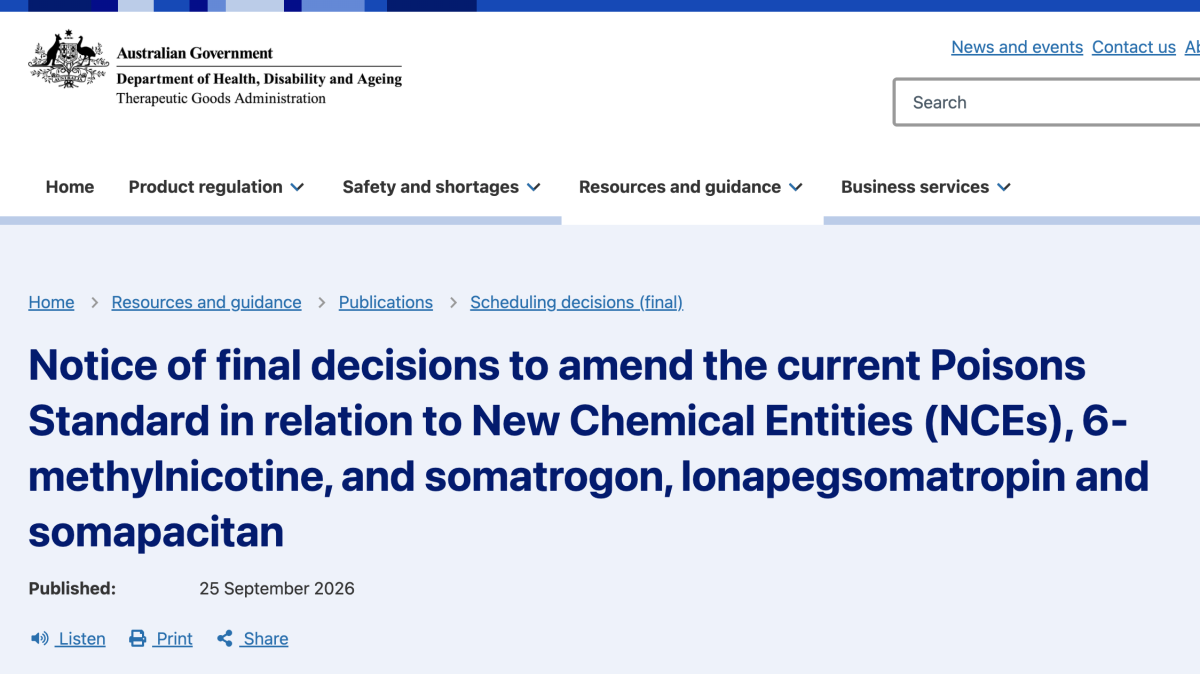
Australia's Therapeutic Goods Administration published a final decision on September 25 to classify 6-methylnicotine as a Schedule 9 prohibited substance under the Poisons Standard, effective October 1, 2026. TGA said the chemical has been reported in e-cigarette liquids sold in Australia and marketed as nicotine-free or nicotine alternatives, while evidence also indicates its use in preparations such as oral pouches. The government originally proposed a Schedule 7 classification but ultimately adopted the stricter Schedule 9 designation, citing acute toxicity, dependence risk, use in unapproved consumer products and misleading marketing.
News
Sep.29 by 2Firsts Perspectives
Special Report | How Capital Is Reassessing the Global Tobacco and Modern Nicotine Industry: Lessons from a New York Forum
Capital is reassessing the global tobacco and modern nicotine industry as heated tobacco, vaping and nicotine pouches reshape demand, profitability and regulation. At the 2026 New Approaches Summit in New York, investors and analysts examined whether smoke-free growth can sustain earnings, how regulation shapes startup value, and whether shareholder engagement can be more effective than divestment. The debate points to a broader shift: tobacco transition is increasingly becoming a capital-allocation, governance and valuation question.
Capital Markets
Oct.05
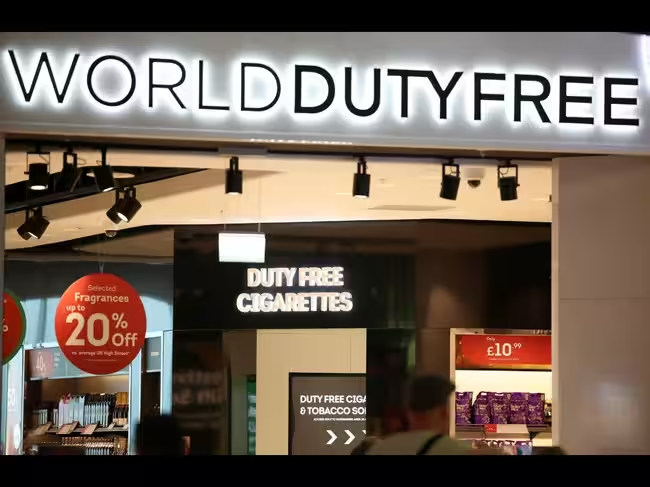
India Duty-Free Nicotine Pouch Sales Face Regulatory Test as ZYN, FOX Classification Remains Open
The Bombay High Court has ruled that airport duty-free shops are not exempt from India's domestic regulatory laws merely because they operate beyond the customs barrier, leaving in place a sales halt covering ZYN and FOX nicotine pouches at Mumbai's international airport. The court, however, did not determine that the products necessarily qualify as "drugs" under India's Drugs and Cosmetics Act. The retailers have four weeks to submit product information to the appropriate authorities, including CDSCO, which must complete its review within 30 days of receiving the submissions.
Sep.24
GAO Audit Finds Nearly 132,000 FDA Tobacco Applications Waiting an Average 1,266 Days as Nicotine Pouch Pilot Practices Move Into Vape PMTA Reviews
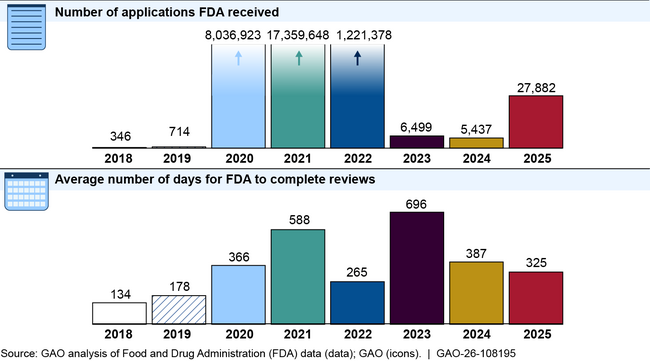
A U.S. Government Accountability Office audit found that 131,915 tobacco product applications submitted to the FDA since 2018 remained without a final review as of December 31, 2025, with pending applications waiting an average of 1,266 days. GAO also found FDA lacks the data needed to systematically determine whether scientific reviews meet applicable timelines. HHS agreed to upgrade the agency's tracking systems. At the same time, FDA has begun applying lessons from its nicotine pouch PMTA pilot to e-cigarette reviews, while changes to enforcement policy and electronic submissions are making the specific stage of a PMTA increasingly relevant to market access.
FDA
Oct.03