Key Points:
Law Enforcement and Ban: The Russian consumer rights protection and public supervision agency, Rospotrebnadzor, conducted an inspection following instructions from the Prosecutor General's Office and found that several e-commerce platforms were selling Chinese HQD brand e-cigarettes and energy drinks. Regulatory authorities determined that this action violated laws prohibiting the sale of nicotine products that stimulate consumption and issued orders for the e-commerce platforms to cease sales.
The company involved:HQD's rights holder in Russia being Meridian-Trade AO, whose business covers e-cigarette and beverage sales. In 2024, the company's revenue reached 1.43 billion rubles and it is currently facing additional investigations.
Legal and public opinion divided: Social groups and lawyers believe that the company is indirectly promoting e-cigarettes through its beverage brand, leading to consumer enticement, and should be severely punished or even temporarily suspended from operating.
Company response: Meridian-Trade states that there is currently no ban on the sale of HQD Energy, as any ban must be decided by the court and the company has not yet received a ruling. The company clarifies that trademark confusion rulings only apply to similar products within the same category and do not prohibit the use of similar trademarks in different categories. If the court rules against the company, they are willing to comply and consider rebranding their beverage products.
According to a report by the Russian newspaper "Izvestia" on August 11th, the Russian consumer rights protection and public oversight agency (Rospotrebnadzor) has banned the sale of e-cigarettes and energy drinks produced by the same brand.
According to the results of an inspection conducted at the request of the Russian Prosecutor General's Office, online stores selling HQD brand e-cigarettes and energy drinks have received relevant bans. Officials believe that promoting energy drinks and e-cigarettes of the same brand together violates regulations prohibiting the promotion of nicotine-containing products.
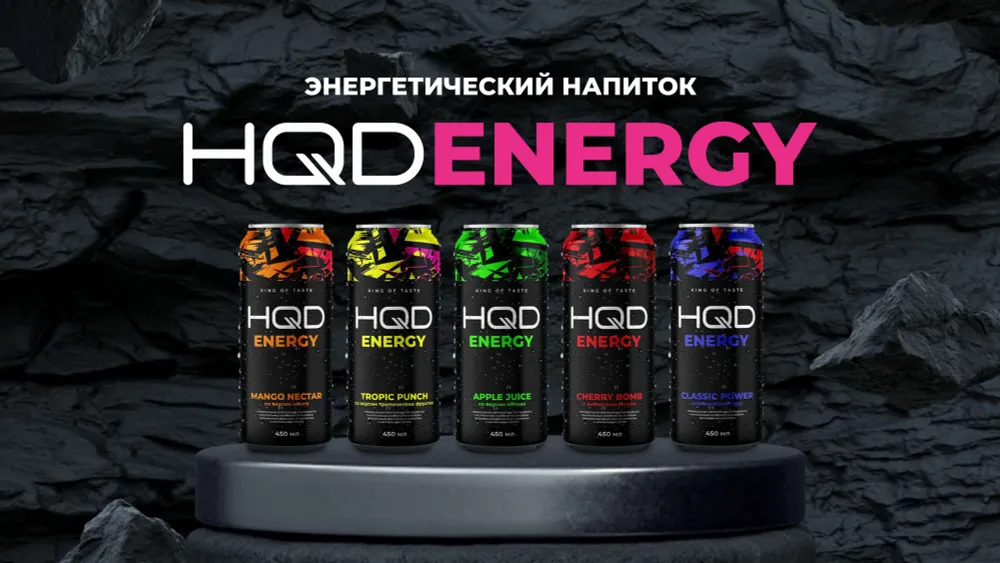
In Russia, energy drinks and e-cigarettes will no longer be able to be sold under the same brand, as this type of transaction violates the provisions of the law "On the protection of citizens' health from the harmful effects of environmental tobacco smoke, consequences of tobacco consumption, or consumption of nicotine-containing products".
According to the newspaper "Izvestia," the reason for this inspection was a complaint filed by Oleg Pavlov, the Chairman of the Public Commission of the Russian Consumer Rights and Public Welfare Supervision Bureau (Rospotrebnadzor). The brand in question is HQD, a Chinese brand whose rights holder in Russia is the company AO "Meridian-Trade.
The company sells both e-cigarettes and beverages, as confirmed by information on its official website and a unified contact method for wholesale orders. According to SPARK-Interfax data, the company had a revenue of 1.43 billion rubles (approximately 17.97 million US dollars) in 2024.
The Russian Consumer Rights Protection and Public Interest Supervision Bureau responded by stating:
The e-cigarette brand HQD is selling non-alcoholic energy drinks, which does not comply with federal laws prohibiting the sale and promotion of nicotine-containing products. Specifically, this is done through the use of the trademark in the production of non-tobacco and non-nicotine products, as well as the wholesale and retail of such products.
An order containing the above conclusion has been sent to all websites, and a further investigation will be conducted on the "Meridian Trade" company itself.
Oleg Pavlov explained, "We are demanding that these products be removed from shelves as soon as possible. The actions of the distributors are unethical, as they are using energy drinks to encourage or even incite (including young people) to use e-cigarettes.
The Izvestia has requested the Russian Consumer Rights Protection and Public Interest Supervision Bureau to comment on the timing of product removal from shelves.
The Containing Nicotine Products Industry Alliance (CIPNI) disagrees with this interpretation of the law. The Director of the alliance, German Lukashov, believes that using the same brand for different products is not inappropriate, as it allows companies to guarantee product quality.
He said:
The regulatory authorities have made a legal interpretation in their favor, as they need to issue warnings and fines within their scope of responsibilities. This is targeted at a market participant who complies with all legal requirements, operates legitimate goods "in a straightforward manner," and conceals nothing.
At the same time, lawyers and activists believe that the violations are clear. Lawyer Anton Nedzvetsky stated that the distributor company does not have the right to use the same trademark for energy drinks and e-cigarettes, as the law clearly prohibits the wholesale and retail of such products.
Pavel Shapkin, Chairman of the All-Russian Consumer Rights Protection Alliance, called this situation a "shocking case." He believes that when it comes to cigarettes, there is simply no question of quality assurance.
He said, "It is well known that cigarettes are harmful to health, and considering e-cigarettes, which are even more harmful, as high-quality products is simply absurd.
He believes that it is important for the company to not evade responsibility and to be severely punished, including temporarily shutting down until corrective actions are completed.
The company may face legal consequences for violating Article 14.3.1 of the Russian Federal Administrative Offenses Code, which prohibits sponsorship of tobacco or nicotine-containing products, advertising and promoting tobacco, tobacco products, nicotine-containing products, consumption devices for nicotine-containing products, or hookahs. The maximum penalty is a fine of up to 150,000 rubles (approximately $1,884).
The company "Meridian Trade" stated after the report was released that there is currently no ban on the sale of HQD Energy products. A ban can only be issued by a court, and the company has not received any court ruling, the news release added.
In addition, the company pointed out that according to Article 5, Paragraph 2, item 3 of the Advertising Law (Federal Law No. 38-FZ) issued on March 13, 2006, the assessment of "similar trademarks to the point of causing confusion" is limited to the same or similar range of goods or services. The law does not prohibit two similar trademarks from existing in different Nice Classification (MKTU) categories.
However, if the court rules that these trademarks are indeed similar enough to cause confusion, АО 'Meridian Trade' will comply with the decision and is prepared to rebrand its beverage products as these products have already captured a significant market share. This was stated by the company.
We welcome news tips, article submissions, interview requests, or comments on this piece.
Please contact us at info@2firsts.com, or reach out to Alan Zhao, CEO of 2Firsts, on LinkedIn
Notice
1. This article is intended solely for professional research purposes related to industry, technology, and policy. Any references to brands or products are made purely for objective description and do not constitute any form of endorsement, recommendation, or promotion by 2Firsts.
2. The use of nicotine-containing products — including, but not limited to, cigarettes, e-cigarettes, nicotine pouchand heated tobacco products — carries significant health risks. Users are responsible for complying with all applicable laws and regulations in their respective jurisdictions.
3. This article is not intended to serve as the basis for any investment decisions or financial advice. 2Firsts assumes no direct or indirect liability for any inaccuracies or errors in the content.
4. Access to this article is strictly prohibited for individuals below the legal age in their jurisdiction.
Copyright
This article is either an original work created by 2Firsts or a reproduction from third-party sources with proper attribution. All copyrights and usage rights belong to 2Firsts or the original content provider. Unauthorized reproduction, distribution, or any other form of unauthorized use by any individual or organization is strictly prohibited. Violators will be held legally accountable.
For copyright-related inquiries, please contact: info@2firsts.com
AI Assistance Disclaimer
This article may have been enhanced using AI tools to improve translation and editorial efficiency. However, due to technical limitations, inaccuracies may occur. Readers are encouraged to refer to the cited sources for the most accurate information.
We welcome any corrections or feedback. Please contact us at: info@2firsts.com