Support for Complete Ban on e-cigarette Sales: Russian Official

Jan.20.2025
Support for Complete Ban on e-cigarette Sales: Russian Official
Russian Duma chairman launches survey on banning e-cigarette sales, with 88% of voters supporting the proposal.

According to a report by a Russian newspaper on January 18th, Vyacheslav Volodin, the Chairman of the Russian State Duma, initiated a survey on his Telegram channel. Preliminary results indicate that the majority of voters support a complete ban on the sale of e-cigarettes.


Wolokin stated that as early as 2023, legislators had passed a law prohibiting the sale of e-cigarettes and related e-liquids to minors. However, an analysis of law enforcement found that these measures were insufficient to protect children. Therefore, he asked subscribers whether they supported a complete ban on the sale of e-cigarettes and their e-liquids.


As of January 18th, more than 45,000 people have participated in the vote. Among them, 88% of voters expressed support for the ban, 8% of voters chose not to support it, and a small number indicated they were indifferent.


Previously, a group of lawmakers from the Communist Party of the Russian Federation (KPRF) proposed banning the wholesale and retail of e-cigarettes and their e-liquids. The proposal was submitted for consideration by the State Duma on December 26. Lawmakers pointed out that these nicotine and non-nicotine e-liquid consumer devices pose health risks and are currently not regulated enough.


We welcome news tips, article submissions, interview requests, or comments on this piece.

Please contact us at info@2firsts.com, or reach out to Alan Zhao, CEO of 2Firsts, on LinkedIn


Notice

1.  This article is intended solely for professional research purposes related to industry, technology, and policy. Any references to brands or products are made purely for objective description and do not constitute any form of endorsement, recommendation, or promotion by 2Firsts.

2.  The use of nicotine-containing products — including, but not limited to, cigarettes, e-cigarettes, nicotine pouchand heated tobacco products — carries significant health risks. Users are responsible for complying with all applicable laws and regulations in their respective jurisdictions.

3.  This article is not intended to serve as the basis for any investment decisions or financial advice. 2Firsts assumes no direct or indirect liability for any inaccuracies or errors in the content.

4.  Access to this article is strictly prohibited for individuals below the legal age in their jurisdiction.


Copyright


This article is either an original work created by 2Firsts or a reproduction from third-party sources with proper attribution. All copyrights and usage rights belong to 2Firsts or the original content provider. Unauthorized reproduction, distribution, or any other form of unauthorized use by any individual or organization is strictly prohibited. Violators will be held legally accountable.

For copyright-related inquiries, please contact: info@2firsts.com


AI Assistance Disclaimer


This article may have been enhanced using AI tools to improve translation and editorial efficiency. However, due to technical limitations, inaccuracies may occur. Readers are encouraged to refer to the cited sources for the most accurate information.

We welcome any corrections or feedback. Please contact us at: info@2firsts.com

EU Commission Clarifies Vaping, Smokeless Nicotine Use in Proposed Cardiovascular Checks
The European Commission has clarified to 2Firsts that its proposed cardiovascular health checks would assess smoking, vaping and the use of smokeless nicotine products as part of patients’ medical histories. The Commission also said Member States may organise additional checks within their healthcare systems. In the same response, it pointed to JRC research on e-cigarettes, heated tobacco products and nicotine pouches that has fed into the evaluation of EU tobacco legislation.
Nov.09
DATA|UK Retail Research Group IGD Says Convenience Tobacco and Vape Sales Fell 10.6%, With 15.4% Market Share Versus Alcohol's 15.1%; Top Rank at Risk in 2027
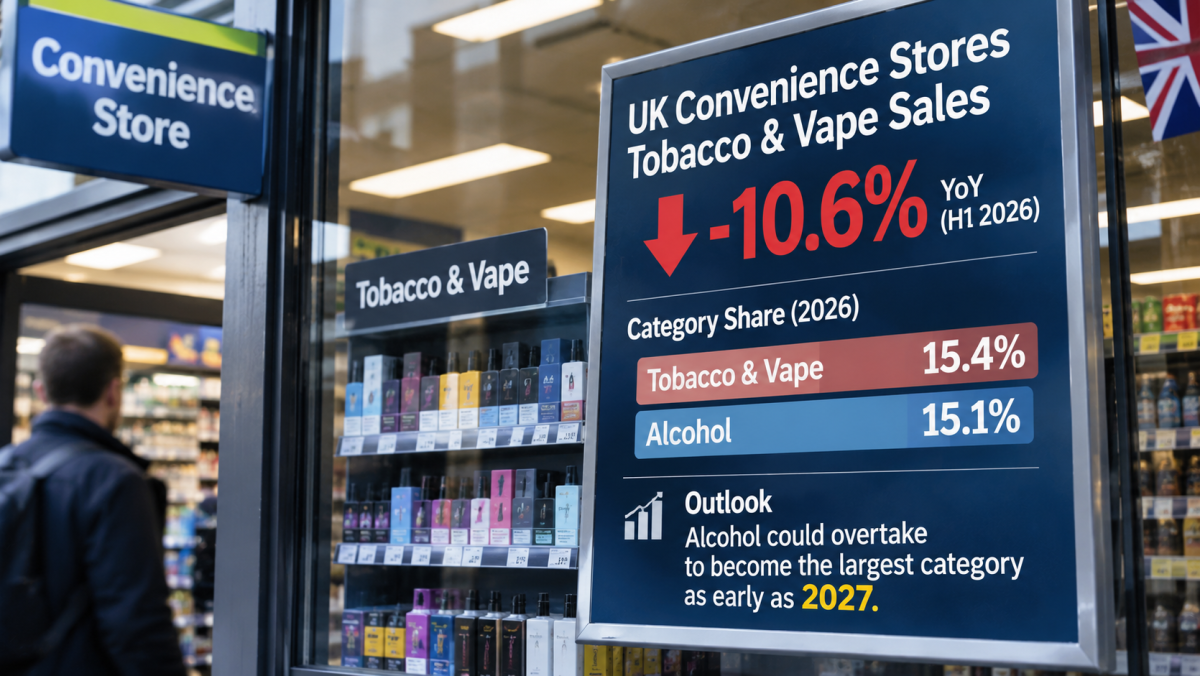
Combined tobacco and vaping sales in UK convenience stores fell 10.6% year over year in the first half of 2026, making the category a major drag on channel performance, according to retail research organization IGD. Total convenience sales declined 1.2%, while sales excluding tobacco and vaping increased 0.7%. IGD's 2026 category-share figures show tobacco and vaping accounting for 15.4% of convenience sales, compared with 15.1% for alcohol. The organization forecasts alcohol could overtake tobacco and vaping as the largest category by sales value as early as 2027 if current trends continue. IGD expects the convenience market to increase from £48.6 billion in 2026 to £54.9 billion in 2031, a 2.5% compound annual growth rate, or 3.4% excluding tobacco and vaping.
DATA
Nov.11
Turning Point Brands Q3 Modern Oral Net Sales Rise 103% to $74.4 Million as Attributable Profit Falls 81%
Turning Point Brands (TPB) reported third-quarter 2026 Modern Oral net sales of $74.4 million on November 9, up 102.9% year over year and representing 49.2% of consolidated net sales. Total company net sales rose 27.0% to $151.1 million, while net income attributable to TPB declined 81.4% to $3.93 million. The company is expanding the US retail presence of its FRE and ALP nicotine pouch brands and expects its Modern Oral chain-store footprint to grow by more than 70% during 2026. Selling, general and administrative expenses increased 69.1% to $75.3 million, while PMTA-related expenses reached approximately $3.15 million and manufacturing start-up costs totaled about $593,000. ALP plans to open a branded pop-up in New York City's SoHo neighborhood on November 13, alongside a marketing campaign extending into January 2027. TPB owns 50% of ALP but consolidates the venture in its financial statements.
company
Nov.11
How Investors Are Repricing the Global Tobacco Industry as Nicotine Markets Shift
How are investors reassessing the global tobacco industry as nicotine markets evolve? In an interview with 2Firsts, Charlie Chen, Head of Research at CCB International Securities, forecasts annual growth of 30–50% for nicotine pouches, outpacing vaping and heated tobacco. He examines how regulatory enforcement, shifting market shares and new business models are influencing company valuations. The report also explores differences between multinational tobacco groups and Chinese companies, drawing on insights from the New Approaches Summit on profitability, investment strategies and industry consolidation.
Nov.11
Smoke-Free Business Hits 42% of Q2 Net Revenue as PMI’s First TNFD Report Covers Single-Use Electronics, Critical Raw Materials and IQOS Repairs
Philip Morris International has published its first report aligned with the Taskforce on Nature-related Financial Disclosures, bringing its electronics supply chain and the use and end-of-life stages of smoke-free devices and consumables into its nature-related assessment. PMI said its smoke-free business accounted for about 42% of total net revenues in the second quarter of 2026. The report says non-circular electronic products, particularly single-use items, can increase consumption of limited natural resources and also details an IQOS repair pilot. A 2040 circularity scenario tests assumptions including a 50% reduction in product waste-related costs, 10% raw-material savings and a 25% substitution rate for refurbished products versus new products.
Sep.23
Why Does JPMorgan Favor BAT Over Philip Morris Despite Forecasting Slower Growth of 3.9% Versus 6.2%?
JPMorgan resumed equity research coverage of British American Tobacco (BAT), Philip Morris International (PMI) and Imperial Brands in November 2026, assigning BAT an Overweight rating and the other two companies Neutral ratings. The bank forecasts like-for-like sales growth of 3.9% for BAT and 6.2% for PMI in 2027, but estimates the two companies will trade at approximately 11 times and 21 times 2027 earnings, respectively. JPMorgan cited BAT's improving position in US nicotine pouches and vaping products as a driver of its investment outlook. BAT reported a 220% constant-currency increase in US modern oral nicotine revenue in the first half of 2026, while PMI's ZYN US shipments returned to growth in the third quarter. Imperial expects NGPs to represent 4% to 5% of sales and has expanded its oral portfolio through acquisitions.
Capital Markets
Nov.12