Thailand's E-Cigarette Crackdown: 4 Million Items Seized, 11,000 URLs Blocked

Aug.25.2025
Thailand's E-Cigarette Crackdown: 4 Million Items Seized, 11,000 URLs Blocked
Thai government crackdown on illegal e-cigarettes results in 3200 arrests, seizure of 4 million products worth $17.89 million.

Key points: 

·In a large-scale crackdown from February to August 2025, the Thai government arrested over 3,200 people nationwide for illegal e-cigarette activities, seizing over 4 million e-cigarettes and related products worth 5.8 billion Thai Baht (approximately $17.89 million USD). 

·Online blockade: The Ministry of Digital Economy and Society blocked 11,000 websites selling e-cigarettes, forcing sellers to move from physical stores to online platforms and social media. 

·Health risks: The use of e-cigarettes is associated with an increased risk of stroke and heart disease, with regular e-cigarette users having a 1.623 times higher risk of stroke than non-users. 

·Severe penalties: Smuggling e-cigarettes can lead to up to 10 years in prison and a fine five times the value of the products; sellers face up to three years in prison and a fine of 600,000 Thai Baht (approximately $20,000 USD).


According to a report from The Nation Thailand on August 24, authorities in Thailand have seized over 4 million e-cigarettes and related products worth 5.8 billion baht (approximately 17.89 million USD) in a nationwide crackdown that began in 2025, a government spokesperson announced on August 24.


The spokesperson for the Deputy Prime Minister, Anukool Pruksanusak, stated that from February to August 23rd, more than 3,200 individuals have been arrested in operations targeting the illegal sale of e-cigarettes.


These efforts led to over 4 million e-cigarette devices and accessories being seized, worth 5.8 billion baht.


Anukul pointed out that the crackdown has forced many sellers to move underground, shifting from physical stores to online platforms and social media channels.


Thailand's E-Cigarette Crackdown: 4 Million Items Seized, 11,000 URLs Blocked
图源:nation thailand


He also mentioned that the Ministry of Digital Economy and Society has blocked over 11,000 websites selling e-cigarettes.


The spokesperson emphasized that e-cigarettes pose serious health risks, including stroke and heart disease.


He cited data from the disease control department, saying that people who frequently use e-cigarettes are 1.623 times more likely to have a stroke than the average person, while those who occasionally use e-cigarettes are 1.28 times more at risk of having a stroke.


According to the data from the Ministry of Public Health, stroke is the second leading cause of death in Thailand. In 2024, there were 358,062 reported cases of stroke patients, with 39,086 deaths.


Thailand's E-Cigarette Crackdown: 4 Million Items Seized, 11,000 URLs Blocked
图源:nation thailand


Anukul warned that those involved in smuggling e-cigarettes may face up to 10 years in prison, a fine five times the value of the products, or both. According to the Consumer Protection Act, sellers could face up to three years in prison and a maximum fine of 600,000 Thai Baht (approximately $20,000). Additionally, under customs law, offenders could face five years in prison or a fine four times the value of the products.


Possession of an e-cigarette could also result in a maximum penalty of five years in prison or a fine of up to four times the value of the product, or both.


We welcome news tips, article submissions, interview requests, or comments on this piece.

Please contact us at info@2firsts.com, or reach out to Alan Zhao, CEO of 2Firsts, on LinkedIn


Notice

1.  This article is intended solely for professional research purposes related to industry, technology, and policy. Any references to brands or products are made purely for objective description and do not constitute any form of endorsement, recommendation, or promotion by 2Firsts.

2.  The use of nicotine-containing products — including, but not limited to, cigarettes, e-cigarettes, nicotine pouchand heated tobacco products — carries significant health risks. Users are responsible for complying with all applicable laws and regulations in their respective jurisdictions.

3.  This article is not intended to serve as the basis for any investment decisions or financial advice. 2Firsts assumes no direct or indirect liability for any inaccuracies or errors in the content.

4.  Access to this article is strictly prohibited for individuals below the legal age in their jurisdiction.


Copyright


This article is either an original work created by 2Firsts or a reproduction from third-party sources with proper attribution. All copyrights and usage rights belong to 2Firsts or the original content provider. Unauthorized reproduction, distribution, or any other form of unauthorized use by any individual or organization is strictly prohibited. Violators will be held legally accountable.

For copyright-related inquiries, please contact: info@2firsts.com


AI Assistance Disclaimer


This article may have been enhanced using AI tools to improve translation and editorial efficiency. However, due to technical limitations, inaccuracies may occur. Readers are encouraged to refer to the cited sources for the most accurate information.

We welcome any corrections or feedback. Please contact us at: info@2firsts.com

UK HMRC Launches Vape Duty Stamps on October 1, Ushering in Supply-Chain Traceability as Chinese Exporters Face New Compliance Hurdles
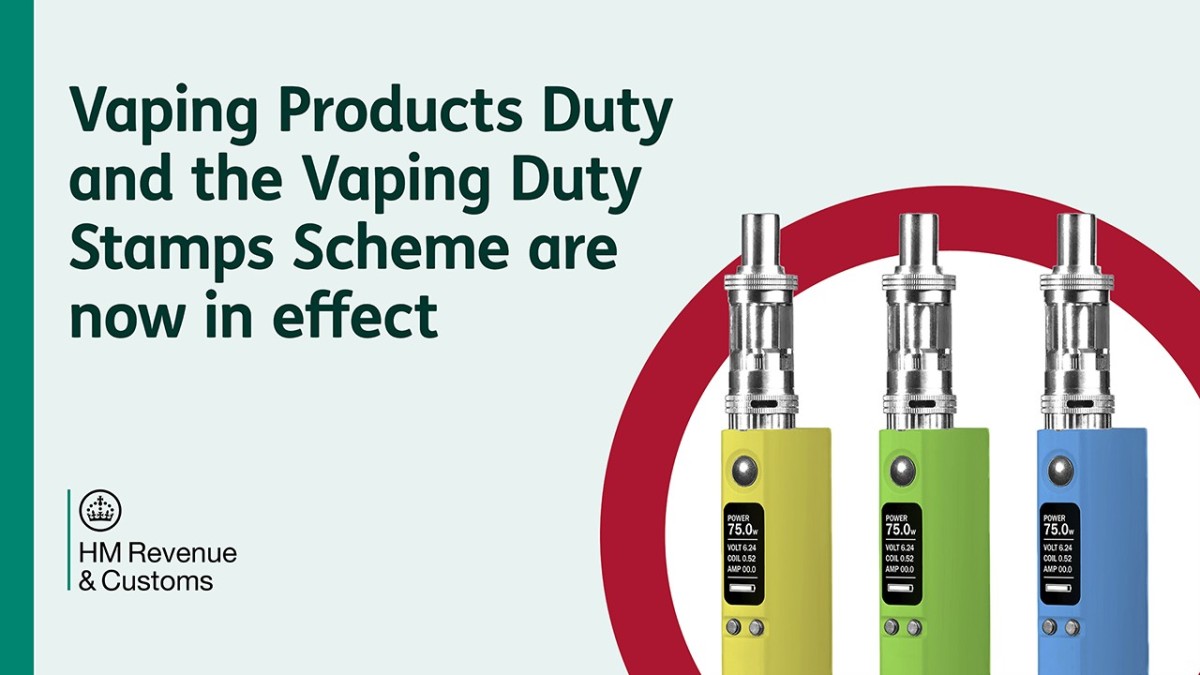
HM Revenue & Customs put the UK's Vaping Products Duty and Vaping Duty Stamps Scheme into effect on October 1. All vaping liquids manufactured in or imported into the UK are now subject to duty at £2.20 per 10ml, regardless of nicotine content. The stamp regime will introduce digital functionality designed to provide traceability throughout the supply chain, with approved manufacturers, importers and warehousekeepers required to report product movements and retailers and consumers eventually able to scan stamps to verify authenticity. China exported $177 million of vape-related products to the UK in August, up 51.4% year over year, increasing the significance of the new compliance regime for China's Shenzhen-centered vape supply chain.
Regulations
Oct.04
South Korea Constitutional Court Upholds Volume-Based E-Liquid Tax, With Challenged Rates at KRW 370 and KRW 628 per Milliliter
South Korea's Constitutional Court has upheld fixed taxes on nicotine-containing e-cigarette liquids based on solution volume, ruling that challenged provisions imposing KRW 370 per milliliter in individual consumption tax and KRW 628 per milliliter in tobacco consumption tax do not violate the Constitution. The cases stemmed from historical disputes involving importers that reported nicotine as being extracted from tobacco stems rather than leaves. South Korea has since broadened its tobacco definition to include synthetic nicotine, while current tax laws provide reduced rates for certain products not derived from tobacco.
Sep.18
Australia Extends Illicit Tobacco Crackdown From Tougher Penalties to Customs and Logistics Supply Chains
Australia's federal government introduced a new illicit tobacco enforcement bill on September 10 that would strengthen evidentiary presumptions, representative sampling, seizure and forfeiture procedures, proceeds-of-crime powers and obligations for customs and logistics operators. The proposal follows the Combatting Illicit Tobacco Act 2026, which took effect in August and increased penalties while expanding investigative and asset-recovery tools. Together, the reforms extend Australia's crackdown from tougher criminal sanctions into import, logistics and evidentiary enforcement.
Sep.14
Australia Adds 6-Methylnicotine to Schedule 9 Prohibited Substances, Effective October 1
Australia's Therapeutic Goods Administration published a final decision on September 25 to classify 6-methylnicotine as a Schedule 9 prohibited substance under the Poisons Standard, effective October 1, 2026. TGA said the chemical has been reported in e-cigarette liquids sold in Australia and marketed as nicotine-free or nicotine alternatives, while evidence also indicates its use in preparations such as oral pouches. The government originally proposed a Schedule 7 classification but ultimately adopted the stricter Schedule 9 designation, citing acute toxicity, dependence risk, use in unapproved consumer products and misleading marketing.
News
Sep.29 by 2Firsts Perspectives
Ispire Q4 Revenue Rebounds 33% but Full-Year Sales Still Fall 25% as FY2027 Focus Shifts to Malaysia Manufacturing, ODM, Nicotine Pouches and Age Verification
Ispire Technology reported FY2026 revenue of about $96 million, down 24.7% year over year, as U.S. cannabis-vapor hardware and European e-cigarette sales declined by $17.4 million and $12.7 million, respectively. Fourth-quarter revenue rose 32.5% to $26.7 million, while quarterly gross margin fell to 6.3%. For FY2027, the company is prioritizing Malaysia manufacturing and vapor ODM while continuing to develop nicotine pouches, IKE Tech age-verification technology and G-Mesh licensing. Ispire has not separately disclosed the revenue or profit contribution of those newer businesses.
Regulations
Sep.17 by 2Firsts Perspectives
Texas Extends Tobacco Tax Interpretation to a 6-Methylnicotine Product, Citing VELO Ruling
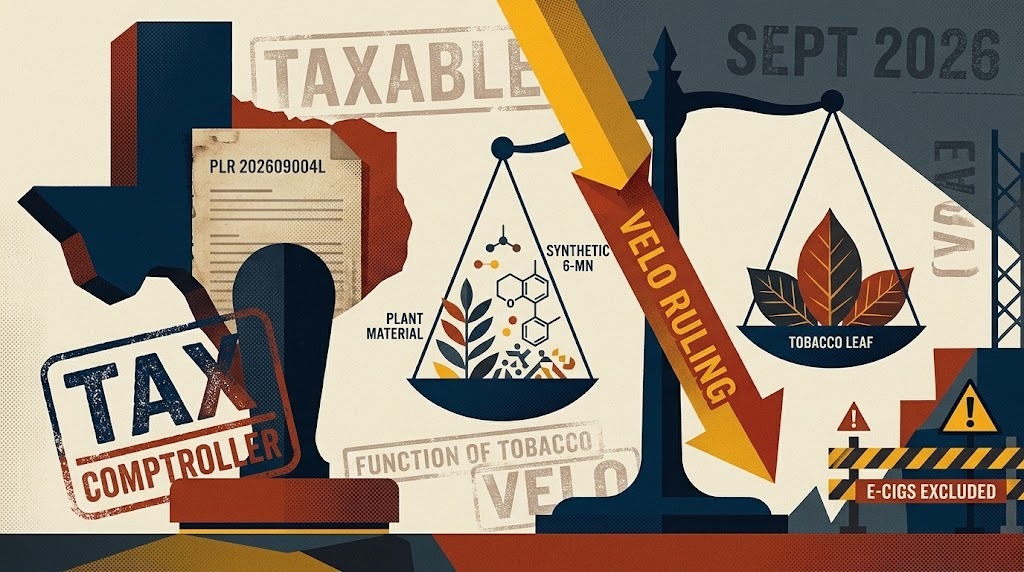
The Texas Comptroller of Public Accounts ruled in September 2026 that a combustible product made with non-tobacco plant material and 6-methylnicotine (6-MN), a synthetic nicotine analog, qualifies as a taxable tobacco product. The applicant said the product contained neither tobacco leaf nor measurable conventional nicotine. The determination applies reasoning from a May Texas Supreme Court decision involving VELO nicotine pouches, finding that the plant material and 6-MN together perform the functions of tobacco in a conventional smoking product. The ruling carries applicable tax, licensing and reporting obligations but is limited to the facts submitted by the taxpayer. It does not establish a blanket tax classification for all 6-MN products or extend the same conclusion to e-cigarettes.
Regulations
Nov.06