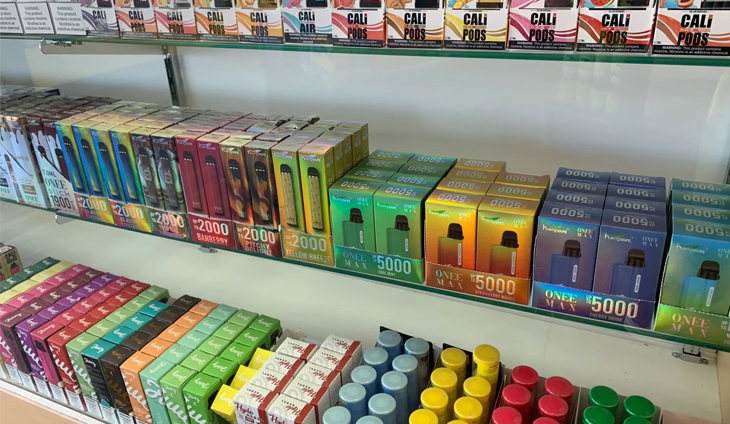
In January of this year, the UK government announced a full ban on the sale of disposable e-cigarettes and restrictions on the flavors of refillable e-cigarettes. Recently, a well-known e-cigarette distributor revealed that the UK government plans to announce the latest update on the disposable e-cigarette ban this Friday, the 6th of May. It is expected that the ban will come into effect on the 1st of April, 2025. In response to this news, 2Firsts reached out to David Lawson, CEO of the UK independent CRO and leading lab Inter Scientific.
In response to 2Firsts' questions about e-cigarette compliance, David stated that the draft clearly specifies that refillable pod products are not restricted, but devices must have a charging function or replaceable atomizer cores. From a technical standpoint, products "can" be charged, even if they cannot be used after charging (such as when the battery is depleted), they are not subject to regulation. At the same time, David observed that over 80% of e-cigarette products seized by UK enforcement agencies were found to be non-compliant, "clearly indicating a demand from consumers for such high-capacity products (often characterized by capacities greater than 8 milliliters).
Below are the specific questions and answers between 2Firsts and David.
2Firsts: How do you view the ban on disposable e-cigarettes that will take effect on April 1, 2025? What impact do you believe this will have on the e-cigarette industry?
David: The current Draft Statutory Instrument is proposed to come into effect from 1st April 2025. In fact, there are several draft Regulations which mirror the same definitions and restrictions for; England & Wales, Northern Ireland and Scotland, amounting to three draft Regulations to cover the entirety of the UK. The Regulation comes following a UK-wide consultation from October 2023-December 2023 with the outcome published on 12th February 2024. The draft Regulation is not yet approved however it will include a minimum period of 6 months for a ‘lead-in’ time to allow businesses to adapt.
The draft Regulations will prohibit the sale of single-use vape products which are not refillable and/or not rechargeable. The draft regulation excludes pod product or product that can be refilled. Devices must be rechargeable or have a replaceable coil. As the Tobacco and Related Products Regulation (2016) is in effect in the UK and limits the tank volume to 2mL for pods and devices, this presents a challenge to vape product manufacturers.
Since the proposal of the Single-use Vape Regulation several months ago, the UK has seen rapid innovation to overcome the challenges presented by the Regulation including devices which incorporate several 2mL pods or devices which have a detachable 10mL bottle for refilling.
The vaping industry has evolved since the early days of the ‘cig-a-like’ device and I believe we will continue to see leading brands innovate new solutions to make vape products comply with the proposed draft Regulation.
Unfortunately, many consumers do not dispose of their vape products responsibly, and the environmental impact can often be seen on UK roads where used vape products are discarded or in canals around some of the UK major cities.
2Firsts: Do you believe there are any misunderstandings or compliance issues with disposable e-cigarettes on the market currently? Is your company prepared to address the upcoming regulatory changes?
David: The major challenge that we have seen in the UK for the past two years, and now in European markets, is the sale of illegal vape products that do not comply with TPD or TRPR, the EU and UK regulations governing vape products. The majority of illegal products contain in excess of 2mL of e-liquid per device. These products are not ‘notified’ to the European and UK regulatory authorities as is required by law under TPD and TRPR respectively.
From recent work conducted by Inter Scientific, >80% of vape products confiscated by UK enforcement agencies were found to be illegal and non-compliant. It is clear however that consumer are creating demand for such products which are typically characterised by large tanks (>8mL). Inter Scientific continues to support UK enforcement agencies and manufactures in ensuring that safe and complaint products are available on the UK market.
2Firsts: What challenges do you foresee in terms of compliance and enforcement after the ban takes effect?
David: The draft Regulation presents several challenges for compliance. Firstly, in the definition of a single-use vape product, it is unclear whether a vape product is considered to be except if it is refillable but not rechargeable by design but not by intent. That is, whether simply putting a refilling port into a current single-use product would exempt the product from the draft Regulations. Technically, provided the product ‘can’ be refilled would exempt the product even if the product is not usable after refilling, for example because the battery energy is consumed.
Additionally, rechargeable batteries (secondary cells) are currently used in almost all single-use vape products, though they do not incorporate recharging circuitry. By simplify incorporating a non-functioning USB charging port on a singe-use vape product, they may evade enforcement.
In order for the draft Regulation to be effective, the Government must issue further guidance or standards for manufactures to understand the precise meaning and definitions of the draft Regulation and to provide a way for manufacturers to demonstrate compliance, which is typically achieved through testing.
I am confident that vape product manufacturers can innovate new product designs which are more environmentally friendly and meet the proposed draft Regulations. These changes may have a positive effect for consumers and the environment not just in the UK, but also across Europe and the Middle-East as similar products are supplied across the region.
We welcome news tips, article submissions, interview requests, or comments on this piece.
Please contact us at info@2firsts.com, or reach out to Alan Zhao, CEO of 2Firsts, on LinkedIn
Notice
1. This article is intended solely for professional research purposes related to industry, technology, and policy. Any references to brands or products are made purely for objective description and do not constitute any form of endorsement, recommendation, or promotion by 2Firsts.
2. The use of nicotine-containing products — including, but not limited to, cigarettes, e-cigarettes, nicotine pouchand heated tobacco products — carries significant health risks. Users are responsible for complying with all applicable laws and regulations in their respective jurisdictions.
3. This article is not intended to serve as the basis for any investment decisions or financial advice. 2Firsts assumes no direct or indirect liability for any inaccuracies or errors in the content.
4. Access to this article is strictly prohibited for individuals below the legal age in their jurisdiction.
Copyright
This article is either an original work created by 2Firsts or a reproduction from third-party sources with proper attribution. All copyrights and usage rights belong to 2Firsts or the original content provider. Unauthorized reproduction, distribution, or any other form of unauthorized use by any individual or organization is strictly prohibited. Violators will be held legally accountable.
For copyright-related inquiries, please contact: info@2firsts.com
AI Assistance Disclaimer
This article may have been enhanced using AI tools to improve translation and editorial efficiency. However, due to technical limitations, inaccuracies may occur. Readers are encouraged to refer to the cited sources for the most accurate information.
We welcome any corrections or feedback. Please contact us at: info@2firsts.com