Former KT&G Researcher Sues Company for Unpaid Invention Bonus

Oct.15.2024
Former KT&G Researcher Sues Company for Unpaid Invention Bonus
Former KT&G researcher sues company for not compensating innovative e-cigarette technology development, with trial beginning on the 17th.

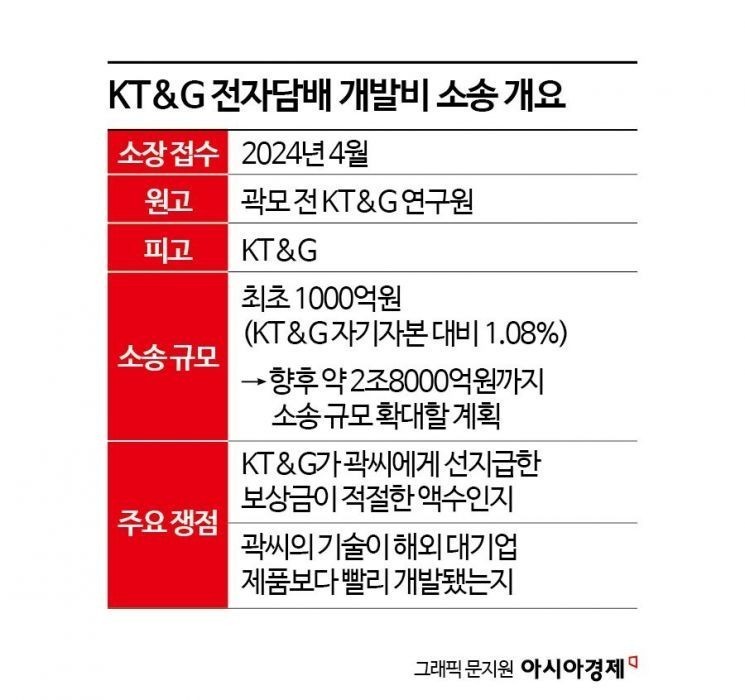
According to N.News, a former researcher at South Korean tobacco company KT&G has filed a lawsuit against the company, demanding payment for a development bonus for a job invention. The researcher claims to have invented the world's first rolled cigarette type e-cigarette technology but did not receive proper compensation. The first trial of this civil litigation case will be held on the 17th, and the amount of the lawsuit may increase to tens of billions of Korean won during the trial process.


According to reports, in 2005, the employee began researching and developing a heated tobacco product e-cigarette while working as a researcher at KT&G. In July of that year, he submitted a patent for the heating element. However, further research was terminated, with the employee claiming that his proposal was not adopted by the company. He left the company in 2010 due to restructuring, stating that KT&G inherited his invention but did not obtain permission for many of the technologies, despite applying for some technical patents.


In April of this year, the employee filed a lawsuit with the court, claiming to be the original developer of the "heating-type e-cigarette" and seeking compensation. KT&G had only paid a prepayment of 20 million Korean won (14,000 USD) from March 2021 to March 2022, along with a monthly technology consultant salary of 6.25 million Korean won (4,600 USD). The requested compensation amount is based on the loss incurred by the employee due to their technology not being patented overseas. He pointed out, "Since KT&G failed to obtain patents overseas, other global companies have been launching heating-type e-cigarettes in Korea since 2017 and profiting from it.


KT&G responded by stating that they have already compensated the employee appropriately and pointed out that these patents are not being utilized in the products currently being manufactured. They also mentioned that products sold by other international companies do not use the related technology.


However, the employee's claim amount has set a new record for the highest civil claim amount ever filed domestically. The initial lawsuit amount is 100 billion Korean won ($73.53 million), and the court service fees alone have already surpassed 300 million Korean won ($220,000).


The employee plans to increase the claim amount to several trillion Korean won based on the progress of the lawsuit. If it is increased to 2.8 trillion Korean won (2 billion US dollars), it will reach 30% of the company's equity. However, it is not ruled out that the court may resolve the dispute through mediation without a final judgment.


If mediation is unsuccessful, the court may issue a mediation decision by force through its authority.


We welcome news tips, article submissions, interview requests, or comments on this piece.

Please contact us at info@2firsts.com, or reach out to Alan Zhao, CEO of 2Firsts, on LinkedIn


Notice

1.  This article is intended solely for professional research purposes related to industry, technology, and policy. Any references to brands or products are made purely for objective description and do not constitute any form of endorsement, recommendation, or promotion by 2Firsts.

2.  The use of nicotine-containing products — including, but not limited to, cigarettes, e-cigarettes, nicotine pouchand heated tobacco products — carries significant health risks. Users are responsible for complying with all applicable laws and regulations in their respective jurisdictions.

3.  This article is not intended to serve as the basis for any investment decisions or financial advice. 2Firsts assumes no direct or indirect liability for any inaccuracies or errors in the content.

4.  Access to this article is strictly prohibited for individuals below the legal age in their jurisdiction.


Copyright


This article is either an original work created by 2Firsts or a reproduction from third-party sources with proper attribution. All copyrights and usage rights belong to 2Firsts or the original content provider. Unauthorized reproduction, distribution, or any other form of unauthorized use by any individual or organization is strictly prohibited. Violators will be held legally accountable.

For copyright-related inquiries, please contact: info@2firsts.com


AI Assistance Disclaimer


This article may have been enhanced using AI tools to improve translation and editorial efficiency. However, due to technical limitations, inaccuracies may occur. Readers are encouraged to refer to the cited sources for the most accurate information.

We welcome any corrections or feedback. Please contact us at: info@2firsts.com

FDA Unifies Tobacco Registration and Product Listing Form Across Product Categories
The U.S. FDA has consolidated two tobacco establishment registration and product listing forms into a redesigned Form FDA 3741 covering all regulated product categories, including e-cigarettes, heated tobacco products and nicotine pouches. The current requirements remain limited to domestic establishments. Separately, the FDA has proposed extending registration and product listing requirements to foreign manufacturers, signaling greater regulatory attention to manufacturing entities and product-level information across the tobacco and nicotine supply chain.
FDA
Sep.30
Australia Adds 6-Methylnicotine to Schedule 9 Prohibited Substances, Effective October 1
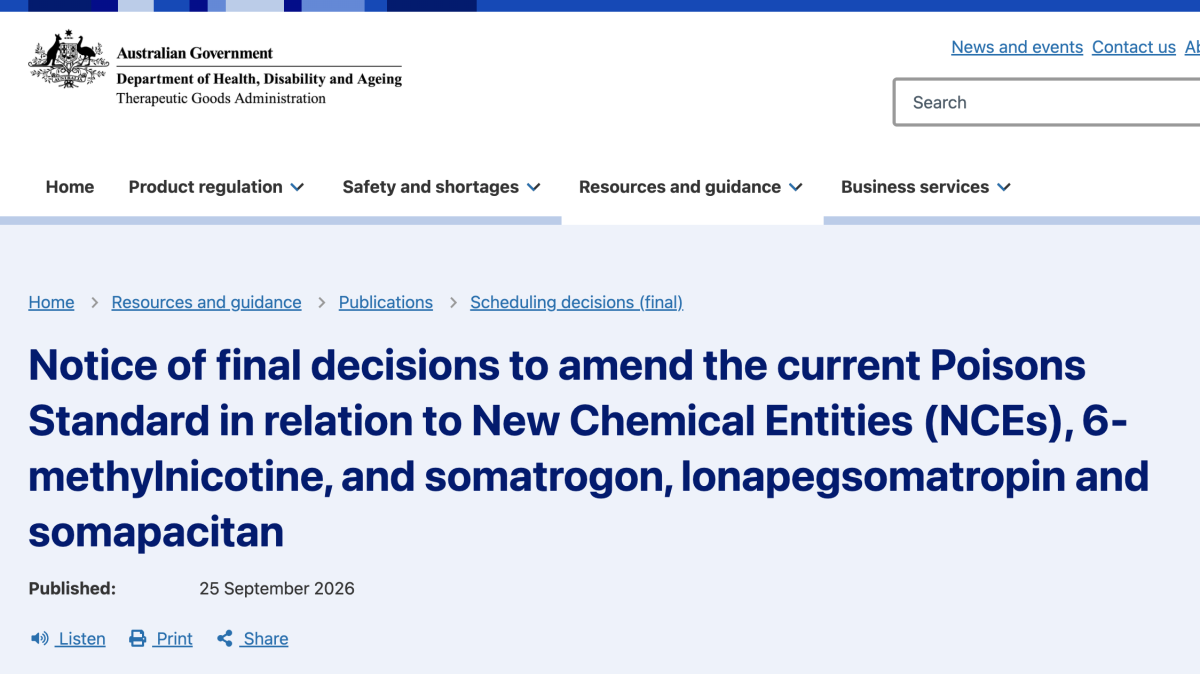
Australia's Therapeutic Goods Administration published a final decision on September 25 to classify 6-methylnicotine as a Schedule 9 prohibited substance under the Poisons Standard, effective October 1, 2026. TGA said the chemical has been reported in e-cigarette liquids sold in Australia and marketed as nicotine-free or nicotine alternatives, while evidence also indicates its use in preparations such as oral pouches. The government originally proposed a Schedule 7 classification but ultimately adopted the stricter Schedule 9 designation, citing acute toxicity, dependence risk, use in unapproved consumer products and misleading marketing.
News
Sep.29 by 2Firsts Perspectives
U.S. Health Groups Seek to Overturn FDA Enforcement Discretion for Pending PMTAs as Altria's Helix, NJOY and AVM Move to Intervene
American Vapor Manufacturers (AVM) and Altria subsidiaries Helix Innovations and NJOY filed separate motions on October 7, 2026, seeking to intervene on the FDA's side in a lawsuit challenging its enforcement guidance for certain e-cigarette and nicotine pouch products with pending premarket tobacco product applications (PMTAs). Seven public health and tobacco-control organizations, including the Campaign for Tobacco-Free Kids, sued the agency in July to overturn the policy. AVM argues that vacating the guidance could disrupt orders, inventory, retail distribution and investments in regulatory submissions.
Regulations
Oct.09
Japanese Addiction Psychiatrist Says Complete Abstinence Is Not Always the Goal of Harm Reduction | 2Firsts Interview
Complete abstinence is not always the goal of addiction treatment under a harm-reduction approach, Japanese psychiatrist Tomohiro Shirasaka told 2Firsts in Manila. In the interview, he discussed patients' quality of life, Japan's shift towards heated tobacco products, and the challenges of quitting smoking for people with mental illness. Drawing on addiction treatment work in the Philippines, he advocated support rather than punishment and questioned whether fear-based health warnings effectively address the reasons people continue smoking.
Nov.10
Product | BAT Launches VELO WRKS Nicotine Pouches in Sweden, Introducing Dual-Compartment Cans With Two Flavours
British American Tobacco (BAT)'s VELO brand launched the VELO WRKS nicotine pouch range in Sweden on November 2, 2026. The initial release features three Dual Can variants, each containing two separate flavours in a dual-compartment container. Each can holds 20 slim pouches with 8mg of nicotine per pouch and retails for SEK 52.99. According to VELO, the first release, Drop 1, is limited to 75,000 cans and will remain available until February 2027 or while stocks last. VELO positions WRKS as a platform for testing new product concepts and has introduced an online consumer feedback survey. EU trademark records show BAT applied to register VELO WRKS in March 2026 under Class 34, covering nicotine pouches, e-cigarettes, heated tobacco products and other tobacco-related goods.
product
Nov.03
German Tobacco Tax Revenue Falls 10.8% Through August as Tax-Paid Cigarette Volume Drops 12.6%
Germany collected €9.789 billion in total tobacco tax revenue from January through August 2026, down 10.8% from a year earlier, according to the Federal Ministry of Finance. Germany's tobacco tax base covers not only cigarettes and fine-cut tobacco but also heated tobacco and vaping liquids taxed as tobacco substitutes. The German Association of the Tobacco Industry and Novel Products, or BVTE, citing federal statistical data, said tax-paid cigarette volume fell 12.6% to 40.6 billion sticks. BVTE is using the latest figures to argue against further tax increases planned from 2027 through 2030, while Germany's parliament is scheduled to hold a first reading of the bill on September 24.
Sep.23