Philip Morris exploits loopholes in Israeli smoking ad ban

Dec.16.2022
Philip Morris exploits loopholes in Israeli smoking ad ban
Philip Morris International used legal loopholes to advertise cigarettes and e-cigarettes in Israel, according to a new study.

According to a report by the Jerusalem Post, a new study has shown that Philip Morris International (PMI) has exploited a loophole in the ban on Israeli tobacco advertising.


A study published in the journal "Tobacco Control" analyzed PMI's advertising spending over four years amongst the general population, Haredi community, Arabic speakers, and Russian speakers.


Dr. Amal Khayat stated that due to regulatory changes in tobacco product advertisements, a comparison was made of advertising expenditures for all Philip Morris cigarette brands and the IQOS brand (a type of heated tobacco stick that entered the local market in December 2016).


According to the study, advertising restrictions resulted in decreased marketing expenses for PMI. However, the company exploited legal loopholes in print media.


Even after the law had taken effect, the company continued spending almost 3 million in new shekels (about 6.078 million yuan) on advertising, with a focus on print media, according to chief researcher Yael Bar-Zeev. "While the law limits print advertising to one ad per newspaper, 40% of IQOS ads are huge, two-page ads, effectively doubling the product's ad space while still being considered a single ad under the law.


PMI also utilized QR codes to allow consumers to scan and access more information. According to the study, prior to the implementation of this law, PMI significantly increased its advertising efforts targeting the Haredi community, who previously had the lowest smoking rates in Israel.


Our data shows that since the launch of IQOS electronic cigarettes, 216 targeted advertisements have been released, with 55% aimed at the Haredi community, 6% aimed at Arab communities, and the remainder aimed at Russian-speaking audiences," said Bazelevs CEO. For regular cigarette brands, 87% of advertisements are targeted at the Haredi community.


We expect the company to focus on the demographic of Arab men, who have the highest smoking rates in Israel, rather than a population with almost no smokers," Bar-Zeev said.


After conducting research, the 24th Parliament has decided to eliminate the exemption for printed media advertisements, however, the implementation of this decision has been delayed for seven years. During this period, the use of coupons, QR codes, and advertisements for cigarettes without mandatory non-decorated packaging will be prohibited in printed media.


This document has been generated through artificial intelligence translation and is provided solely for the purposes of industry discourse and learning. Please note that the intellectual property rights of the content belong to the original media source or author. Owing to certain limitations in the translation process, there may be discrepancies between the translated text and the original content. We recommend referring to the original source for complete accuracy. In case of any inaccuracies, we invite you to reach out to us with corrections. If you believe any content has infringed upon your rights, please contact us immediately for its removal.


Product | GEEKBAR MATE 60K Launches in U.S. Channels With 15ml E-Liquid and Up to 60,000 Puffs
E-cigarette brand GEEKBAR has recently launched its new product, the GEEKBAR MATE 60K, on its official website. The product adopts a pod-based system, consisting of a reusable 900mAh device and a pod prefilled with 15ml of e-liquid and equipped with a built-in 200mAh battery, bringing the total battery capacity to 1100mAh. It supports both Regular and Pulse modes.
Mar.30 by 2FIRSTS.ai
Indonesian Health Ministry Says New Vape Rules Will Cover Age Limits, Advertising, and Product Standards
Indonesia’s Ministry of Health is preparing to implement regulations on electronic cigarettes, as provided for in Government Regulation No. 28 of 2024. The ministry said e-cigarettes will be regulated under provisions equivalent to those applied to conventional cigarettes, including age restrictions, advertising controls, product content standards, pictorial health warnings, and bans on use in smoke-free areas.
Apr.16 by 2FIRSTS.ai
Delaware Tax Proposal Targets Vapes, Nicotine Pouches and Other Tobacco Products
Delaware’s latest tobacco tax increase bill cleared its first House committee hurdle on April 22. Backed by House Speaker Melissa Minor-Brown, the bill would raise the cigarette tax from $2.10 to $3.60 per pack and increase taxes on moist snuff, vapor products and other tobacco products.
Apr.24 by 2FIRSTS.ai
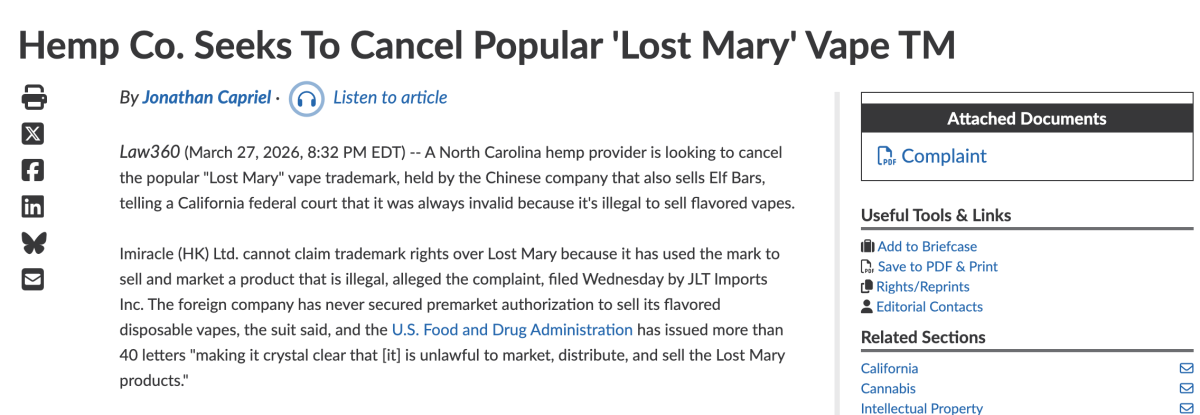
U.S. Company Seeks Cancellation of “Lost Mary” Vape Trademark
North Carolina hemp provider JLT Imports Inc. has filed suit in California federal court seeking cancellation of the “Lost Mary” vape trademark held by Chinese company Imiracle (HK) Ltd.
Mar.30 by 2FIRSTS.ai
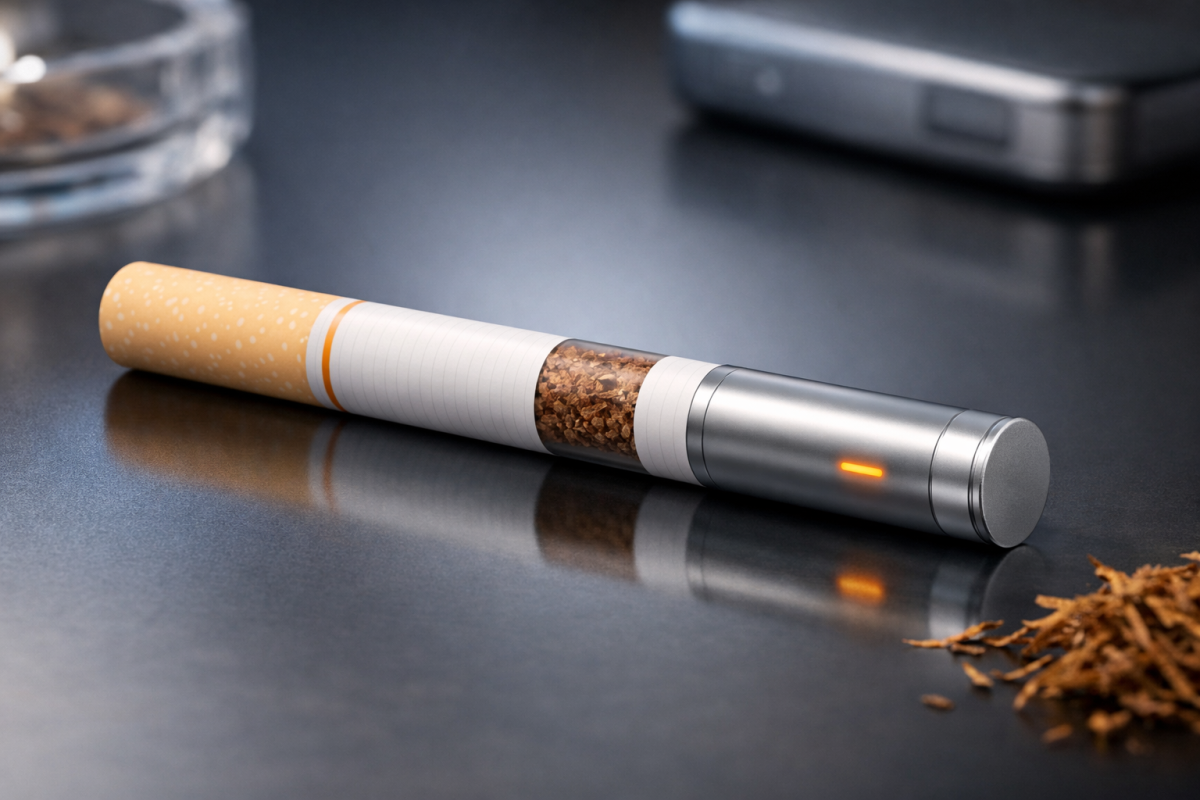
Special Report|Disposable Heated Tobacco? A China Tobacco Patent Reimagines the Heated-Tobacco Stick as a Self-Contained Product
A newly published China Tobacco patent proposes a holder-free heat-not-burn stick that integrates the filter, tobacco substrate, heating element, controller and power source into one cigarette-shaped product. It stands out not just for eliminating the external heating device, but for explicitly highlighting two less common goals in heated tobacco: restoring cigarette-like social sharing and enabling post-use recovery through a recoverable component group.
Innovation
Mar.18
Alan Zhao: What the Rise of Nicotine Pouches Means for Tobacco Retailers
Alan Zhao argues that nicotine pouches are no longer a niche alternative, but a force quietly reshaping the future of tobacco retail. For distributors and retailers, the real risk is not missing a trend—it is moving too late, after regulation tightens, shelf space hardens and the market begins to choose its winners.
Mar.31 by Alan Zhao | 2Firsts Perspectives