Correction Notice :
(Updated at 17:50, January 16, 2026, Beijing Time)
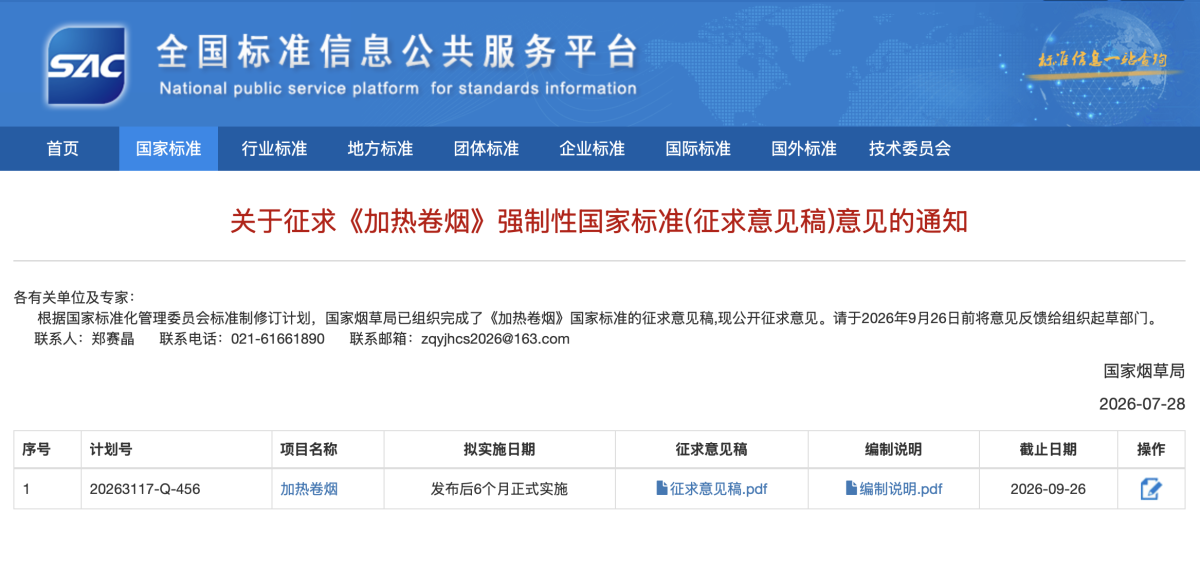
In the previous version of this article, the scope of customs tariff codes covered by the cancellation of export VAT rebates for e-cigarette products was not stated with sufficient precision. Upon verification, the rebate elimination applies to HS Code 24041200 (non-combustible inhalation products containing nicotine, excluding tobacco or reconstituted tobacco) and HS Code 85434000.90 (other electronic cigarettes and similar personal electronic vaporizing devices), rather than to all subcategories under HS Code 85434000.
Specifically, HS Code 85434000.10 (equipment and devices used to aerosolize products listed under HS Code 24041200 for inhalation) is not included in the scope of the rebate cancellation.
This article has been revised accordingly. Please refer to the updated version for the most accurate information. For further inquiries or discussion, please contact 2Firsts.
Key Points:
- China has formally eliminated export VAT rebates for e-cigarettes, placing manufacturers in a cost and risk environment without policy buffers. The rebate removal covers disposable e-cigarettes and other e-liquid-containing products that previously dominated the market, signaling the end of rebate-based cost offsetting.
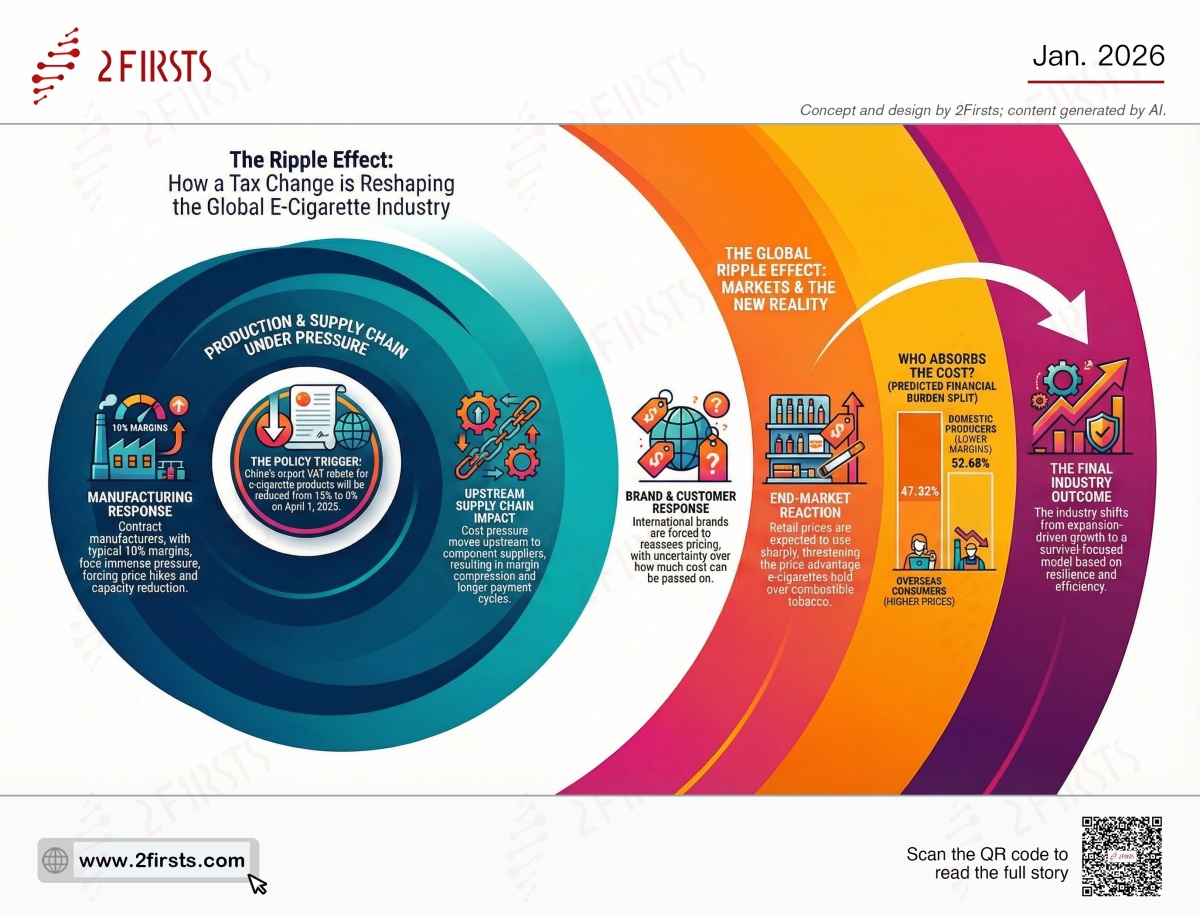
- Contract manufacturers are bearing the brunt of the impact, particularly those with thin margins and limited differentiation. With industry profit margins around 10%, the loss of the 13% rebate is forcing factories to raise prices, reassess orders and accelerate capacity reduction.
- Cost pressures are cascading across the supply chain while accelerating manufacturing offshoring. Repricing is spreading from factories to suppliers, brands and distributors, with Southeast Asia and the U.S. emerging as key destinations for overseas capacity.
- The shift reflects a broader industry reshaping driven by overlapping regulatory and cost pressures worldwide. As China’s policy changes converge with tightening regulation in major consumer markets, competition in e-cigarette manufacturing is moving from expansion to survival capacity.
2Firsts, January 15, 2025, Shenzhen
A survival-centered restructuring of the industry is being set in motion by China’s cancellation of export rebates. With export rebates withdrawn, e-cigarette manufacturing is entering a critical test of survival.
On January 9, 2026, China’s Ministry of Finance and State Taxation Administration jointly issued a notice adjusting export value-added tax (VAT) rebate policies for certain products. According to the announcement, the revised measures will take effect on April 1, 2026, with export VAT rebates for some product categories reduced directly to zero.
Against this backdrop, 2Firsts has recently conducted extensive outreach and interviews with e-cigarette manufacturers, international brands and clients, as well as logistics and supply-chain companies, to better understand how the adjustment to China’s export tax rebate policy is reshaping manufacturing operations, cost structures, and global production strategies.
Part I | Policy Set: How China’s Export VAT Rebates for E-Cigarettes Were Eliminated
China’s policy environment for e-cigarette exports is undergoing a change of clear symbolic significance.
Among the products covered by the latest policy adjustment, e-cigarette-related products have been explicitly included in the list subject to the elimination of export VAT rebates. According to the customs tariff codes specified in the policy annex, the relevant categories include HS Code 2404120000 (non-combustible inhalation products containing nicotine, excluding tobacco or reconstituted tobacco) and HS Code 85434000.90 (other electronic cigarettes and similar personal electronic vaporizing devices). Products classified under HS Code 2404120000—most notably disposable e-cigarettes, which had previously represented the dominant export format—are clearly brought under the rebate elimination.
At the implementation level, the eight-digit heading HS Code 85434000 comprises multiple subcategories. The rebate removal applies specifically to HS Code 85434000.90, while HS Code 85434000.10—which covers equipment and devices used to aerosolize substances listed under HS Code 24041200 for inhalation—is not included in the scope of the adjustment. As a result, the policy is primarily directed at finished e-cigarette products and related forms, rather than all atomization devices classified under the broader heading.
At the same time, not all nicotine-related products fall within the scope of the adjustment. Under the current policy framework, products containing tobacco or reconstituted tobacco that are consumed through heating rather than combustion, as well as orally consumed nicotine products classified under HS Code 24049100—commonly referred to as Modern Oral products—are not included in the rebate cancellation list.
According to customs export data, China’s e-cigarette exports totaled approximately $10.9 billion in 2024 and about $9.6 billion in the first 11 months of 2025. Of this amount, products classified under HS Code 2404120000—nicotine-containing, non-combustible inhalation products—accounted for roughly $8.21 billion in 2024 and about $6.66 billion during the first 11 months of 2025, representing the majority of e-cigarette exports and corresponding to disposable products that had long dominated the market.
Based on an assumed manufacturing profit margin of around 10%, the annual value of export VAT rebates for e-cigarettes in 2024 is estimated at between $830 million and $1.1 billion (approximately RMB 6–8 billion, or about $0.8–1.1 billion), with a broadly comparable scale in 2025.
By comparison, data disclosed by China’s Ministry of Finance show that total national export VAT rebates amounted to about RMB 1.93 trillion in 2024 (approximately $270 billion), with a budgeted RMB 2.25 trillion for 2025 (around $310–320 billion). On this basis, e-cigarette export rebates accounted for roughly 0.3% to 0.4% of the national total.
Part II | Shock at the Front Line: Contract Manufacturers Under Strain, Cost Pass-Through and Accelerating Offshoring
“It’s a bad thing—but it’s also a good thing.”
That was how one leading e-cigarette manufacturer told 2Firsts about the impact of China’s decision to eliminate export VAT rebates. In his view, the move delivers a direct shock to the industry’s existing structure, but may also mark a turning point after years of relentless price competition. “Everyone has been stuck in a race to the bottom,” he said. “This may finally bring it to an end.”
That ambivalence captures the prevailing mood across the industry: the disruption is real, but so is the sense that the change signals an irreversible structural reset.
The Hardest Hit: Contract Manufacturers Without Defenses
Within the supply chain, the effects of the rebate withdrawal are being felt most acutely not by brands or distributors, but by manufacturers—particularly pure contract factories with limited product differentiation, little brand presence and few research or design capabilities.
Industry executives say margins at such factories have long been thin. Typical operating profits for e-cigarette contract manufacturers hover around 10%, while the 13% export VAT rebate had effectively become a critical support for day-to-day operations. For factories already operating on razor-thin margins, the rebate often exceeded their entire manufacturing profit, turning it into a de facto fiscal buffer for survival.
“Most contract manufacturers were essentially staying alive on that 13% rebate,” one executive told 2Firsts.
With the rebate gone, raising prices has become almost the only option available to manufacturers. But not all producers have the leverage to pass costs downstream. Executives note that factories lacking differentiated products or bargaining power face growing difficulty pushing through price increases.
That divergence is now widely seen as an accelerant of industry shakeout. Manufacturers with no meaningful product barriers are expected to be the first to exit. Even before the rebate policy was formally announced, factory bankruptcies, restructurings and ownership transfers had already begun to appear across Shenzhen’s e-cigarette manufacturing cluster.
This assessment is also consistent with broader findings in trade policy research. The academic study VAT Rebates as Trade Policy: Evidence from China, which examines multiple export product categories rather than the e-cigarette sector specifically, finds that over a five-year observation period, negative adjustments to VAT export rebates are associated with an average 28.04% decline in the number of exporting firms serving a given destination. While not specific to e-cigarettes, the findings provide an empirical reference for assessing the risks currently facing manufacturers.
Price Increases and Cost Pass-Through: A Chain Under Tension
On the first Monday after the policy announcement, one contract manufacturer spent nearly an entire morning in internal meetings. The agenda was singular: how to respond.
The conclusion was straightforward—price increases were unavoidable. And the recalibration would not stop at the factory gate.
Industry participants say rebate withdrawal is triggering a broad repricing across the supply chain. As manufacturers reassess pricing, upstream suppliers and downstream brands and distributors are being forced to adjust in tandem.
An executive at a major Russian e-cigarette brand told 2Firsts that the company has begun recalculating its overall cost structure and evaluating the magnitude of price increases required. At the same time, a nicotine e-liquid producer said it had already initiated pricing reviews for consumer-facing bottled products, while still assessing bulk supplies sold to manufacturers. The reason, he said, is the expectation that factories may seek to shift part of the cost burden upstream.
From the manufacturing perspective, switching to cheaper suppliers is both a defensive response to cost pressure and a potential trigger for another round of competitive reshuffling.
Distributors share similar expectations. While price increases are widely seen as inevitable, concerns about market acceptance are growing. A distributor in Washington State told 2Firsts that the combined impact of China’s rebate withdrawal and a 95% state excise tax on e-cigarettes, effective January 1, 2026, could drive sharp jumps in retail prices.
“A disposable e-cigarette that used to sell for $20 could easily rise to $45 or more,” he said. “At that point, e-cigarettes lose their price advantage over combustible cigarettes.” Such a shift would effectively erase the category’s value proposition, putting consumer demand to a severe test.
Academic research also provides a quantitative view of this cost-sharing mechanism. The previously cited trade policy study, based on multiple export product categories, further finds that when VAT export rebates are reduced, approximately 47.32% of the resulting cost burden is passed on to overseas consumers through higher export prices, while the remaining 52.68% is absorbed by domestic producers in the form of lower pre-tax prices.
Manufacturing Offshoring: An Accelerating Option
As cost structures are recalculated, offshoring is moving from a long-term consideration to a more immediate agenda item.
Logistics providers say Southeast Asia—particularly Indonesia—is increasingly prominent in discussions about overseas production. One logistics company told 2Firsts that it began building export routes from Indonesia to multiple global destinations in 2025, and that volumes have continued to grow for more than a year.
According to the company’s estimates, the removal of the 13% rebate is rapidly narrowing the cost gap between manufacturing in China and Indonesia. As shipment volumes scale up, Indonesian exports could shift from shared cargo flights to dedicated freighter operations, driving logistics costs down further and accelerating convergence with China-based exports.
Manufacturers that already operate overseas facilities have a more nuanced view. One company with production in Malaysia said the advantages of its overseas plant are becoming more apparent, but emphasized that the calculus extends beyond tax policy to factors such as currency movements and rising costs for key inputs like batteries.
Another manufacturer that has invested in automated capacity in the United States said the rebate withdrawal would narrow the China–U.S. cost gap—but only marginally. In his view, the decisive variables are inventory levels in the U.S. market and the intensity of customs enforcement.
“My machines will start running when the U.S. market runs short,” he told 2Firsts. “As long as Chinese-made products continue to enter through grey-market channels, domestic manufacturing won’t be truly competitive.”
E-liquid producers are also weighing overseas expansion. One company said its offshoring plans were driven not by the rebate change itself, but by the cumulative effect of regulatory developments at home and abroad, with overseas capacity already under construction.
Overall, companies across e-cigarettes, e-liquids and—more recently—nicotine pouches are showing growing willingness to shift capacity abroad, with Southeast Asia, the United States and the Middle East emerging as primary destinations.
Grey Areas and Workarounds: Feasible Paths, Growing Discussion
Against the backdrop of the export VAT rebate withdrawal, discussions around potential workarounds have begun to surface within the industry, though they remain exploratory rather than consensus-driven.
From a technical perspective, adjusting product formats or export structures to mitigate the impact is not entirely unfeasible. Industry participants note that approaches such as shifting from disposable products to pod-based systems, or exporting empty devices and completing final steps—such as e-liquid filling—in destination markets, are operationally possible under existing rules. These strategies essentially involve reconfiguring product design or reallocating stages of the manufacturing process to align with different regulatory and tax treatments.
At the operational level, such discussions are increasingly translating into concrete areas of consideration. On the one hand, some companies have begun exploring product designs during new product development that could allow for greater flexibility under the current tax framework. On the other, renewed interest has emerged around “U.S.-based filling,” referring to the export of empty devices or semi-finished products followed by final e-liquid filling and assembly in the U.S., which some manufacturers are reassessing as a potential option.
By contrast, so-called grey-channel trade is not widely expected to change in substance as a result of the rebate adjustment. Industry participants note that even under grey-channel models, export declarations within China are typically completed in compliance with customs requirements, with informal or grey-market elements occurring primarily in destination countries or transit hubs. Previously, both grey-channel and fully compliant exports were declared legally at the point of exit from China and qualified for export VAT rebates; the current policy change does not alter this underlying framework.
Part III | The Policy Logic: Curbing Excess Capacity and Recalibrating Manufacturing
The elimination of export VAT rebates for e-cigarettes is, at its core, a policy move aimed at curbing excess capacity and restraining intensifying price competition.
The adjustment is directed squarely at China’s manufacturing base—particularly the Shenzhen-centered production cluster—where years of rapid expansion and increasingly disorderly competition have produced structural imbalances. Rather than targeting individual companies or specific products, the policy addresses the overall pace and mode of manufacturing growth.
In the global trading system, export VAT rebates are commonly used as a policy tool to support an industry’s participation in international competition. By refunding taxes paid at earlier stages of production, governments can lower exporters’ costs and enhance price competitiveness abroad. Conversely, when a country withdraws export rebates for a specific product or sector, it signals a shift away from fiscal support for international competitiveness, placing a greater share of cost and risk back onto market mechanisms.
That logic is particularly evident in the e-cigarette industry. Global e-cigarette manufacturing is now highly concentrated in China, supported by a complete and deeply integrated supply chain. As a result, Chinese manufacturers do not rely solely on price-based subsidies to compete internationally. In this context, export VAT rebates have functioned less as a competitive lever than as a cost buffer, and their removal represents a recalibration of manufacturing incentives rather than a retreat from global markets.
The adjustment to export rebates did not occur in isolation. In December 2025, shortly before the rebate elimination was announced, China’s State Tobacco Monopoly Administration (STMA) released a draft notice titled Notice on Further Strengthening Capacity Management in the E-Cigarette Industry for public consultation. The document called for guiding the industry toward a dynamic balance between supply and demand, while curbing disorderly expansion and so-called “involution-style” competition. The regulatory signal was directed at manufacturing capacity as a whole, rather than at individual firms.
Earlier policy signals had pointed in the same direction. In the Industrial Structure Adjustment Guidance Catalogue (2024 Edition), issued by China’s National Development and Reform Commission (NDRC) and implemented in 2024, e-cigarettes were formally classified as a “restricted” industry. While the designation does not amount to a prohibition, it reflects a policy intent to impose tighter constraints on capacity expansion and new investment in selected manufacturing sectors.
Market conditions suggest these signals were not disconnected from reality. Since 2023, even in the absence of meaningful manufacturing competition from other countries, price-based competition within Shenzhen’s e-cigarette manufacturing sector has intensified markedly.
Ordering practices among international clients have shifted. Where advance payment was once common, manufacturers are now often asked to begin production and complete export shipments after receiving deposits of around 10%. Remaining payments are frequently settled only after products are sold in overseas markets—or even bundled into subsequent orders. Inventory risk and working-capital pressure have thus been systematically transferred to manufacturers.
Financial strain has in turn propagated upstream along the supply chain. Payment cycles to component and raw material suppliers have lengthened, often stretching to several months or longer. As price competition continues to intensify, profit margins for both manufacturers and upstream suppliers have been steadily compressed. The Shenzhen manufacturing ecosystem is increasingly characterized by high capacity utilization, thin margins and heavy reliance on cash flow, leaving it markedly more vulnerable to changes in cost structures.
Against this backdrop, the withdrawal of export VAT rebates is no longer simply a technical tax adjustment. It has become part of a broader regulatory and industrial policy framework, working in tandem with capacity controls and structural constraints to exert more direct influence on how e-cigarette manufacturing competes—and how its costs are ultimately absorbed.
Part IV | A Shift in Competition: From Expansion to Survival Capacity
As the current round of adjustments unfolds, the e-cigarette industry is entering a phase that is both clearer in direction and more demanding in nature. Survival, rather than growth, is increasingly becoming the industry’s primary concern.
From a manufacturing perspective, capacity reduction in Shenzhen’s e-cigarette production base is no longer a question of whetherit will occur, but how and how fast. As costs become more transparent and room for price competition narrows, manufacturing capacity that lacks product differentiation and relies heavily on uniform pricing models is facing mounting pressure to exit. This process is not being driven by any single factor, but by the combined effects of cost structures, cash-flow constraints, compliance burdens and market conditions—making the outcome increasingly deterministic.
Running in parallel with capacity reduction is an acceleration of offshore production. This is not a simple relocation of manufacturing sites, but a form of structural spillover: some capacity is being eliminated, while some is being reallocated to other regions to adapt to changing cost and regulatory environments. Offshoring, in this sense, is no longer a strategic option but a natural extension of the capacity adjustment process. China is likely to remain a central hub for global e-cigarette manufacturing, but it will no longer absorb all marginal capacity.
More importantly, these changes are not occurring in isolation. Adjustments in regulation, taxation and market conditions across both manufacturing and consumer countries are taking effect within the same time window. As policy and market variables across different jurisdictions interact, the industry is experiencing more than a cyclical fluctuation—it is undergoing a structural reshaping. From manufacturing to distribution, and from domestic markets to overseas ones, each link in the e-cigarette supply chain is being repriced and reordered.
In this environment, the industry’s dividing lines are shifting. What will determine a company’s position in the next phase is no longer its pace of expansion or sheer scale, but its ability to sustain operations amid heightened uncertainty. Cash-flow discipline, tolerance for compliance costs, pricing power and multi-regional deployment are emerging as more decisive factors than cost advantages alone.
For the e-cigarette industry, this moment does not represent an endpoint, but a process of selection. As the supply chain is reshaped, some firms will exit, some will pivot, and others will settle into a new equilibrium. What is clear, however, is that a growth model built on policy buffers and price advantages is giving way to a competitive logic centered on survival capacity.
For the latest updates on China’s e-cigarette exports, stay tuned to 2Firsts’ coverage.
If you have any questions or suggestions, please feel free to contact us at: alan@2firsts.com