Key Points:
- rchitecture Shift: This China Tobacco patent proposes a holder-free heated-tobacco stick that moves power, heating and control functions from an external device into the stick itself.
- Technical Path: The design combines internal resistive heating with a mechanical temperature-control structure, suggesting a rethink not only of product format but also of the control architecture required to support it.
- Product Logic: In use logic, the concept can be read as a form of “disposable heated tobacco” — a self-contained terminal product rather than a conventional device-plus-stick system.
- Social Use: The patent explicitly identifies cigarette-like sharing as a design goal, extending the focus beyond portability to the social behavior built around the product.
- Category Implication: The filing may never become a commercial product, but it introduces a new technical and product logic into a global heated-tobacco market that has recently looked increasingly settled.
2firsts
2026年3月18日
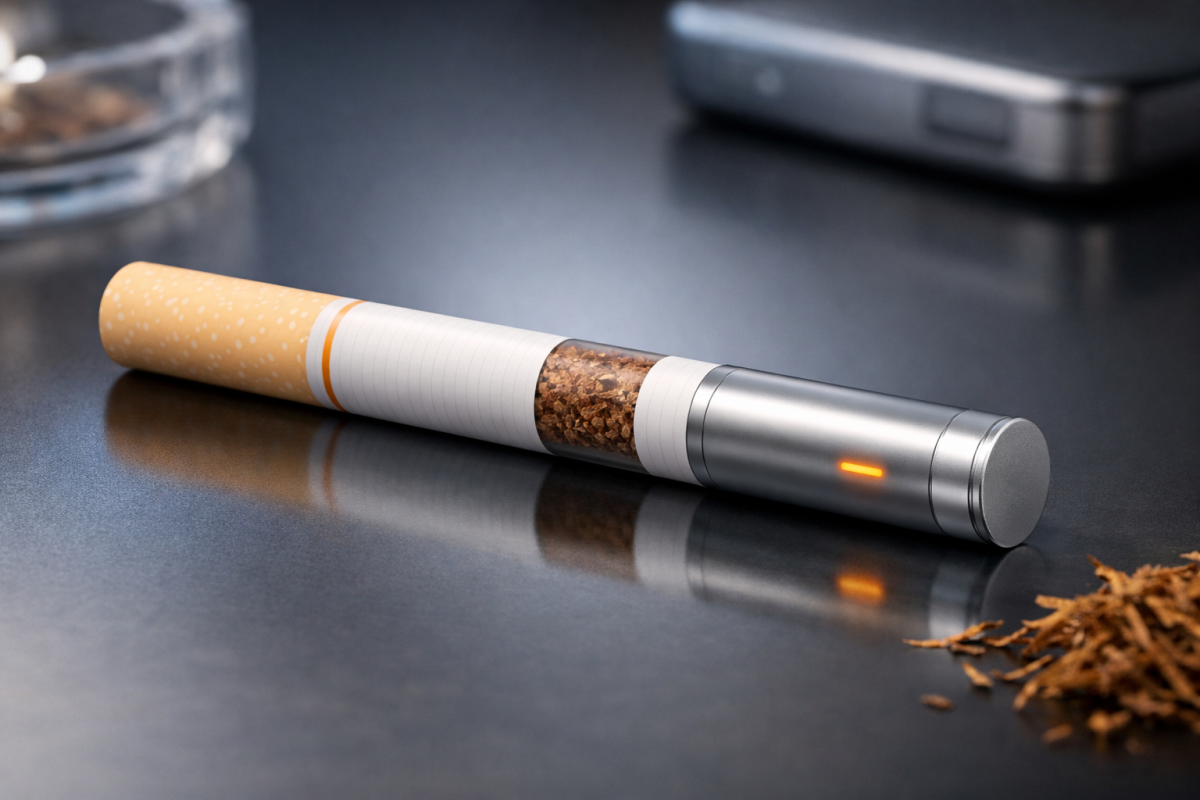
Most heated-tobacco products still follow a familiar two-part architecture: the stick is consumable, while a separate device provides power, heat and control. A patent published in China this month by China Tobacco’s Shanghai New Tobacco Products Research Institute proposes a different idea. Its “holder-free electrically heated, non-combustible tobacco stick” combines the filter section, tobacco section, heating element, controller and power source into a single cylindrical product that can be used independently. That matters because it suggests a different direction for heated tobacco—one in which the stick itself begins to absorb functions that have historically belonged to the device.
Patent Information
- Title of the Invention: A Holder-Free Electrically Heated Heat-Not-Burn Tobacco Stick
- Patent Application No.: 202411158146.9
- Application Date: August 21, 2024
- Publication Date: March 3, 2026
- Applicant: Shanghai New Tobacco Products Research Institute Co., Ltd.
What the patent covers
The core structure is straightforward. According to the filing, the product includes a filter section, a tobacco section, a heating element, a controller and a power source. The controller directs electrical energy from the power source to the heating element, which heats the nearby tobacco section to generate smoke or aerosol. The tobacco section is defined as a solid aerosol-generating substrate containing natural tobacco or reconstituted tobacco, while the filter is used to cool and/or filter the output. A wrapping material then joins these parts into an integrated cigarette-shaped cylinder.
The patent then adds a more consequential design layer: the heating element, controller and power source form a unified recoverable component group. The heating element protrudes from that group and can be inserted into the tobacco section. In effect, this is not simply a redesigned consumable for an existing holder. It is a proposal to move power and heating into the stick itself, turning heated tobacco from a device-dependent system into a more self-contained endpoint. The filing also says the wrapping process could be applied on traditional production lines, linking the concept not just to product design, but also to manufacturability.

The technical principle
Technically, the concept relies on internal resistive heating. The heating element is described as a needle-shaped or sheet-shaped resistive heater inserted into the tobacco section. The filing says this can increase contact area, improve utilization of the tobacco material and lower heating temperature. It also describes multiple airflow routes, including intake holes in the wrapping paper and gap-based channels that direct air through the tobacco section and filter. An inhalation-indicator area using thermochromic material can show when inhalation starts, when it ends, and whether the stick has already been used.
One of the more distinctive features is the control architecture. The filing says the controller functions as a temperature sensor and thermal breaker—specifically a thermal-expansion breaker using an airbag structure and/or bimetal structure. It also says this approach is meant to reduce the use of semiconductor components in a high-temperature environment. Before use, an insulating tab keeps the circuit open. Once removed, the circuit closes and the heater begins working. As temperature rises, the thermal structure repeatedly opens and closes the circuit to maintain a constant-temperature control cycle, while a protection circuit terminates the process once voltage falls to a threshold.
The onboard energy design also points to a single-stick use case rather than a reusable-device profile. The patent lists storage ranges from up to 80mWh through 380–400mWh, and states elsewhere that 80mWh or above is needed to complete the basic use of a full stick, while 400mWh is treated as the upper control boundary. It also sets ranges for storage-unit weight and volume, and says smaller, lighter storage is better suited to paper wrapping and a cigarette-like form factor.
Why the idea resembles disposable vapes
This is where the phrase disposable heated tobacco becomes analytically useful. The comparison works not because the products use the same substrate, but because they share a similar product logic: power and heating are embedded in the terminal product rather than outsourced to a reusable external device. In that sense, the patent appears to borrow part of the convenience model associated with disposables—simpler use, fewer components to carry, and less dependence on a hardware ecosystem. The patent itself frames current heated-tobacco systems as cumbersome because users must carry more items, follow a more complex process and clean residue from the device after repeated use.
The analogy, however, has limits. Disposable vapes heat e-liquid; this patent heats a solid tobacco substrate containing natural tobacco or reconstituted tobacco. And unlike a pure throwaway vape, the design explicitly builds in a recoverable component group and recommends that used sticks be retained and collected so the recoverable parts can be reused. So “disposable heated tobacco” works best as a description of the use logic—a self-contained, single-use terminal format—rather than as a literal one-to-one equivalent of disposable vaping hardware.
Two features stand out: social sharing and recoverability
Two parts of the patent deserve special attention because they point to design priorities beyond miniaturization.
The first is social sharing. The background section says existing heated-tobacco systems weaken one of the traditional cigarette’s social functions because sticks depend on a dedicated holder and therefore cannot be casually shared “like traditional cigarettes.” The patent repeatedly presents its integrated format as a way to restore that pattern. In its discussion of beneficial effects, it explicitly says the product can be shared with others like a conventional cigarette, restoring tobacco’s original social characteristic. That is unusual language in a category whose development has often centered more on device performance than on shared-use behavior.
The second is recoverability. Rather than presenting the stick as purely disposable, the patent proposes that the heating element, controller and power source be grouped into a recoverable module, and recommends that consumers retain used sticks so sales units can collect them and reuse the recoverable parts. The inhalation-indicator design also helps users identify whether a stick has already been used, which the filing links to retention and environmental handling. In other words, the concept tries to combine the convenience logic of disposables with at least a partial recovery loop for embedded electronics.
What remains uncertain
This remains a patent publication, not a commercial product. The filing lays out a structure, control logic and a set of claimed benefits, but it does not establish market-ready answers on aerosol consistency, real puff count, storage safety, logistics, recovery execution or regulatory classification across markets. What it does establish is narrower but still meaningful: a concrete attempt by a China Tobacco research entity to rethink heated tobacco as a self-contained, cigarette-shaped terminal product rather than a stick designed around a permanent holder.
2Firsts Editor’s Note:
The rise of disposable vapes was not merely a product innovation. It reshaped product design, consumer behavior and channel economics, helping drive the category’s rapid global expansion after 2020. Could disposable heated tobacco have a similar effect? This patent may never become a commercial product. But it does introduce a new line of thinking for the global heated-tobacco sector.
At a time when both product formats and market structure in heated tobacco increasingly look settled, the appearance of new technologies and new product logic may be one way that equilibrium gets disrupted. For the category as a whole, that is likely a constructive signal.
Follow 2Firsts for the latest global technologies and trends in next-generation tobacco products.
For the full patent information (PDF), please contact: info@2firsts.com
Cover image: Concept rendering based on the product described in the patent | Illustration by 2Firsts

Disclaimer
This article is provided solely for professional research, industry discussion, and informational purposes. Any references to brands, companies, products, technologies, or policies are made for factual reporting and analytical purposes only, and do not constitute endorsement, recommendation, promotion, or advertising by 2Firsts.
Nicotine-containing products, including but not limited to cigarettes, e-cigarettes, heated tobacco products, and nicotine pouches, carry significant health risks. Readers are responsible for complying with all applicable laws and regulations in their respective jurisdictions, including age restrictions and access limitations.
The information contained in this article should not be regarded as investment, legal, medical, regulatory, or commercial advice. While 2Firsts strives to ensure the accuracy and reliability of its content, it does not assume liability for any direct or indirect loss arising from errors, omissions, inaccuracies, or reliance on the information contained herein.
This article is not intended for individuals below the legal age for accessing tobacco or nicotine-related information in their jurisdiction.
Copyright Notice
This article is either original content produced by 2Firsts or content reproduced, translated, summarized, or adapted from third-party sources with attribution where applicable. The intellectual property rights of the original content remain with 2Firsts or the respective original rights holders.
No individual or organization may copy, reproduce, distribute, republish, modify, translate, or otherwise use this content without prior authorization. Any unauthorized use may result in legal action.
For copyright-related inquiries, corrections, or removal requests, please contact: info@2firsts.com.
AI-Assisted Translation and Editing Notice
Portions of this article may have been translated, edited, or reviewed with the assistance of artificial intelligence tools to improve efficiency and readability. Due to the limitations of AI-assisted translation and editing, discrepancies, omissions, or inaccuracies may exist when compared with the original source.
Where applicable, readers are advised to refer to the original source for the most complete and accurate information. If you identify any errors or believe that any content infringes upon your rights, please contact us at info@2firsts.com, and we will review and address the matter promptly.