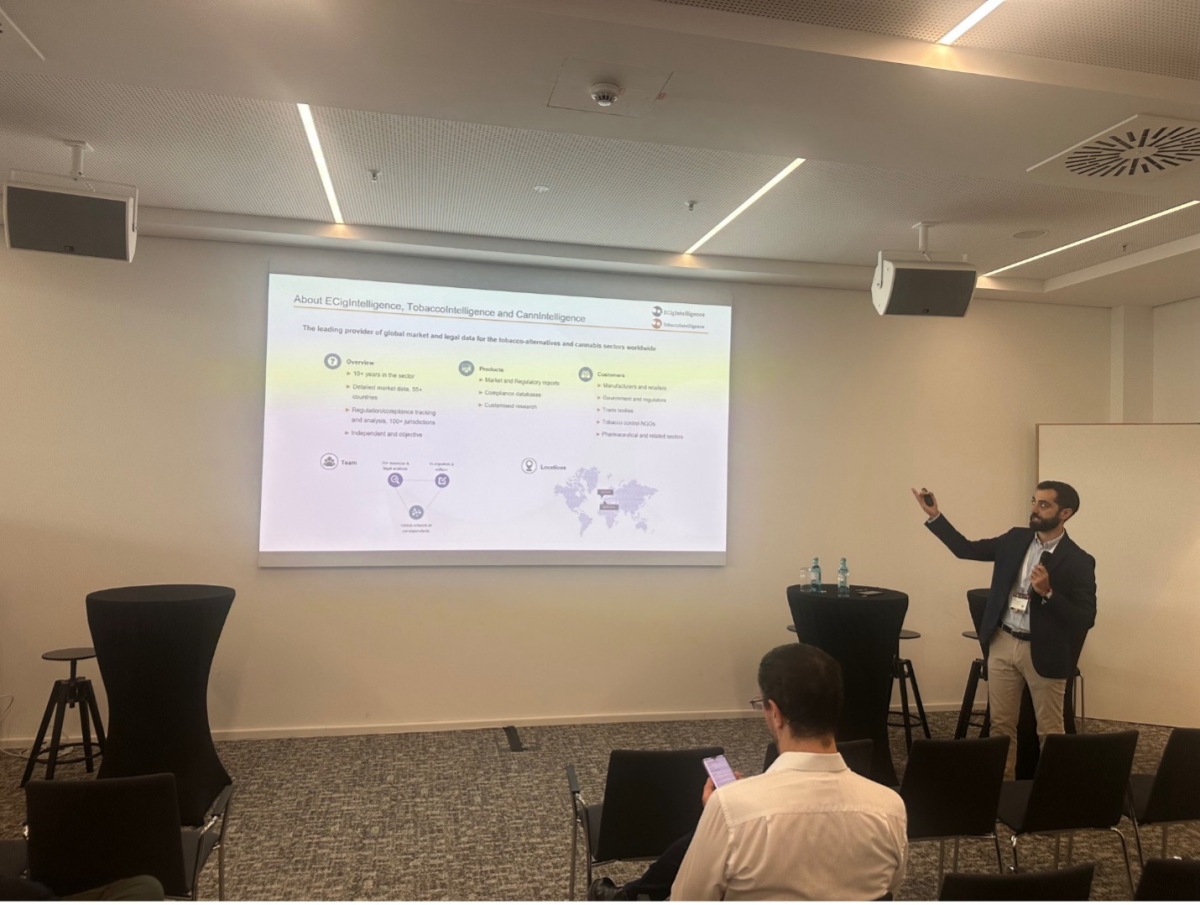
2Firsts, September 18, 2025, Dortmund, Germany (By Taco Tuinstra) —— During a Sept. 18 presentation at the InterTabac trade fair in Dortmund, Germany, Pablo Cano Trilla of Tamarind Intelligence provided an overview of how different regulatory approaches, political debates and enforcement trends are shaping the business environment for novel nicotine products. Tamarind Intelligence is a leading research and intelligence firm specializing in novel tobacco and nicotine products. Its subsidiary, EcigIntelligence, focuses on the e-cigarette sector, providing ongoing analysis of global policy developments, market trends, and regulatory changes.
A look at the global map revealed stark regional differences. For example, while the North American market is dominated by vapes, tobacco heating products (THP) prevail in Europe, the Middle East and Africa (EMEA) in terms of value. Nicotine pouches are the fastest growing category in both regions.
Tamarind Intelligence estimates the value of the global market for novel nicotine products at $80 billion, but Trilla noted that the market for traditional tobacco products is still 10 times bigger—which suggests considerable potential for growth as smokers transition to less harmful options.
Risks Ahead
The extent to which next-generation products can capitalize on that potential will be determined largely by regulation. Trilla identified several risks, including outright product bans, flavor restrictions and high taxes. France will ban nicotine pouches next year. Russia—one of the world’s largest vape markets—wants to give its regions leeway to ban vapes, paving the way for a ban across the entire federation.
Worldwide, at least 20 jurisdictions are considering flavor bans, including in the U.S., Canada and the EU. While a relatively small market in the global context, developments in the EU are significant because other jurisdictions tend to follow its example, Trilla said.
The political climate and most stakeholders are negative toward new nicotine products, according to Trilla. More than half of the 100 countries Tamarind tracks oppose the harm reduction potential of alternative products. Only 20 percent of the 700 stakeholders tracked by Tamarind hold positive views of harm reduction.
The South American market is especially hostile toward new products, with outright bans in Brazil and Argentina.
Stronger Enforcement
On the positive side, said Trilla, the United States has been stepping up its enforcement against noncompliant products, which suggest a clearer path for market authorization. In a recent action, authorities seized a record $86.5 million in illicit products.
The prevailing nationalistic political climate, Trilla suggested, will favor marketing authorizations for U.S.-made products over Chinese offerings. The Trump administration also appears to have a more favorable view of nicotine pouches than its predecessors.
European Tax Plans
The dominant themes in the EU are taxes and the upcoming revision to the Tobacco Product Directive. Modern oral companies have been alarmed about the European Commission’s proposed tax rates for nicotine pouches; the envisioned minimum tax levels are so high that they could put the sector out of business, according to Trilla.
Tamarind expects the new tax directive to pass, but not in its current form. The proposed rates on nicotine pouches will likely be reduced due to considerable opposition from member states, Trilla said.
Despite the EU’s insistence that all nicotine products are the same, the Commission’s plans would tax THPs at only 50 percent of the rate applied to cigarettes per 1,000 units. The intention to tax consumables rather than the device will boost innovation in hardware, Trilla predicted. More efficient devices, he said, will reduce the amount of tobacco consumed, with some devices allowing consumers to use the same stick twice.
As the EU is preparing to revise its Tobacco Product Directive, the big question is whether it will ban pouches, just like it has prohibited snus. Trilla expects pouches to remain legal at the EU level, in part due to strong opposition in the European Parliament. Of course, that will offer little consolation to modern oral companies, as some of the most populous EU states, such as France, have already banned pouches at the national level.
The More You Know…
Interestingly, the more politicians know about the new nicotine products, the less negative they tend to be about the category. A Tamarind survey among EU politicians revealed striking differences in attitudes between those who declared to have some knowledge of the category and how.
While acknowledging the challenges, Trilla was encouraged by the stronger enforcement against noncompliant products, not just in the U.S. but also in other markets. Proper enforcement, he said, will make more people comfortable with the sector and create climate that allows industry to reach its potential.
For more on-the-ground coverage, visit the 2Firsts InterTabac Special Section.