Germany Urged to Ban Disposable Vapes Following European Examples

Nov.20.2024
Germany Urged to Ban Disposable Vapes Following European Examples
The German government is set to vote on amendments to the Electrical and Electronic Equipment Act, which include addressing disposable vapes. Environmental groups argue that the government's recycling plans are insufficient to tackle environmental issues and are calling for a ban on disposable vapes, following the example of other European countries.

According to Presse Portal on November 20th, the Federal Council of Germany will be voting on an amendment to the Electrical Law. This approval pertains to the handling of disposable e-cigarettes.


According to an evaluation by the German Environmental Aid organization (DUH), the federal government's planned retail recycling regulations are insufficient to solve the growing problem of waste piles, environmental issues, and fire hazards caused by improper disposal of disposable e-cigarettes.


Federal Executive Director Barbara Metz commented, "As called for by the Senate Committee on Environment, federal states must implement a ban on disposable e-cigarettes in the Electrical Law. Germany consumes at least 60 million disposable e-cigarettes each year, which could potentially lead to fires if they are improperly disposed of as regular trash or placed in yellow waste bins due to the lithium batteries they contain."


"The proposal by the federal government to start a retail recycling program in July 2026 is not only too late but also unlikely to change the disastrous way disposable devices are being handled. This is because there is no incentive for consumers to actually return their disposable devices to the stores. Most importantly, these disposable devices are inherently wasteful and harmful to health. Other European countries have already recognized this issue: aside from Belgium and France, the UK is now also banning disposable e-cigarettes. We urge states in the federal government to contribute to this effort and for Germany to follow suit."


We welcome news tips, article submissions, interview requests, or comments on this piece.

Please contact us at info@2firsts.com, or reach out to Alan Zhao, CEO of 2Firsts, on LinkedIn


Notice

1.  This article is intended solely for professional research purposes related to industry, technology, and policy. Any references to brands or products are made purely for objective description and do not constitute any form of endorsement, recommendation, or promotion by 2Firsts.

2.  The use of nicotine-containing products — including, but not limited to, cigarettes, e-cigarettes, nicotine pouchand heated tobacco products — carries significant health risks. Users are responsible for complying with all applicable laws and regulations in their respective jurisdictions.

3.  This article is not intended to serve as the basis for any investment decisions or financial advice. 2Firsts assumes no direct or indirect liability for any inaccuracies or errors in the content.

4.  Access to this article is strictly prohibited for individuals below the legal age in their jurisdiction.


Copyright


This article is either an original work created by 2Firsts or a reproduction from third-party sources with proper attribution. All copyrights and usage rights belong to 2Firsts or the original content provider. Unauthorized reproduction, distribution, or any other form of unauthorized use by any individual or organization is strictly prohibited. Violators will be held legally accountable.

For copyright-related inquiries, please contact: info@2firsts.com


AI Assistance Disclaimer


This article may have been enhanced using AI tools to improve translation and editorial efficiency. However, due to technical limitations, inaccuracies may occur. Readers are encouraged to refer to the cited sources for the most accurate information.

We welcome any corrections or feedback. Please contact us at: info@2firsts.com

South Korea Extends Vape Rules to Unmanned Stores After Bringing Synthetic Nicotine Under Tobacco Law
South Korea's Ministry of Gender Equality and Family said on September 14 that it plans to designate unmanned e-cigarette stores as businesses where minors are prohibited from entering or working. Operators would be required to verify customers' ages and display notices restricting access by minors. The proposal is open for public comment through October 6. The move follows an April expansion of South Korea's statutory tobacco definition that brought products made with natural or synthetic nicotine under the Tobacco Business Act. Nicotine-free liquids and products using nicotine analogues such as 6-methylnicotine, however, remain an emerging regulatory issue.
Sep.21
FRE and ALP Push Modern Oral to 48% of Q2 Sales as Turning Point Brands Changes CEO and Lowers Profit-Guidance Ceiling
Turning Point Brands said Executive Chairman David E. Glazek will become CEO on October 1, replacing Graham Purdy, who is stepping down for personal reasons. The company narrowed its 2026 adjusted EBITDA outlook to $70 million-$80 million from $70 million-$90 million while maintaining Modern Oral gross sales guidance of $330 million-$350 million and net sales guidance of $260 million-$270 million. In the second quarter, Modern Oral net sales rose 128% to $68.4 million and accounted for 48% of company-wide net sales. Adjusted EBITDA fell 50% year over year. TPB shares closed about 10% lower on September 21.
Market
Sep.22 by 2Firsts Perspectives
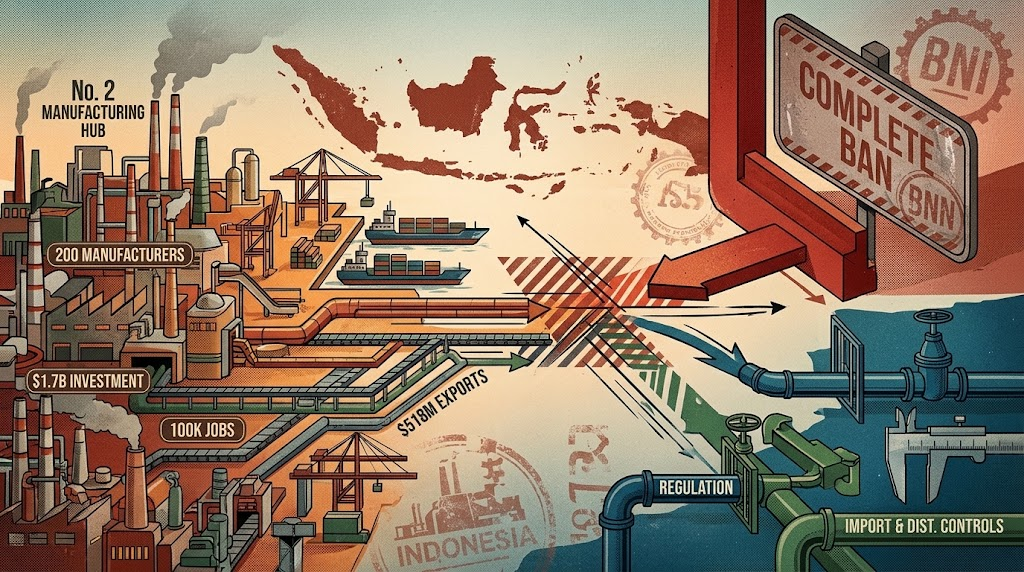
Special report|Indonesia's Vape Industry Has 200 Manufacturers and $1.7 Billion in Investment. Could a Regulatory Divide Derail Its Rise as the World's No. 2 Manufacturing Hub After Shenzhen?
Indonesia's Ministry of Industry said at a November 3, 2026, policy forum that the country has about 200 electronic cigarette companies, Rp31 trillion (approximately $1.71 billion) in cumulative industry investment and around 100,000 jobs across the supply chain. The National Narcotics Agency is seeking a comprehensive ban on vape use and circulation, while the industry ministry favors tighter import, product-standard and distribution controls. Indonesia exported approximately $518 million in vaping products in 2025, and Chinese manufacturers including Smoore, GEEKVAPE and Jinjia Group have established local operations. An international logistics specialist interviewed by 2Firsts said more Chinese vape companies began production in Indonesia from the second half of 2025, accompanied by increased shipments of manufacturing equipment and investment in logistics facilities. The regulatory debate comes as Indonesia expands its role in international vaping manufacturing.
Special Report
Nov.05
German Tobacco Tax Revenue Falls 10.8% Through August as Tax-Paid Cigarette Volume Drops 12.6%
Germany collected €9.789 billion in total tobacco tax revenue from January through August 2026, down 10.8% from a year earlier, according to the Federal Ministry of Finance. Germany's tobacco tax base covers not only cigarettes and fine-cut tobacco but also heated tobacco and vaping liquids taxed as tobacco substitutes. The German Association of the Tobacco Industry and Novel Products, or BVTE, citing federal statistical data, said tax-paid cigarette volume fell 12.6% to 40.6 billion sticks. BVTE is using the latest figures to argue against further tax increases planned from 2027 through 2030, while Germany's parliament is scheduled to hold a first reading of the bill on September 24.
Sep.23
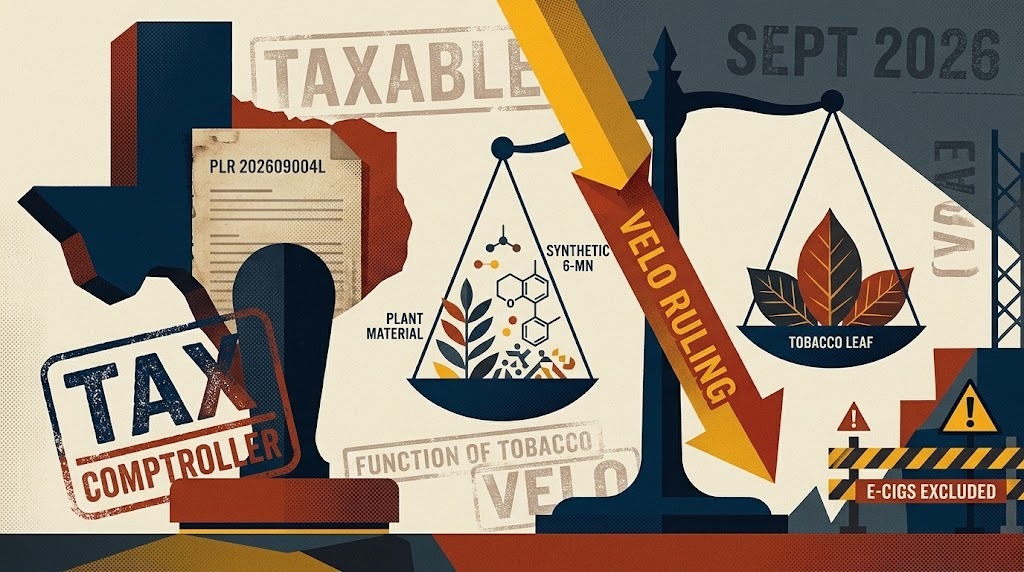
Texas Extends Tobacco Tax Interpretation to a 6-Methylnicotine Product, Citing VELO Ruling
The Texas Comptroller of Public Accounts ruled in September 2026 that a combustible product made with non-tobacco plant material and 6-methylnicotine (6-MN), a synthetic nicotine analog, qualifies as a taxable tobacco product. The applicant said the product contained neither tobacco leaf nor measurable conventional nicotine. The determination applies reasoning from a May Texas Supreme Court decision involving VELO nicotine pouches, finding that the plant material and 6-MN together perform the functions of tobacco in a conventional smoking product. The ruling carries applicable tax, licensing and reporting obligations but is limited to the facts submitted by the taxpayer. It does not establish a blanket tax classification for all 6-MN products or extend the same conclusion to e-cigarettes.
Regulations
Nov.06
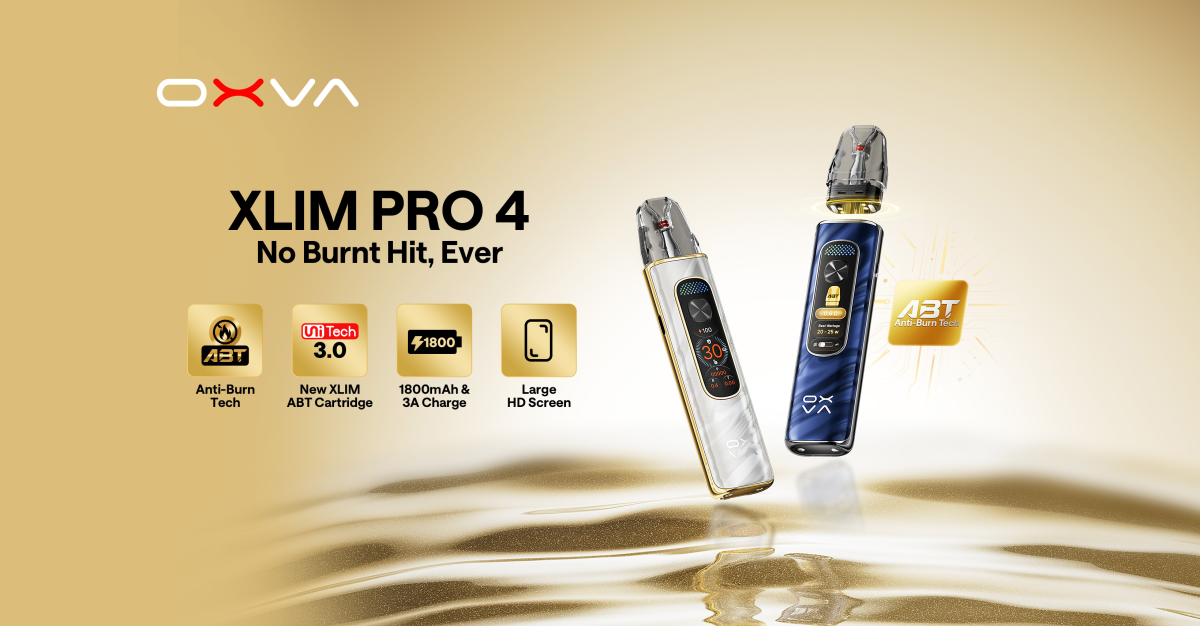
Product | OXVA Introduces XLIM PRO 4 With Liquid-Level Anti-Burn Technology and Dedicated Pods
Vaping brand OXVA introduced the XLIM PRO 4 refillable pod system in October 2026, featuring Anti-Burn Tech (ABT) based on smart e-liquid-level detection. The system can issue refill alerts and stop power output when e-liquid levels become too low. ABT requires the XLIM PRO 4 device and a dedicated XLIM ABT cartridge. Standard XLIM pods remain compatible but do not support ABT protection. OXVA previously introduced temperature-based anti-burn technology in the XLIM Pro 2 DNA, developed with Evolv. The new device features a 1,800mAh battery, 5–30W output and a 0.98-inch HD color screen. OXVA's official store lists the device at $37.90 and dedicated ABT replacement cartridges at $12.99. Independent testing confirmed the low-liquid protection response but recorded varying cartridge lifespans.
product
Oct.30