New Zealand Government Neglects E-Liquid Regulation, Thousands of Retailers at Risk

Regulations by 2FIRSTS.ai
Apr.10.2024
New Zealand Government Neglects E-Liquid Regulation, Thousands of Retailers at Risk
Thousands of e-liquid retailers in New Zealand may escape legal consequences due to lack of government oversight.

According to the New Zealand media nzdoctor on April 10, if the New Zealand government continues to turn a blind eye and invest in the wrong areas, thousands of e-liquid retailers may potentially operate outside the law. Letitia Harding, CEO of the Asthma and Respiratory Foundation NZ, stated that the news of Health Ministry layoffs was regrettable but not surprising.


According to our understanding, they are not the ones enforcing the law on the thousands of e-liquid retailers. What we hope to see is the government shifting its focus towards investing in this area.


A survey conducted last year revealed that the Department of Health's e-liquid Regulatory Authority (VRA) has only one full-time employee, while the regulatory manager works only 10 hours per week, equivalent to a total of three-and-a-half full-time employees.


The foundation visited an e-liquid retailer last week and observed many non-compliant products. Hardin stated that the government has not committed to limiting the number of specialist e-liquid retailers (SVRs), of which there are currently 1530, so there is a need for continued investment in e-liquid compliance.


They need to invest in people who conduct door-to-door product inspections to ensure all products meet regulatory requirements. Perhaps this task should not fall on the Department of Health, but instead be handled by the Department of Legal Affairs, similar to how alcohol selling venues are regulated. Without this investment, our young people will continue to be addicted to e-cigarettes.


According to information provided to the foundation under the Official Information Act (OIA), the e-liquid regulatory authority has initiated an investigation into a company that operates two e-liquid websites for failing to comply with new e-liquid laws. This investigation comes after examining 29 websites to ensure compliance with safety requirements, including the company's failure to include removable batteries with products, not meeting nicotine strength labeling requirements, and not installing child safety mechanisms.


In order to protect the company's right to a fair trial, the Health Department has not disclosed the name and website domain of the company. The department has confirmed that no fines have been issued to date, but stated that "violations are not necessarily punishable offenses" in this case.


We welcome news tips, article submissions, interview requests, or comments on this piece.

Please contact us at info@2firsts.com, or reach out to Alan Zhao, CEO of 2Firsts, on LinkedIn


Notice

1.  This article is intended solely for professional research purposes related to industry, technology, and policy. Any references to brands or products are made purely for objective description and do not constitute any form of endorsement, recommendation, or promotion by 2Firsts.

2.  The use of nicotine-containing products — including, but not limited to, cigarettes, e-cigarettes, nicotine pouchand heated tobacco products — carries significant health risks. Users are responsible for complying with all applicable laws and regulations in their respective jurisdictions.

3.  This article is not intended to serve as the basis for any investment decisions or financial advice. 2Firsts assumes no direct or indirect liability for any inaccuracies or errors in the content.

4.  Access to this article is strictly prohibited for individuals below the legal age in their jurisdiction.


Copyright


This article is either an original work created by 2Firsts or a reproduction from third-party sources with proper attribution. All copyrights and usage rights belong to 2Firsts or the original content provider. Unauthorized reproduction, distribution, or any other form of unauthorized use by any individual or organization is strictly prohibited. Violators will be held legally accountable.

For copyright-related inquiries, please contact: info@2firsts.com


AI Assistance Disclaimer


This article may have been enhanced using AI tools to improve translation and editorial efficiency. However, due to technical limitations, inaccuracies may occur. Readers are encouraged to refer to the cited sources for the most accurate information.

We welcome any corrections or feedback. Please contact us at: info@2firsts.com

Smoke-Free Business Hits 42% of Q2 Net Revenue as PMI’s First TNFD Report Covers Single-Use Electronics, Critical Raw Materials and IQOS Repairs
Philip Morris International has published its first report aligned with the Taskforce on Nature-related Financial Disclosures, bringing its electronics supply chain and the use and end-of-life stages of smoke-free devices and consumables into its nature-related assessment. PMI said its smoke-free business accounted for about 42% of total net revenues in the second quarter of 2026. The report says non-circular electronic products, particularly single-use items, can increase consumption of limited natural resources and also details an IQOS repair pilot. A 2040 circularity scenario tests assumptions including a 50% reduction in product waste-related costs, 10% raw-material savings and a 25% substitution rate for refurbished products versus new products.
Sep.23
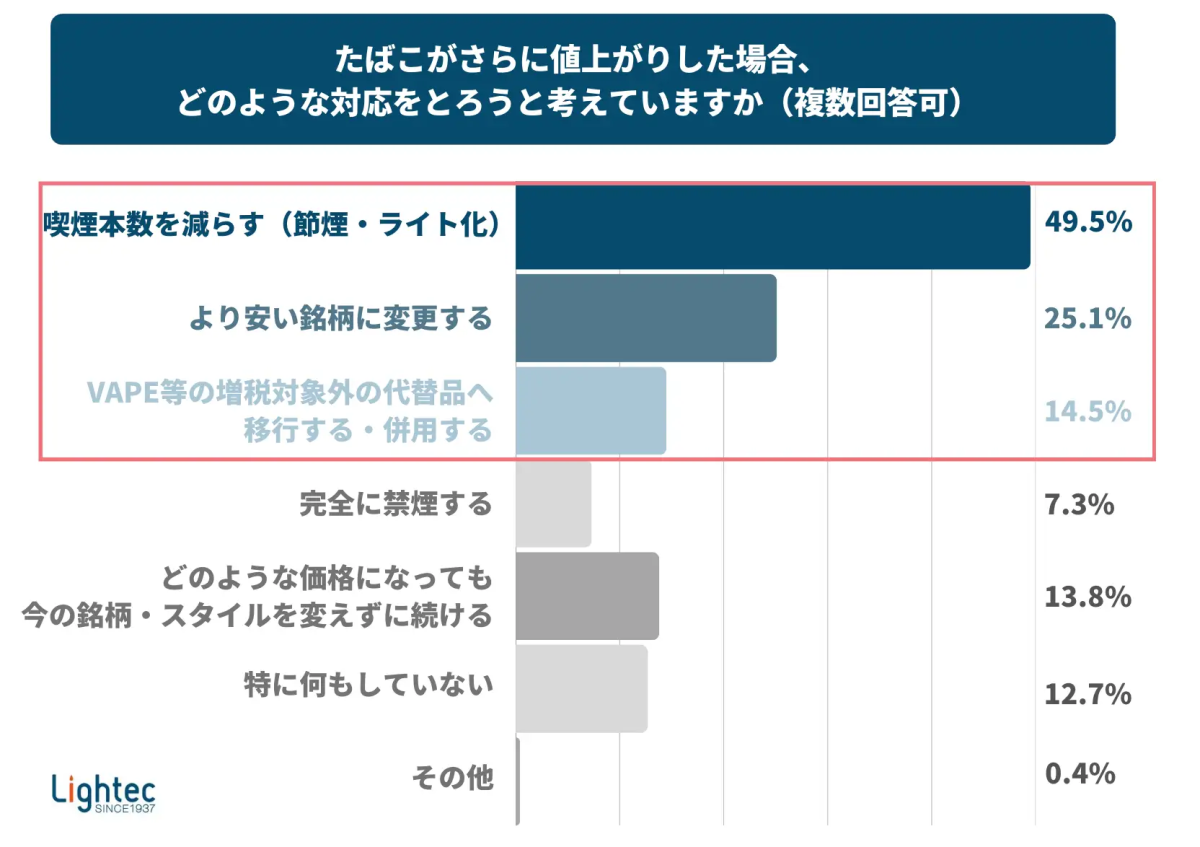
Japan Survey Finds 49.5% Would Cut Tobacco Use if Prices Rise, 64.6% Show Interest in Nicotine-Free Alternatives
A September online survey commissioned by Japanese smoking-accessories company Lightec found that 49.5% of respondents would consider reducing tobacco use if prices rose further, while 25.1% would consider switching to cheaper brands and 14.5% would consider using or combining alternatives such as vapes and nicotine-free herbal sticks. Another 64.6% expressed some level of interest in such alternatives. The survey covered 1,088 respondents aged 20 to 70 and was conducted by a company that sells NICOLESS nicotine-free vaping and herbal-stick products, meaning its findings should not be treated as representative of Japan's smoking population.
DATA
Oct.12
Huabao International Buys Indonesian HNB Manufacturer for RMB 90 Million, Adding OEM/ODM Capacity
Huabao International Holdings Limited will acquire 100% of PT Broad Far Indonesia through two wholly owned subsidiaries for approximately RMB 90 million. The Indonesian company manufactures and sells heat-not-burn tobacco sticks and provides OEM/ODM services. The sellers are part of a related-party group controlled by Huabao International Chair and controlling shareholder Zhu Linyao. PT Broad Far Indonesia generated $4.37 million in revenue and $177,000 in profit after tax in the first half of 2026, while net assets stood at about $326,000 at June-end. An independent valuer assessed the company’s equity at approximately RMB 93.06 million. Following completion, the HNB manufacturing operation will be consolidated into Huabao International.
News
Sep.29 by 2Firsts Perspectives
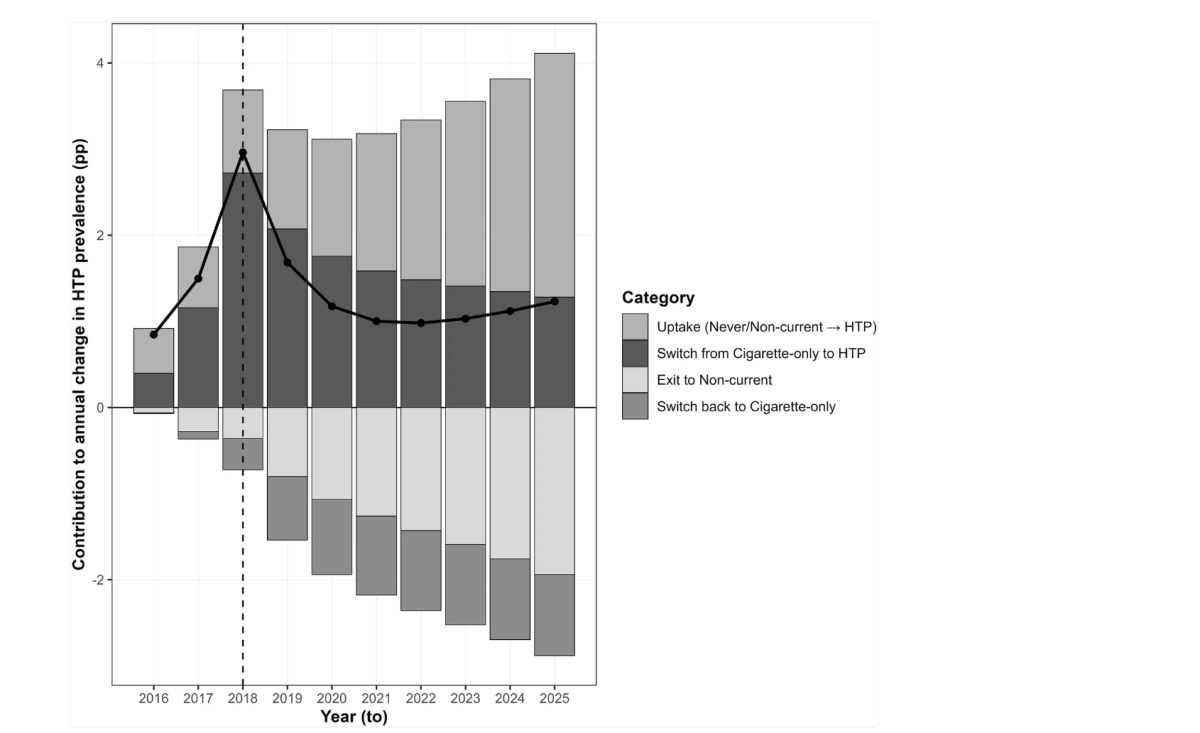
Japan's Heated Tobacco Use Rises From 0.1% to 14.9% Over a Decade as Growth Extends Beyond Cigarette Switching
A decade-long study published in The Lancet Regional Health – Western Pacific found that heated tobacco product use in Japan increased from 0.1% in 2015 to 14.9% in 2025, although growth slowed after 2018. Switching from conventional cigarettes remained an important source of HTP uptake, while the contribution from previously non-current users increased. Approximately 56% of HTP users also smoked conventional cigarettes in 2025. Separate industry data show that Japan's heated tobacco sales reached 73.4 billion units in fiscal 2025, approaching conventional cigarette sales of 78.2 billion units.
SCIENCE
Nov.10
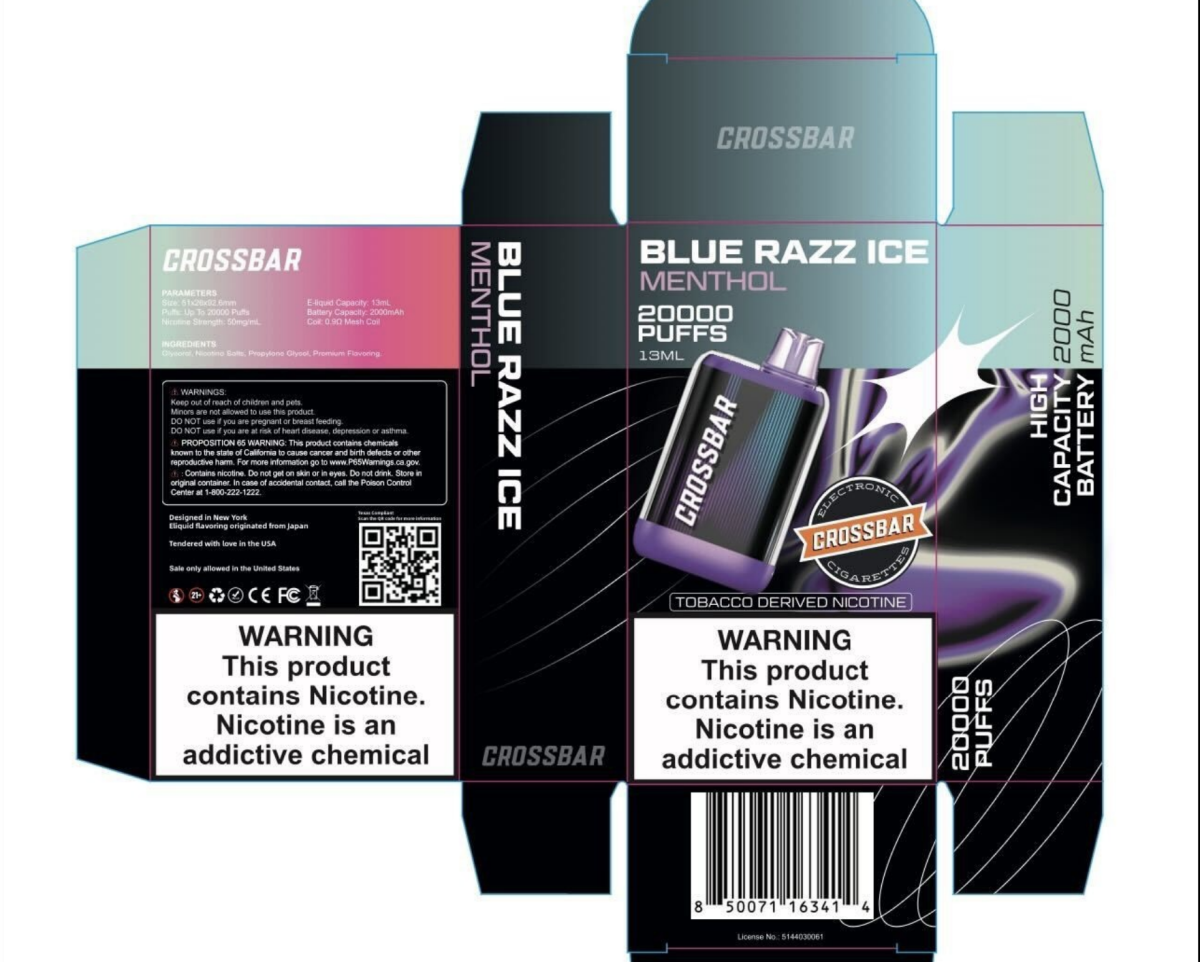
Product | Four CrossBar 20K 13mL High-Puff Vapes Listed on Pennsylvania's ENDS Directory, Rated for Up to 20,000 Puffs
Four CrossBar 20K disposable e-cigarettes appeared on Pennsylvania's 163-entry ENDS directory ahead of enforcement beginning October 19, 2026. The devices feature 13mL e-liquid reservoirs, 50mg/mL nicotine, 2,000mAh batteries and 0.9Ω mesh coils, with advertised puff counts of up to 20,000. CrossBar was the only modern high-puff disposable series among the directory's 15 disposable entries. Its packaging emphasizes New York design and Japanese-origin flavoring, while historical CrossBar records identify a registered U.S. tobacco manufacturing-related establishment. The link between the newer 13mL devices and earlier 1.3mL PMTA filings remains unconfirmed.
product
Oct.26
AIR Global Starts Debt Refinancing Four Months After Nasdaq Listing With About $400 Million Notes Expected
AIR Limited, a wholly owned subsidiary of AIR Global, has launched an offering of U.S. dollar-denominated senior unsecured notes, with proceeds primarily intended to repay its existing term loan and revolving credit facility. AIR has not disclosed the final size, maturity or coupon; Refinitiv, citing Moody's, reported an expected issuance of approximately $400 million and a Ba3 rating. AIR had about $412.4 million outstanding under the two bank facilities at June 30 and net debt of $344.8 million. In the first half of 2026, AIR's Al Fakher-led flavored shisha molasses business generated about 99% of company revenue, while New Growth Categories including Crown Switch produced $2.2 million in revenue and remained loss-making on an adjusted EBITDA basis.
Sep.23