Key Points
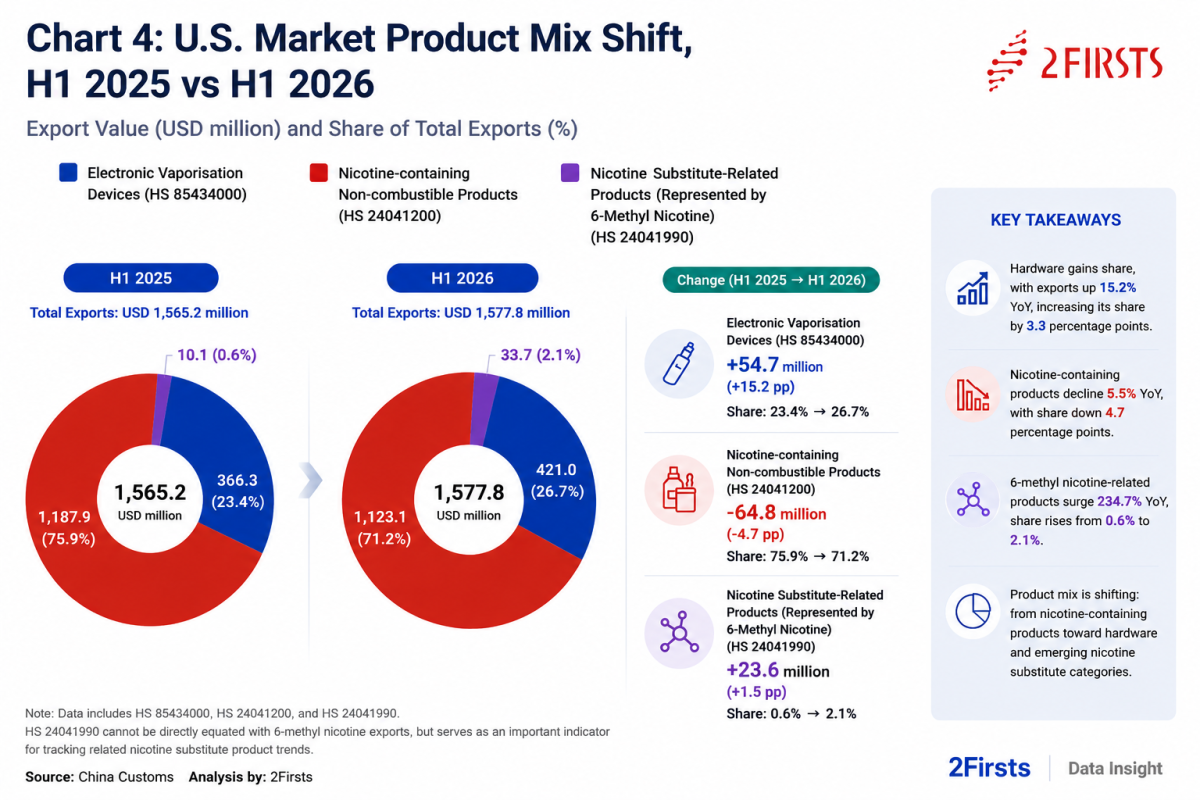
- China’s U.S.-bound vape exports totaled approximately $1.58 billion in H1 2026.
- Export momentum has not fully returned after the volatility cycle triggered by U.S. enforcement and inventory effects in 2025.
- Vaping devices and atomization hardware exports rose 15.2% YoY to approximately $421 million.
- Nicotine-containing vaping product exports declined 5.5% YoY to approximately $1.12 billion.
- 6-methyl nicotine-related and other nicotine substitute products increased 234.7% YoY to approximately $33.7 million, emerging as a new category to watch.
2Firsts | Shenzhen
July 22, 2026
China’s vape exports to the U.S. have not yet regained their previous growth momentum.
According to China Customs data analyzed by 2Firsts, China exported approximately $1.58 billion worth of vape-related products to the U.S. in the first half of 2026.
Compared with the same period in 2025, exports were broadly unchanged. But the flat headline number masks a deeper shift: the drivers behind China’s U.S.-bound exports are changing.
Following a year marked by U.S. enforcement actions, supply disruptions and inventory-driven purchasing cycles, the market is moving into a new adjustment phase. Hardware is gaining momentum, traditional nicotine products are losing momentum, and emerging nicotine categories are expanding from a small base.
China’s U.S. Vape Exports Remain Below Previous Momentum After 2025’s Volatility Cycle
The past two years of China’s vape exports to the U.S. cannot be interpreted through a simple year-over-year comparison.
In 2025, the U.S. market experienced two opposing forces.
Early in the year, intensified enforcement against unauthorized vape products disrupted cross-border supply channels, creating shortages and reducing shipments.
Later in 2025, distributors and importers responded by rebuilding inventories, creating a supply-chain “bullwhip effect” that amplified orders and pushed exports sharply higher.
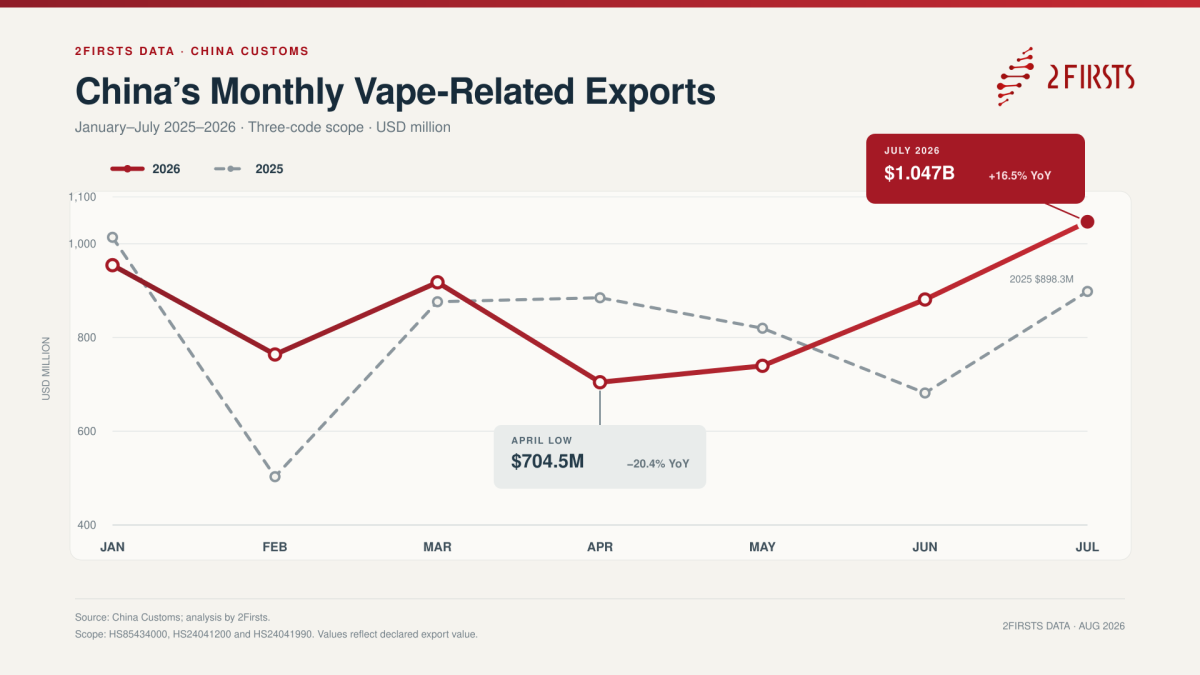
China’s vape exports to the U.S. reached a monthly peak of approximately $590 million in October 2025.
However, the peak was not necessarily a reflection of underlying consumer demand growth. Instead, it reflected a combination of:
- enforcement-driven supply disruption;
- logistics normalization;
- distributor inventory rebuilding.
By 2026, exports began moving away from the extreme volatility of the previous year and toward a more adjusted market environment.

Hardware Exports Reach $421 Million as Traditional Nicotine Products Continue to Decline
The most significant shift in 2026H1 occurred at the product level.
Different product categories are moving in different directions.
Hardware Gains Momentum
Vaping devices and atomization hardware exports continued to expand.
Export value:
- H1 2024: approximately $341 million
- H1 2025: approximately $366 million
- H1 2026: approximately $421 million
Year-over-year growth in H1 2026:
+15.2%
Unlike other categories affected by market adjustments, hardware exports maintained growth momentum across the three-year comparison period.
The data suggests that manufacturing-oriented segments remain relatively resilient as the U.S. market adjusts.
Nicotine-Containing Products Lose Momentum
Traditional nicotine-containing vaping products moved in the opposite direction.
Export value:
- H1 2024: approximately $1.47 billion
- H1 2025: approximately $1.19 billion
- H1 2026: approximately $1.12 billion
Year-over-year change in H1 2026:-5.5%
The continued decline indicates that the traditional finished-product export model is facing increasing pressure from regulatory changes, market maturity and evolving demand patterns.
6-Methyl Nicotine-Related Products Rise 234.7%, Emerging From a Small Base
Beyond traditional vaping categories, a new product signal is emerging.
Products classified under HS24041990, represented by 6-methyl nicotine-related and other nicotine substitute products, reached approximately $33.7 million in U.S.-bound exports during H1 2026.
Year-over-year growth:
+234.7%
Historical data shows that the category has expanded rapidly:
Period | Export Value |
H1 2024 | ~$12.2M |
H1 2025 | ~$10.1M |
H1 2026 | ~$33.7M |
Although still much smaller than hardware and nicotine-containing vaping products, the category has become increasingly visible as U.S. regulators and industry participants debate emerging nicotine compounds, including 6-methyl nicotine.
Because customs classifications do not identify specific chemical ingredients, HS24041990 should not be treated as a direct measurement of 6-methyl nicotine exports. However, it provides an important indicator of the expansion of related nicotine substitute products.
Hardware and Emerging Nicotine Categories Gain Momentum as Product Mix Shifts
The 2026H1 data shows that China’s U.S.-bound vape exports are not simply recovering or declining.
They are changing composition.
Three product trends are developing simultaneously:
- Hardware: gaining momentum with sustained growth;
- Nicotine-containing vaping products: losing momentum amid continued adjustment;
- 6-methyl nicotine-related and other nicotine substitute products: expanding rapidly from a small base.
The shift suggests that China’s role in the U.S. vape supply chain is evolving beyond a single dominant export model.
2026H1 Data Shows a Shift in China’s U.S.-Bound Vape Export Momentum
China’s vape exports to the U.S. have not yet returned to their previous growth momentum.
But the composition of growth is changing.
Hardware exports continue to expand, reflecting the resilience of China’s manufacturing ecosystem. Emerging nicotine substitute categories are gaining visibility, while traditional nicotine-containing products remain under pressure.
For Chinese suppliers, future competitiveness will depend not only on production capacity, but also on the ability to adapt to changing regulatory environments, product categories and market cycles.
Data does not tell the whole story — but it reveals the signals behind market change. 2Firsts Data will continue tracking China’s vape exports, global market flows and product mix shifts, turning customs data and industry analysis into insights on the structural changes shaping the global nicotine industry.
Data Scope
This analysis covers China’s exports to the U.S. across:
Vaping devices and atomization hardware
HS85434000Nicotine-containing vaping products
HS240412006-methyl nicotine-related and other nicotine substitute products
HS24041990Note: HS24041990 cannot be directly equated with 6-methyl nicotine exports, but serves as an important indicator for tracking related nicotine substitute product trends.


Disclaimer
This article is provided solely for professional research, industry discussion, and informational purposes. Any references to brands, companies, products, technologies, or policies are made for factual reporting and analytical purposes only, and do not constitute endorsement, recommendation, promotion, or advertising by 2Firsts.
Nicotine-containing products, including but not limited to cigarettes, e-cigarettes, heated tobacco products, and nicotine pouches, carry significant health risks. Readers are responsible for complying with all applicable laws and regulations in their respective jurisdictions, including age restrictions and access limitations.
The information contained in this article should not be regarded as investment, legal, medical, regulatory, or commercial advice. While 2Firsts strives to ensure the accuracy and reliability of its content, it does not assume liability for any direct or indirect loss arising from errors, omissions, inaccuracies, or reliance on the information contained herein.
This article is not intended for individuals below the legal age for accessing tobacco or nicotine-related information in their jurisdiction.
Copyright Notice
This article is either original content produced by 2Firsts or content reproduced, translated, summarized, or adapted from third-party sources with attribution where applicable. The intellectual property rights of the original content remain with 2Firsts or the respective original rights holders.
No individual or organization may copy, reproduce, distribute, republish, modify, translate, or otherwise use this content without prior authorization. Any unauthorized use may result in legal action.
For copyright-related inquiries, corrections, or removal requests, please contact: info@2firsts.com.
AI-Assisted Translation and Editing Notice
Portions of this article may have been translated, edited, or reviewed with the assistance of artificial intelligence tools to improve efficiency and readability. Due to the limitations of AI-assisted translation and editing, discrepancies, omissions, or inaccuracies may exist when compared with the original source.
Where applicable, readers are advised to refer to the original source for the most complete and accurate information. If you identify any errors or believe that any content infringes upon your rights, please contact us at info@2firsts.com, and we will review and address the matter promptly.