Key Points
- China’s Jiangsu Tobacco Monopoly Bureau and Jiangsu Provincial Medical Products Administration issued a joint regulatory notice.
- The notice targets illegal vape production and sales conducted under the name of medical devices.
- Six categories of violations cover production, sales, promotion, storage and transportation.
- The notice cites China’s tobacco and medical device regulatory frameworks.
- Authorities encouraged the public to report suspected violations through official hotlines.
2Firsts
August 4, 2026
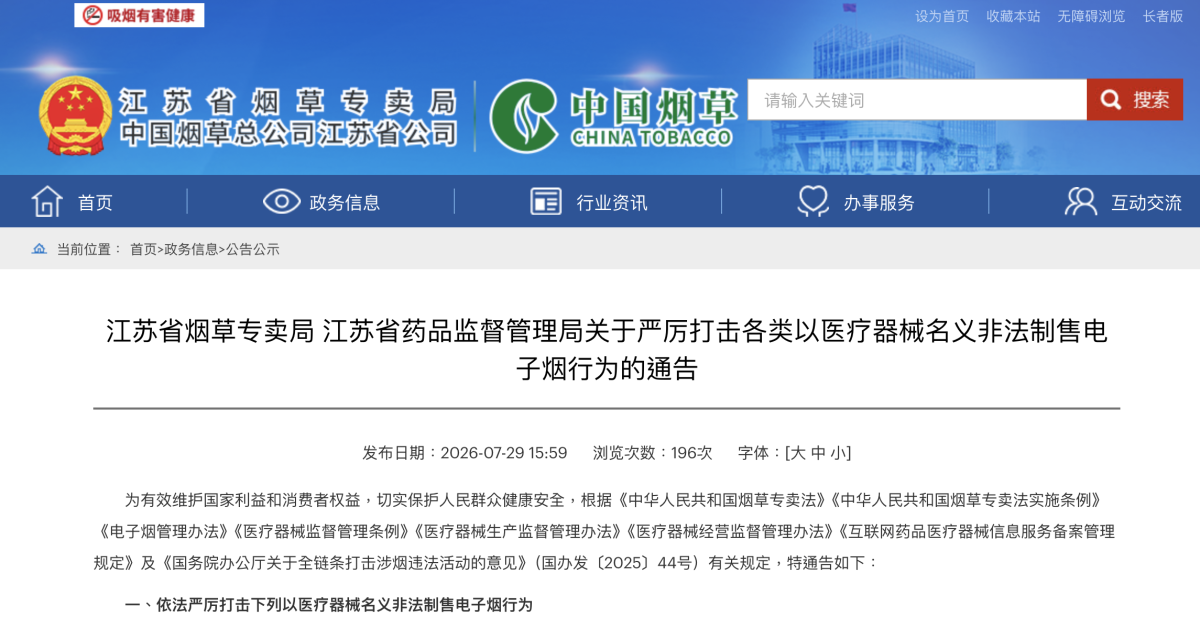
On July 29, 2026, China’s Jiangsu Tobacco Monopoly Bureau and Jiangsu Provincial Medical Products Administration issued a joint notice targeting illegal production and sales of vape products conducted under the name of medical devices.
The notice, dated July 27, 2026, stated that authorities would take action against activities that use medical device identities or credentials to avoid vape regulation.
The notice cited China’s Tobacco Monopoly Law, the Administrative Measures for Electronic Cigarettes, the Regulations on the Supervision and Administration of Medical Devices and other related rules, including the State Council General Office’s 2025 guideline on combating tobacco-related illegal activities across the supply chain.
China’s Jiangsu Regulators Target Vape Activities Disguised as Medical Devices
The joint notice focuses on: illegal production and sales of vape products under the name of medical devices.
Authorities said some entities may attempt to package or market vape products through:
- medical device names;
- medical administrative approvals or filings;
- medical device-related online service qualifications.
The regulators said the action aims to protect national interests, consumer rights and public health.
Six Categories of Violations Listed by Regulators
The Jiangsu regulators identified six categories of activities subject to enforcement:
Category | Specific Conduct |
Licenses and filings | Obtaining medical approvals or filings through false materials or deceptive methods to produce or sell vapes |
Credentials and certificates | Forging, altering or misusing medical device licenses or filing documents |
Product identity | Using medical device names to illegally produce or sell vapes |
Production scope | Expanding production beyond the scope stated in medical device production licenses |
Online sales | Using medical device online trading platforms, websites, apps or services to promote or sell vapes illegally |
Storage and logistics | Using medical device identities to illegally store, transport or deliver vape products |
The measures cover multiple stages of the vape supply chain, including manufacturing, promotion, sales and logistics.
China Regulators Focus on Vape Products Using Alternative Identities
The Jiangsu notice comes as Chinese regulators continue examining cases involving vape products marketed under alternative product identities or credentials.
Previously, Beijing authorities disclosed a criminal case involving aerosol products marketed as “medical nebulizers” and “zero-nicotine” products. Authorities classified the products involved as counterfeit vapes and pursued criminal proceedings.
The Jiangsu notice establishes a regulatory framework targeting the use of medical device identities to illegally produce and sell vape products.
The notice applies to illegal use of medical device identities to avoid vape regulation, rather than all medical device companies or all aerosol products.
Jiangsu Establishes Public Reporting Channels
The notice also introduced public reporting channels.
Individuals and organizations can report suspected violations through:
- 12313 tobacco monopoly hotline;
- China’s national 12315 consumer complaint platform.
Authorities said verified reports may receive rewards under relevant rules, while protecting the personal information and safety of whistleblowers.
The joint notice reflects China’s efforts to strengthen coordination between tobacco monopoly regulation and medical product oversight, with regulators paying closer attention to activities that use alternative industry credentials to avoid vape controls.
Follow 2Firsts for the latest updates on global tobacco and nicotine regulation, industry developments and market trends.
Cover Image source: Jiangsu Tobacco Monopoly Bureau
Disclaimer
This article is provided solely for professional research, industry discussion, and informational purposes. Any references to brands, companies, products, technologies, or policies are made for factual reporting and analytical purposes only, and do not constitute endorsement, recommendation, promotion, or advertising by 2Firsts.
Nicotine-containing products, including but not limited to cigarettes, e-cigarettes, heated tobacco products, and nicotine pouches, carry significant health risks. Readers are responsible for complying with all applicable laws and regulations in their respective jurisdictions, including age restrictions and access limitations.
The information contained in this article should not be regarded as investment, legal, medical, regulatory, or commercial advice. While 2Firsts strives to ensure the accuracy and reliability of its content, it does not assume liability for any direct or indirect loss arising from errors, omissions, inaccuracies, or reliance on the information contained herein.
This article is not intended for individuals below the legal age for accessing tobacco or nicotine-related information in their jurisdiction.
Copyright Notice
This article is either original content produced by 2Firsts or content reproduced, translated, summarized, or adapted from third-party sources with attribution where applicable. The intellectual property rights of the original content remain with 2Firsts or the respective original rights holders.
No individual or organization may copy, reproduce, distribute, republish, modify, translate, or otherwise use this content without prior authorization. Any unauthorized use may result in legal action.
For copyright-related inquiries, corrections, or removal requests, please contact: info@2firsts.com.
AI-Assisted Translation and Editing Notice
Portions of this article may have been translated, edited, or reviewed with the assistance of artificial intelligence tools to improve efficiency and readability. Due to the limitations of AI-assisted translation and editing, discrepancies, omissions, or inaccuracies may exist when compared with the original source.
Where applicable, readers are advised to refer to the original source for the most complete and accurate information. If you identify any errors or believe that any content infringes upon your rights, please contact us at info@2firsts.com, and we will review and address the matter promptly.