As European bureaucrats consider actually taxing smoking cessation, we can foresee millions of former smokers reverting back to their old habits. The EU's flagship "Fight Against Cancer Plan" will be a major topic of discussion at this week's global Nicotine Forum conference in Warsaw.
Experts will tell representatives that when the new European Parliament convenes later this year, product bans, excessive taxation, and plain packaging will all be on the table - not just for cigarettes, but also for e-cigarettes and other safer nicotine products.
It's difficult to say whether the EU is taking the fight against cancer seriously. If it is, then it needs to truly prioritize tobacco control," said tobacco policy expert Clive Bates.
This means using all possible means to help people quit smoking, including e-cigarettes, nicotine pouches, heated tobacco, and snuff. EU institutions have wasted a lot of energy in preventing people from using these products to quit smoking," he said.
Dr. Colin Mendelsohn, founding chairman of the Australian Tobacco Harm Reduction Association, said that Europe may ultimately follow in Australia's footsteps, where you can only legally purchase tobacco if it is intended for smoking.
E-cigarettes are difficult to obtain and may be as restricted as being banned. In the United States, the situation is equally dire, with regulations so burdensome that legal options cannot compete with the black market. Smoking cessation products like e-cigarettes and nicotine pouches need to be affordable and easy to access. The experience in other countries shows that these products can significantly reduce smoking rates and cancer risks," Mendelsohn said.
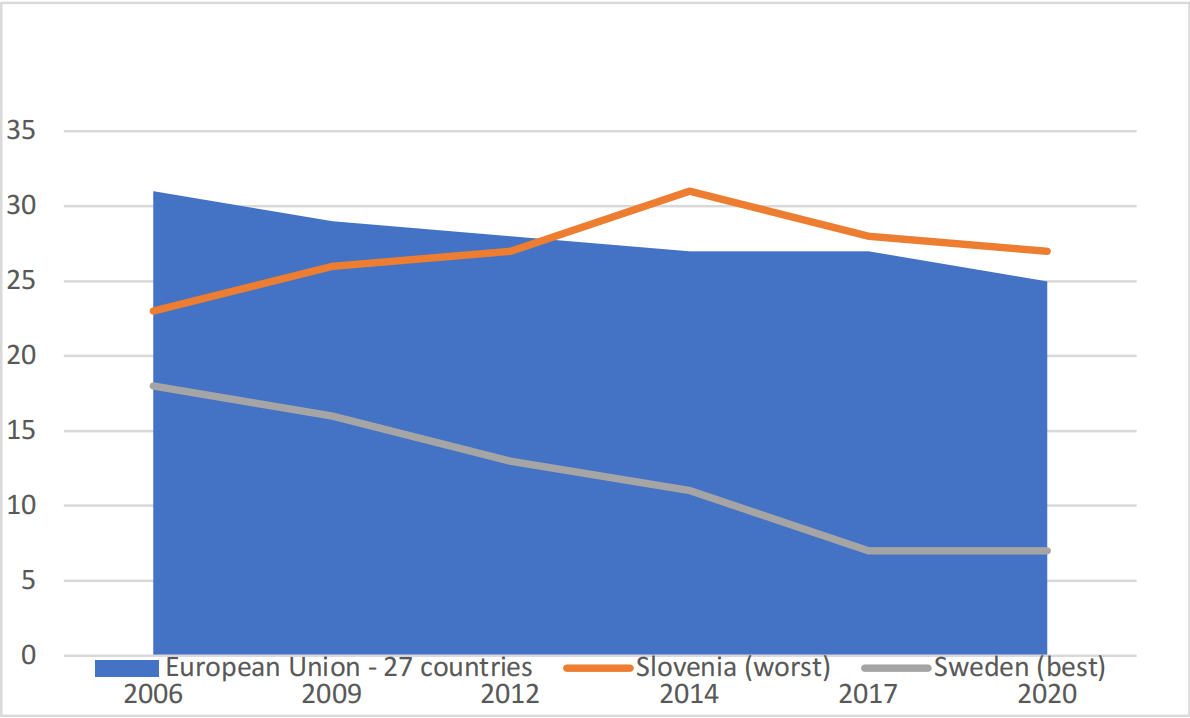
In Sweden, the rate of smoking has decreased three times faster than in other EU countries after smokers turned to snus. In New Zealand and Japan, the introduction of heated tobacco products led to a 50% and 33% decrease in smoking rates, respectively. The European Commission aims to reduce tobacco use to below 5% by 2040. However, progress has been slow. From 2006 to 2020, the smoking rate has only decreased by 6 percentage points. In some countries, such as Slovenia, the smoking rate has even increased (see Figure 1).
Dr. Garett McGovern, Medical Director of Dublin Priority Medical Clinic in Ireland, said that making people unable to quit smoking through pricing or making alternative products so unappealing that no one is willing to use them is not the answer.
Bates said, "EU bureaucrats should recognize that new products are an opportunity, not a threat, but unfortunately, they seem to be misguided by advocacy groups that are hostile to innovation and resistant to change.
We welcome news tips, article submissions, interview requests, or comments on this piece.
Please contact us at info@2firsts.com, or reach out to Alan Zhao, CEO of 2Firsts, on LinkedIn
Notice
1. This article is intended solely for professional research purposes related to industry, technology, and policy. Any references to brands or products are made purely for objective description and do not constitute any form of endorsement, recommendation, or promotion by 2Firsts.
2. The use of nicotine-containing products — including, but not limited to, cigarettes, e-cigarettes, nicotine pouchand heated tobacco products — carries significant health risks. Users are responsible for complying with all applicable laws and regulations in their respective jurisdictions.
3. This article is not intended to serve as the basis for any investment decisions or financial advice. 2Firsts assumes no direct or indirect liability for any inaccuracies or errors in the content.
4. Access to this article is strictly prohibited for individuals below the legal age in their jurisdiction.
Copyright
This article is either an original work created by 2Firsts or a reproduction from third-party sources with proper attribution. All copyrights and usage rights belong to 2Firsts or the original content provider. Unauthorized reproduction, distribution, or any other form of unauthorized use by any individual or organization is strictly prohibited. Violators will be held legally accountable.
For copyright-related inquiries, please contact: info@2firsts.com
AI Assistance Disclaimer
This article may have been enhanced using AI tools to improve translation and editorial efficiency. However, due to technical limitations, inaccuracies may occur. Readers are encouraged to refer to the cited sources for the most accurate information.
We welcome any corrections or feedback. Please contact us at: info@2firsts.com