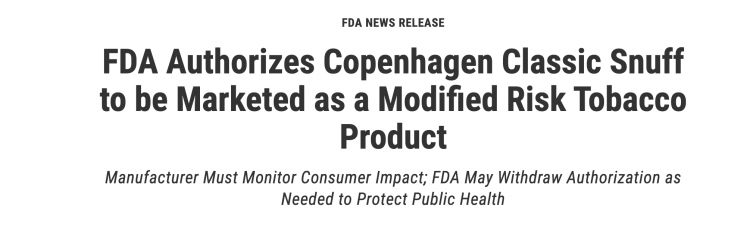
On March 16th, the US Food and Drug Administration (FDA) authorized the sale of Copenhagen Classic snuff, a smokeless tobacco product, as a modified risk tobacco product (MRTP) by the US Smokeless Tobacco Company. Copenhagen's moist snuff smokeless tobacco product is an existing tobacco product that has been sold in the US for years without a modified risk message. Today's action now allows for the product to be sold as a modified risk product, claiming that "if you smoke, consider this product. Completely switching from cigarettes to this product can reduce the risk of lung cancer.
According to Dr. Brian King, MPH in Public Health, "There is no safe tobacco product, nor is there an 'FDA approved' product, so non-tobacco users should not start using them. However, tobacco products do pose a risk, with smokers being the most at risk. In this case, FDA scientific review found that if an adult smoker completely switches from cigarettes to this smokeless product, it will reduce their risk of lung cancer.
After rigorous examination of the available evidence, including recommendations from the Tobacco Products Scientific Advisory Committee, public opinion, and other available scientific information, the FDA has determined that specific statements related to lung cancer risk with Copenhagen Classic Snuff are scientifically accurate. Data suggests that if current smokers were to switch entirely to this product, they would reduce their risk of developing lung cancer. The review also found that these public health benefits are not expected to be offset by non-users initiating use of the product.
The issued risk modification order from this agency prohibits the company from making any additional modified risk statements when selling the product, including statements related to any outcomes other than lung cancer risk, or conveying or possibly misleading consumers to believe that the product is approved or endorsed by the FDA, or that the FDA deems the product to be safe for consumers.
The company is required to conduct post-market surveillance and research, which includes evaluating the behavior and understanding of product users, examining any prior use of tobacco products, and assessing the long-term impact on public health through scientific modeling.
The revised risk grant will expire in five years, and the company must apply for and receive FDA authorization to continue selling the modified risk product. At any point, if the agency determines that this order is no longer advantageous for public health, it must be revoked.
The case is now in the hands of the company's court, and Dr. Jin explains that there will be market research and monitoring of its impact on consumers, with this information being submitted annually to the FDA. If scientific evidence shows that the net benefits of these products no longer outweigh the risks to the population, or if the company fails to conduct the necessary post-market surveillance and research, the FDA is committed to taking appropriate action, including issuing recalls, to protect public health.
The MRTP process outlined in the 2009 Family Smoking Prevention and Tobacco Control Act allows companies to submit applications for the FDA to evaluate whether tobacco products can be sold or distributed in order to reduce harm or the risk of tobacco-related illnesses. According to the law, the FDA must also ensure that the advertising and labeling of risk-modified products is clear in informing the public about the modified risks or exposure information and how it relates to overall health and all tobacco-related illnesses and health conditions.
Disclaimer
This article is provided solely for professional research, industry discussion, and informational purposes. Any references to brands, companies, products, technologies, or policies are made for factual reporting and analytical purposes only, and do not constitute endorsement, recommendation, promotion, or advertising by 2Firsts.
Nicotine-containing products, including but not limited to cigarettes, e-cigarettes, heated tobacco products, and nicotine pouches, carry significant health risks. Readers are responsible for complying with all applicable laws and regulations in their respective jurisdictions, including age restrictions and access limitations.
The information contained in this article should not be regarded as investment, legal, medical, regulatory, or commercial advice. While 2Firsts strives to ensure the accuracy and reliability of its content, it does not assume liability for any direct or indirect loss arising from errors, omissions, inaccuracies, or reliance on the information contained herein.
This article is not intended for individuals below the legal age for accessing tobacco or nicotine-related information in their jurisdiction.
Copyright Notice
This article is either original content produced by 2Firsts or content reproduced, translated, summarized, or adapted from third-party sources with attribution where applicable. The intellectual property rights of the original content remain with 2Firsts or the respective original rights holders.
No individual or organization may copy, reproduce, distribute, republish, modify, translate, or otherwise use this content without prior authorization. Any unauthorized use may result in legal action.
For copyright-related inquiries, corrections, or removal requests, please contact: info@2firsts.com.
AI-Assisted Translation and Editing Notice
Portions of this article may have been translated, edited, or reviewed with the assistance of artificial intelligence tools to improve efficiency and readability. Due to the limitations of AI-assisted translation and editing, discrepancies, omissions, or inaccuracies may exist when compared with the original source.
Where applicable, readers are advised to refer to the original source for the most complete and accurate information. If you identify any errors or believe that any content infringes upon your rights, please contact us at info@2firsts.com, and we will review and address the matter promptly.