InterTabac Live Report | Germany’s BfTG Warns: Over-Regulation Could Impact Europe’s Vaping Market

Sep.18.2025
At InterTabac, the German Alliance for Tobacco-Free Enjoyment (BfTG) warned that high taxation and over-regulation are undermining the vitality of the vaping market, and that potential flavor bans could further weaken the legal market in Europe.

Key Takeaways | BfTG Remarks at InterTabac


  • Rising taxes: Germany’s e-liquid tax will climb to €0.32/ml in 2024, above the EU average.


  • Flavor ban risks: In the Netherlands, bans shrank the legal market, boosted black sales, and increased youth access.


  • Illicit & cross-border trade: Illicit products already make up 40% of the German market; many consumers cross into France to buy cheaper products, hitting border businesses.


  • EU policy impacts: 2027 battery rules will end disposables; nicotine-based excise rates are seen as excessive; TPD revision unlikely before 2030.


  • Industry stance: Vaping must remain cheaper than smoking; over-regulation and flavor bans will only push consumers back to cigarettes or illicit markets.


2Firsts On-Site, Dortmund  — At the 2025 Dortmund NGP press conference, where 2Firsts was present for live coverage, Philip Drögemüller, Managing Director of the German Alliance for Tobacco-Free Enjoyment (Bündnis für Tabakfreien Genuss e.V.,BfTG), warned that excessive taxation and flavor restrictions could undermine the legal vaping market in Germany and across Europe, pushing consumers back to smoking or the illicit market.


Drögemüller noted that Germany has regulated e-cigarettes since 2016 and introduced an e-liquid tax in 2022. The current rate stands at €0.26 per milliliter and will rise to €0.32 in 2024 — significantly above the EU average of €0.20. “Regulation is important, but over-regulation risks destroying market potential,” he stressed.
 

InterTabac Live Report | Germany’s BfTG Warns: Over-Regulation Could Impact Europe’s Vaping Market
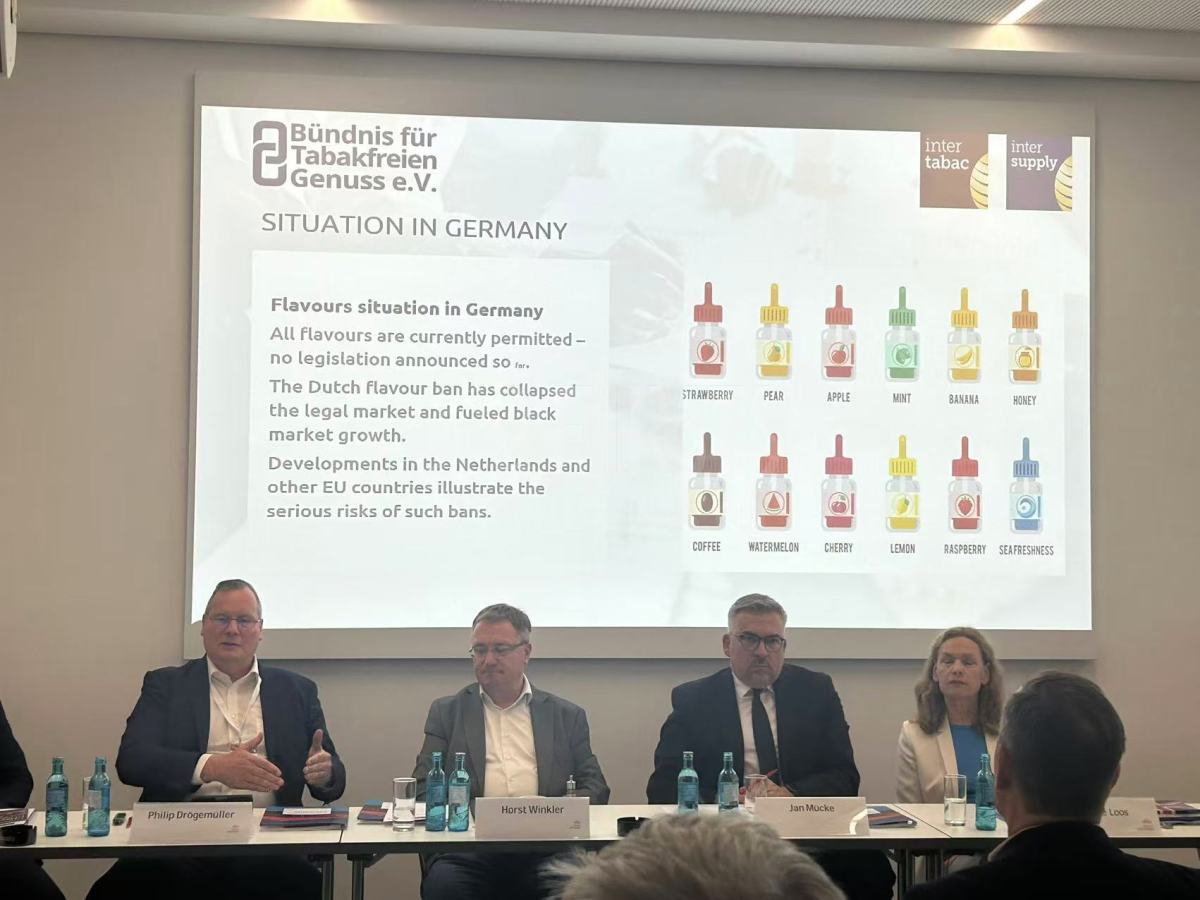
At the press conference, Philip Drögemüller (first on the left) is speaking


Flavor bans under scrutiny


A key concern is the growing debate over flavor bans. Drögemüller cited the Netherlands, where a flavor ban took effect in January 2024. Within three months, the regulated market collapsed, while black-market products surged, easily accessible even to young people. “It’s a failed experiment. Germany must not repeat this mistake,” he said.


Illicit trade on the rise


According to BfTG’s survey, illicit products already account for roughly 40% of the German vaping market, with industry members estimating a 30% loss in potential turnover. Drögemüller urged policymakers to strengthen enforcement capacity to curb the expanding black market.

 

InterTabac Live Report | Germany’s BfTG Warns: Over-Regulation Could Impact Europe’s Vaping Market
Philip Drögemüller |Photo Credit:Xing.com


Policy shifts and looming impacts


Drögemüller outlined several EU-level regulatory moves that could reshape the industry:


  •  Battery Regulation: Effective 2027, requiring removable batteries, effectively phasing out disposables in the EU.
  •  Excise Directive proposal: A tax model based on nicotine concentration — €0.12/ml below 15mg/ml, and €0.36/ml above. “This punishes smokers who rely on higher nicotine strengths to quit,” he warned.
  •  TPD revision: A new Tobacco Products Directive may not be implemented before 2030.


Border effects also add pressure: France has not introduced e-liquid taxation, encouraging cross-border purchases and causing losses for German companies near the frontier.


Clear stance


“Vaping products must remain cheaper than cigarettes to preserve harm-reduction benefits,” Drögemüller concluded. “Flavor bans and excessive taxes are not solutions — they only drive consumers back to smoking or unsafe illicit markets.”


2Firsts was on-site to capture key discussions and will continue to provide in-depth coverage of regulatory developments shaping Europe’s NGP industry.


For more on-the-ground coverage, visit the 2Firsts InterTabac Special Section。


InterTabac Live Report | Germany’s BfTG Warns: Over-Regulation Could Impact Europe’s Vaping Market


Jordan Cuts Taxes on Heated Tobacco and E-cigarettes
Jordan has amended its 2025 Special Tax Law, introducing a package of tax reductions on heated tobacco products and electronic cigarettes. Published in the Official Gazette, the changes take effect Monday morning and include a 50% cut in taxes on heated tobacco devices, as well as significant reductions on e-cigarette hardware and liquids. The move is expected to have an immediate impact on retail prices.
Dec.22 by 2FIRSTS.ai
Philippines DTI Floats Blanket Ban on Open-Pod Vapes and E-Liquids, Seeks Public Input
Philippines’ Department of Trade and Industry (DTI) is inviting stakeholder feedback on a draft Department Administrative Order (DAO) that would impose a blanket ban on open vape pods and e-liquids—covering use, manufacturing, importation, and distribution.
Jan.29 by 2FIRSTS.ai
Alabama SB9 advances: Senate committee clears bill to treat vaping like smoking in enclosed public places
Alabama’s Senate Bill 9 advanced after clearing the Senate Committee on Healthcare, moving to the full Alabama Senate for consideration. The proposal would update the state’s 2003 Clean Indoor Air Act by including e-cigarettes and other vaping devices under the same restrictions that apply to smoking in most enclosed public places.
Jan.22 by 2FIRSTS.ai
Tennessee’s “Tobacco Product Retail Licensing Act” Would Require New Licenses for Tobacco and Vapes
A newly introduced Tennessee bill, S.B. 2086, would create a statewide tobacco product retail licensing system, move oversight to the Tennessee Alcohol Commission, and impose fees and escalating penalties. The proposal also requires all tobacco product sales to occur as in-person, over-the-counter transactions at licensed locations—effectively banning direct-to-consumer shipping of cigars and potentially restricting curbside or phone-order pickup models.
Jan.28 by 2FIRSTS.ai
South Korea’s Seoul Gangnam District Installs “Separated Smoking Booths” , Splitting Cigarettes and Vapes
Seoul's Gangnam district introduces smoking booths on Tehran Road to combat public smoking and secondhand smoke issues.
Jan.23 by 2FIRSTS.ai
New Zealand’s largest vape retailer Shosha accused of using “hidden text” on its website
New Zealand vape retailer Shosha is accused of using hidden, white-on-white text on its website to promote refillable and disposable vapes. A Health Ministry spokesperson said it could not comment on individual businesses’ compliance status while matters are being assessed, and said the ministry continues to monitor digital advertising and promotional activity and will act where it considers there may be a breach.
Jan.12 by 2FIRSTS.ai