Iowa Targets Smoking Products With Tax Plan: Cigarettes to National Average, 15% Tax on Vapes and Consumable Hemp

Feb.06
Iowa Targets Smoking Products With Tax Plan: Cigarettes to National Average, 15% Tax on Vapes and Consumable Hemp
Iowa Gov. Kim Reynolds is proposing higher taxes on cigarettes and new taxes on vaping and consumable hemp products, arguing tobacco use is a key driver of lung cancer. The proposal comes as University of Iowa researchers release preliminary findings suggesting Iowa’s late-stage lung cancer burden is higher—and improving more slowly—than in neighboring states.

Key Points


  • Iowa Gov. Kim Reynolds proposed raising the state cigarette tax to the national average of $2.01 per pack.
  • The plan would introduce a 15% tax on vaping products and consumable hemp products.
  • Reynolds tied the proposal to preliminary University of Iowa research on Iowa’s cancer trends.
  • Researchers said Iowa has a higher share of late-stage lung cancer cases than neighboring states, and lung cancer is declining more slowly than the US overall.
  • Further analysis will examine environmental and genetic data, plus evidence-based prevention programs.


2Firsts, Feb 6, 2026


According to Radio Iowa, Iowa Gov. Kim Reynolds said in Des Moines that she is proposing new taxes and tax increases on smoking-related products as part of a broader effort to address the state’s elevated lung cancer burden.


Reynolds pointed to national data linking tobacco use to lung cancer and said the state should not ignore tobacco-related policy “levers” given the scale of the problem. She made the remarks while hosting University of Iowa researchers who released preliminary findings from an ongoing study into factors contributing to Iowa’s cancer trends.


Under the governor’s proposal, Iowa would raise its cigarette tax to the national average of $2.01 per pack of 20. The plan would also introduce a 15% tax on vaping products and consumable hemp products. Reynolds framed the package alongside other health-focused initiatives she has recently highlighted, including proposals affecting school food additives and physician continuing education in nutrition.


The University of Iowa research team said their work is focusing on the most common cancers and noted that Iowa has a higher share of late-stage lung cancer cases compared with other states. Dr. Mary Charlton, director of the Iowa Cancer Registry, said Iowa’s overall cancer incidence is slightly higher than the region, but lung cancer stands out as an area where Iowa differs more significantly from neighboring states—and the gap appears to be widening. She added that while lung cancer rates are declining both in Iowa and nationwide, the decline is slower in Iowa.


Reynolds also referenced her family’s experience: her husband, Kevin Reynolds, was diagnosed with a fast-growing form of lung cancer in September 2023 despite never having smoked. She said his cancer was discovered after it had metastasized to the spine, and he later underwent immunotherapy, with the cancer now in remission.


Dr. Jacob Oleson, a biostatistics professor at the University of Iowa College of Public Health, said the team will continue to dig into the data, with year-two work expanding into environmental and genetic factors and evaluating evidence-based prevention programs. Reynolds said the research indicates cancer is complex and not driven by a single cause, but argued the state should act on smoking-related risks.


Image source: Radio Iowa


We welcome news tips, article submissions, interview requests, or comments on this piece.

Please contact us at info@2firsts.com, or reach out to Alan Zhao, CEO of 2Firsts, on LinkedIn


Notice

1.  This article is intended solely for professional research purposes related to industry, technology, and policy. Any references to brands or products are made purely for objective description and do not constitute any form of endorsement, recommendation, or promotion by 2Firsts.

2.  The use of nicotine-containing products — including, but not limited to, cigarettes, e-cigarettes, nicotine pouchand heated tobacco products — carries significant health risks. Users are responsible for complying with all applicable laws and regulations in their respective jurisdictions.

3.  This article is not intended to serve as the basis for any investment decisions or financial advice. 2Firsts assumes no direct or indirect liability for any inaccuracies or errors in the content.

4.  Access to this article is strictly prohibited for individuals below the legal age in their jurisdiction.


Copyright


This article is either an original work created by 2Firsts or a reproduction from third-party sources with proper attribution. All copyrights and usage rights belong to 2Firsts or the original content provider. Unauthorized reproduction, distribution, or any other form of unauthorized use by any individual or organization is strictly prohibited. Violators will be held legally accountable.

For copyright-related inquiries, please contact: info@2firsts.com


AI Assistance Disclaimer


This article may have been enhanced using AI tools to improve translation and editorial efficiency. However, due to technical limitations, inaccuracies may occur. Readers are encouraged to refer to the cited sources for the most accurate information.

We welcome any corrections or feedback. Please contact us at: info@2firsts.com

NAS 2026 | Cliff Douglas: Risk Continuum Should Play a Central Role in Tobacco Policy
Cliff Douglas, a veteran U.S. tobacco-control and public health policy figure, told NAS 2026 that the “continuum of risk” should play a central role in tobacco policy. He called for clearer market pathways, stronger risk communication, differentiated regulation and enforcement, and said possible FDA reforms to PMTA reviews could be a “welcome correction” if they create a more efficient, predictable route for scientifically substantiated lower-risk products. Read 2Firsts’ on-site coverage.
Sep.26
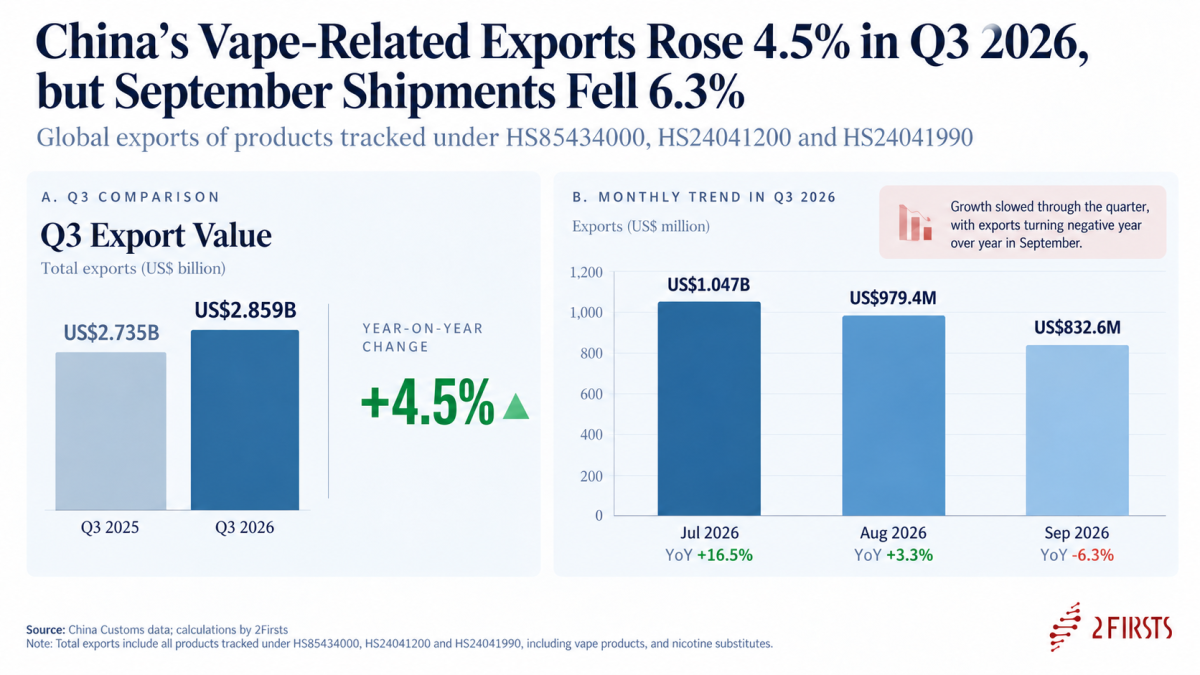
China’s Vape-Related Exports Rose 4.5% in Q3 2026 as 21.6% Growth in Shipments to the UK Offset a Decline in Shipments to the US
China's vape-related exports rose 4.5% year over year to $2.86 billion in the third quarter of 2026, led by stronger shipments to the United Kingdom as exports to the United States declined. UK-bound shipments increased 21.6%, adding $81.9 million, while US exports fell 5.2%, or $53.6 million. Growth weakened through the quarter, with September exports down 6.3% globally and 37.8% to the US. Nicotine-containing vape products accounted for more than 82% of the quarterly net increase, while device exports were nearly flat. Nine-month exports totaled $7.82 billion, up 4.0%.
DATA
Oct.26
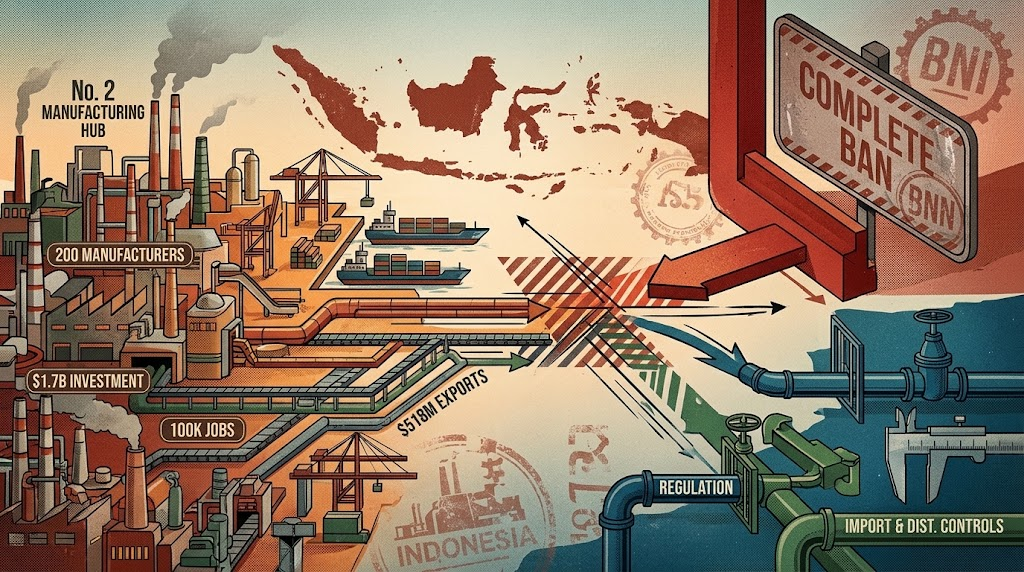
Special report|Indonesia's Vape Industry Has 200 Manufacturers and $1.7 Billion in Investment. Could a Regulatory Divide Derail Its Rise as the World's No. 2 Manufacturing Hub After Shenzhen?
Indonesia's Ministry of Industry said at a November 3, 2026, policy forum that the country has about 200 electronic cigarette companies, Rp31 trillion (approximately $1.71 billion) in cumulative industry investment and around 100,000 jobs across the supply chain. The National Narcotics Agency is seeking a comprehensive ban on vape use and circulation, while the industry ministry favors tighter import, product-standard and distribution controls. Indonesia exported approximately $518 million in vaping products in 2025, and Chinese manufacturers including Smoore, GEEKVAPE and Jinjia Group have established local operations. An international logistics specialist interviewed by 2Firsts said more Chinese vape companies began production in Indonesia from the second half of 2025, accompanied by increased shipments of manufacturing equipment and investment in logistics facilities. The regulatory debate comes as Indonesia expands its role in international vaping manufacturing.
Special Report
Nov.05
FDA Appoints Former Tobacco Enforcement Deputy Jessica Zeller as Director as Agency Weighs PMTA Framework Changes
The U.S. Food and Drug Administration (FDA) has named Jessica Zeller director of the Center for Tobacco Products' (CTP) Office of Compliance and Enforcement (OCE), effective November 1, 2026. Zeller, the office's inaugural deputy director, returns from medical device manufacturer Edwards Lifesciences with more than 20 years of regulatory and legal experience. The appointment follows CTP leadership changes and adjustments to tobacco regulation. Bret Koplow became permanent CTP director in September; the FDA revised enforcement priorities for unauthorized e-cigarettes and nicotine pouches in May and announced faster PMTA review procedures. On September 28, the agency said it would evaluate changes to the existing PMTA regulatory framework, including potential rulemaking to replace it.
FDA
Oct.20 by 2Firsts Perspectives
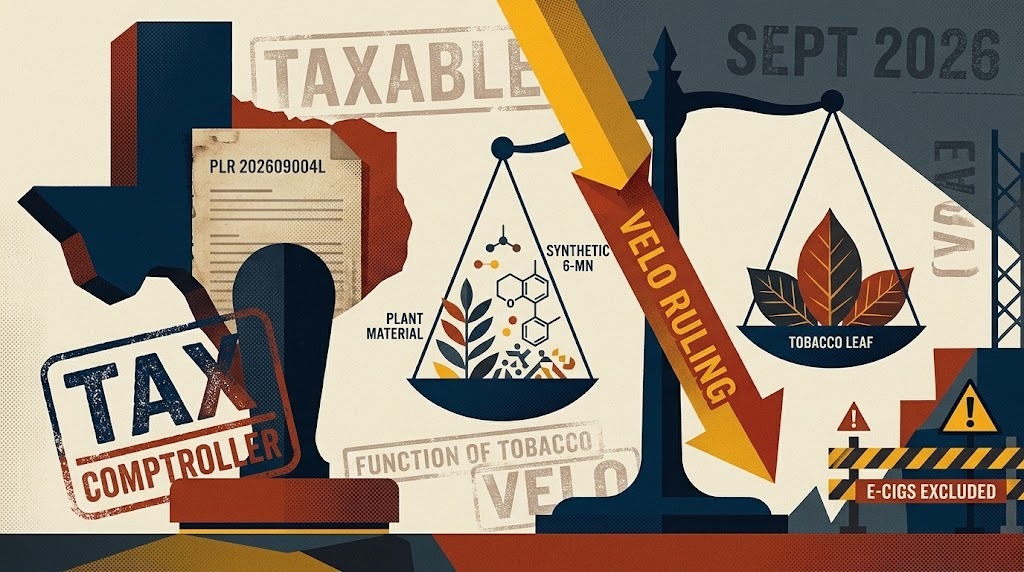
Texas Extends Tobacco Tax Interpretation to a 6-Methylnicotine Product, Citing VELO Ruling
The Texas Comptroller of Public Accounts ruled in September 2026 that a combustible product made with non-tobacco plant material and 6-methylnicotine (6-MN), a synthetic nicotine analog, qualifies as a taxable tobacco product. The applicant said the product contained neither tobacco leaf nor measurable conventional nicotine. The determination applies reasoning from a May Texas Supreme Court decision involving VELO nicotine pouches, finding that the plant material and 6-MN together perform the functions of tobacco in a conventional smoking product. The ruling carries applicable tax, licensing and reporting obligations but is limited to the facts submitted by the taxpayer. It does not establish a blanket tax classification for all 6-MN products or extend the same conclusion to e-cigarettes.
Regulations
Nov.06
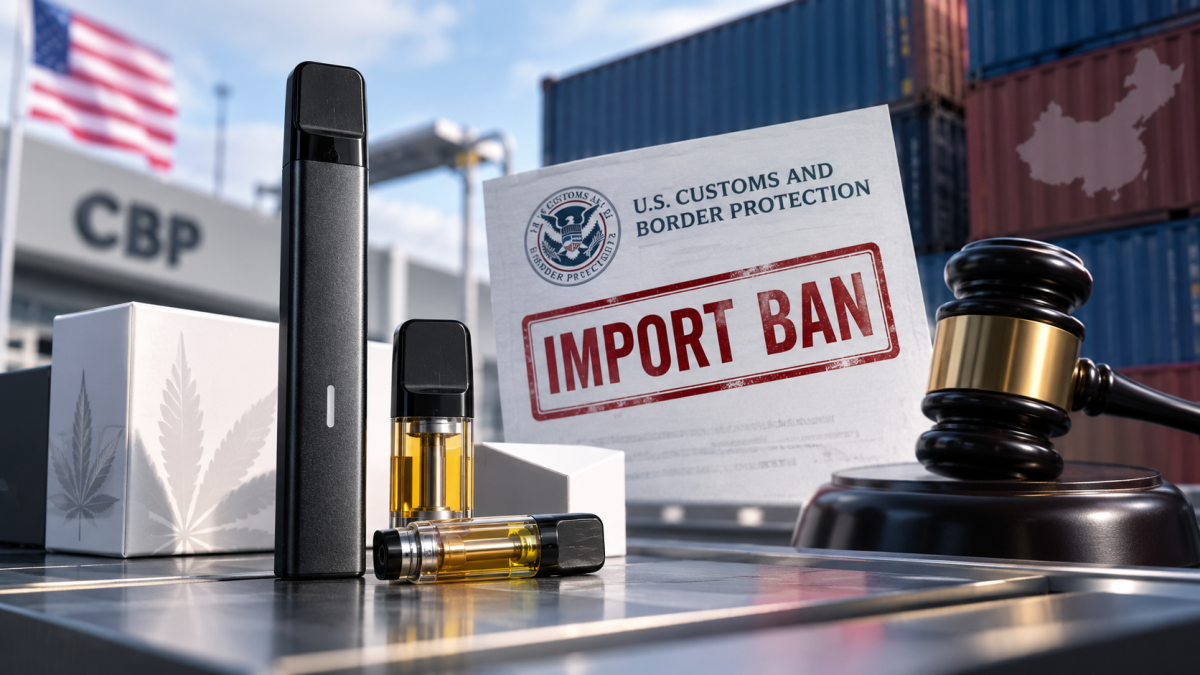
STIIIZY Redesign Fails to Escape PAX Labs Patent Import Ban as Section 337 Case Also Involves China ALD
U.S. Customs and Border Protection ruled that STIIIZY had not shown that the redesigned cannabis-vape products covered by its latest request fall outside an ITC limited exclusion order tied to PAX Labs patents. CBP accepted some of STIIIZY’s claim-construction and non-infringement arguments, but the company did not address two additional claims in the same patent. Earlier STIIIZY redesigned cartridges and certain associated components imported with them had received separate CBP clearance.
Sep.16