Ireland Considering Ban on Nicotine Pouches to Protect Youth, Says Chief Medical Officer

Nov.10.2025
Ireland Considering Ban on Nicotine Pouches to Protect Youth, Says Chief Medical Officer
Ireland’s Department of Health is examining a ban on nicotine pouches to curb nicotine use among young people. Chief Medical Officer Prof. Mary Horgan said the ban could be included in amendments to the current tobacco bill.

Key Points:


  • Department of Health considering nicotine pouch ban.
  • 1% of Irish adults use nicotine pouches; 3% among ages 15–24.
  • Men use them more than women.
  • Tobacco sales to under-21s will be banned from 2028.
  • Belgium, France, and the Netherlands already enforce bans.


2Firsts, Nov. 10, 2025 — According to The Irish Times, Ireland’s Department of Health is examining a ban on nicotine pouches as part of broader efforts to reduce nicotine use among children and young adults.


Nicotine pouches, which are white sachets containing powdered nicotine, flavourings, and other ingredients, are widely available in Ireland and typically placed between the lip and gum.


The 2025 Healthy Ireland survey found that 1% of the population uses nicotine pouches, with usage rising to 3% among 15–24-year-olds. Men are more likely than women to use them.


Concerns have been raised over the health risks of these products, with teachers reporting their increasing use among schoolchildren.


Chief Medical Officer Prof. Mary Horgan confirmed that the Department of Health is considering extending existing tobacco control legislation to cover nicotine pouches.


“Ireland has been a global leader in tobacco control,” said Prof. Horgan. “We are particularly looking at tobacco pouches as part of any amendment to the current tobacco bill. It’s a concern, and legislation should have an impact once introduced.”


Ireland has already passed several measures to reduce nicotine use, including a ban on tobacco sales to people under 21 starting in 2028, and upcoming legislation to prohibit single-use, flavoured, and coloured vapes.


These steps are intended to reduce the “attractiveness and availability” of nicotine products among young people.


Several EU member states — including Belgium, France, and the Netherlands — have already banned nicotine pouches, while others are considering similar restrictions.


Image source: The Irish Times


We welcome news tips, article submissions, interview requests, or comments on this piece.

Please contact us at info@2firsts.com, or reach out to Alan Zhao, CEO of 2Firsts, on LinkedIn


Notice

1.  This article is intended solely for professional research purposes related to industry, technology, and policy. Any references to brands or products are made purely for objective description and do not constitute any form of endorsement, recommendation, or promotion by 2Firsts.

2.  The use of nicotine-containing products — including, but not limited to, cigarettes, e-cigarettes, nicotine pouchand heated tobacco products — carries significant health risks. Users are responsible for complying with all applicable laws and regulations in their respective jurisdictions.

3.  This article is not intended to serve as the basis for any investment decisions or financial advice. 2Firsts assumes no direct or indirect liability for any inaccuracies or errors in the content.

4.  Access to this article is strictly prohibited for individuals below the legal age in their jurisdiction.


Copyright


This article is either an original work created by 2Firsts or a reproduction from third-party sources with proper attribution. All copyrights and usage rights belong to 2Firsts or the original content provider. Unauthorized reproduction, distribution, or any other form of unauthorized use by any individual or organization is strictly prohibited. Violators will be held legally accountable.

For copyright-related inquiries, please contact: info@2firsts.com


AI Assistance Disclaimer


This article may have been enhanced using AI tools to improve translation and editorial efficiency. However, due to technical limitations, inaccuracies may occur. Readers are encouraged to refer to the cited sources for the most accurate information.

We welcome any corrections or feedback. Please contact us at: info@2firsts.com

Product | PMI Launches ZYN Melts in UK, Extending ZYN Beyond Nicotine Pouches Into Dissolvable Tablets
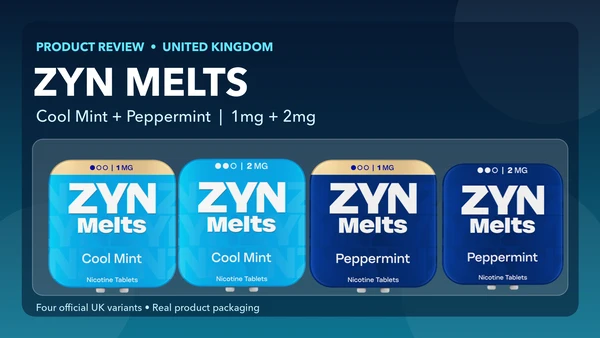
Philip Morris International (PMI) has launched ZYN Melts in the UK, introducing a fully dissolvable oral nicotine tablet format alongside the brand's existing nicotine pouches. The range includes Cool Mint and Peppermint, each offered at 1mg and 2mg of nicotine per tablet, creating four SKUs. Each can contains 20 tablets and is priced at £6.50 in the UK. Unlike ZYN nicotine pouches, Melts are placed between the upper lip and gum and dissolve completely during use.
News
Sep.29 by 2Firsts Perspectives
Kelly White Bets on Female Consumers as Nicotine Pouch Competition Intensifies | 2Firsts Interview
Swedish nicotine pouch brand Kelly White is building its strategy around adult female consumers. Founder and CEO Sophia Wilsby told 2Firsts that women accounted for around 70% of the brand’s repeat customers on HAYPP in Sweden in 2025. The interview explores female consumer segmentation, product and design differentiation, gender stereotypes, packaging regulation, and how independent brands can compete with global players such as ZYN and VELO while considering funding, partnerships and future ownership options.
Business
Sep.24
U.S. Judge Stays Helix, NJOY Challenge to FDA PMTA Rule Pending New Rulemaking Court Stays Altria's Helix, NJOY Challenge to PMTA Rule as FDA Prepares New Rulemaking
A federal judge in Texas on Oct. 8 granted a joint request by the FDA and plaintiffs including Altria subsidiaries Helix Innovations and NJOY to stay litigation challenging the agency's 2021 PMTA rule. The court cited FDA's anticipated rulemaking concerning the regulation at issue. FDA announced on Sept. 28 that it intends to reassess the PMTA framework and could initiate new rulemaking to replace it. The parties must file a joint status report within 45 days and every 45 days thereafter. A motion by three Reynolds American companies to intervene remains pending.
Regulations
Oct.10
NAS 2026 | Cliff Douglas: Risk Continuum Should Play a Central Role in Tobacco Policy
Cliff Douglas, a veteran U.S. tobacco-control and public health policy figure, told NAS 2026 that the “continuum of risk” should play a central role in tobacco policy. He called for clearer market pathways, stronger risk communication, differentiated regulation and enforcement, and said possible FDA reforms to PMTA reviews could be a “welcome correction” if they create a more efficient, predictable route for scientifically substantiated lower-risk products. Read 2Firsts’ on-site coverage.
Sep.26
Australia Adds 6-Methylnicotine to Schedule 9 Prohibited Substances, Effective October 1
Australia's Therapeutic Goods Administration published a final decision on September 25 to classify 6-methylnicotine as a Schedule 9 prohibited substance under the Poisons Standard, effective October 1, 2026. TGA said the chemical has been reported in e-cigarette liquids sold in Australia and marketed as nicotine-free or nicotine alternatives, while evidence also indicates its use in preparations such as oral pouches. The government originally proposed a Schedule 7 classification but ultimately adopted the stricter Schedule 9 designation, citing acute toxicity, dependence risk, use in unapproved consumer products and misleading marketing.
News
Sep.29 by 2Firsts Perspectives
Philippines Mandates Safety Certification for Nicotine Pouches, Gives Industry 12 Months to Comply
The Philippines Department of Trade and Industry has placed nicotine pouches under mandatory product certification through Department Administrative Order No. 26-07, Series of 2026. Nicotine pouches must obtain a Philippine Standard, or PS, license before they can be manufactured, imported, packed, distributed or sold in the country. The regime requires testing for nicotine content, pH and water activity, while packaging must disclose nicotine strength, ingredients, allergens, batch information, the PS certification mark and prescribed health warnings. Existing market participants have a 12-month transition period to comply.
Regulations
Oct.12