The Irish government plans to ban disposable e-cigarettes and impose a tax on e-cigarette oils by the end of the year

Sep.24.2025
The Irish government plans to ban disposable e-cigarettes and impose a tax on e-cigarette oils by the end of the year
The Irish government announced a complete ban on disposable e-cigarettes through new legislation. The legislation will require e-cigarette products to adopt the same packaging standards as cigarettes, including standardized colors, images, and flavor descriptions. In-store advertising will also be prohibited, except in specialty stores. This move aims to strengthen regulation and reduce youth exposure to e-cigarettes. The Ministry of Finance also plans to implement a €0.50 per milliliter tax on

Key points:


·The Irish government is planning to implement new regulations that will ban disposable e-cigarettes and in-store advertising, as well as standardize packaging. 

·The government plans to introduce a licensing system for e-cigarettes and tobacco products, and the delayed e-cigarette tax will be implemented by the end of 2025.


In a report by the Irish Examiner on September 24, 2025, the Irish government announced that it will ban in-store e-cigarette advertising, require standardized packaging, and completely prohibit disposable e-cigarettes, in order to align them with cigarette packaging regulations. Health Minister Jennifer Carroll MacNeill stated that new legislation will be introduced to strengthen regulations in the industry.


The new proposal will be implemented through two new laws, one of which will ban the sale of disposable e-cigarettes.


The second law will restrict the packaging of e-cigarette products, especially in terms of the colors and images on the box and the e-cigarette itself. The legislation will also limit the flavors that can be sold and "prohibit the use of any flavor descriptions and language other than basic flavor names." In-store point of sale displays and advertising will also be prohibited, with the result that e-cigarettes will be placed out of sight, similar to cigarettes and other tobacco products. Any products that have features similar to or look like toys will also be banned.


A government official stated that these laws are a response to restrictions on tobacco sales in the tobacco industry. The previous government had already implemented restrictions on e-cigarette sales, including prohibiting sales to minors under 18 and limiting advertising near schools, public transportation, and cinemas.


The e-cigarette liquid delayed tax announced in the Budget 2025 is expected to be implemented by the end of the year, with a tax of 0.50 euros per milliliter of e-cigarette liquid. Disposable e-cigarettes contain approximately 2 milliliters of e-liquid and are priced at 8 euros. Including value-added tax, the price is expected to rise to 9.23 euros. A spokesperson for Finance Minister Paschal Donohoe confirmed that tax-related preparations have entered a new stage.


Despite government action against e-cigarettes, it is not expected that there will be immediate action taken regarding nicotine pouches. Carol McNeill stated that legislation at the EU level would be "more effective than unilateral action by member states." She has formally called on the European Commission to swiftly propose a revised Tobacco Products Directive, which would cover new nicotine products including nicotine pouches. Carol McNeill aims to push for this revision during her tenure as EU President in Ireland, which is set to begin in July 2026.


We welcome news tips, article submissions, interview requests, or comments on this piece.

Please contact us at info@2firsts.com, or reach out to Alan Zhao, CEO of 2Firsts, on LinkedIn


Notice

1.  This article is intended solely for professional research purposes related to industry, technology, and policy. Any references to brands or products are made purely for objective description and do not constitute any form of endorsement, recommendation, or promotion by 2Firsts.

2.  The use of nicotine-containing products — including, but not limited to, cigarettes, e-cigarettes, nicotine pouchand heated tobacco products — carries significant health risks. Users are responsible for complying with all applicable laws and regulations in their respective jurisdictions.

3.  This article is not intended to serve as the basis for any investment decisions or financial advice. 2Firsts assumes no direct or indirect liability for any inaccuracies or errors in the content.

4.  Access to this article is strictly prohibited for individuals below the legal age in their jurisdiction.


Copyright


This article is either an original work created by 2Firsts or a reproduction from third-party sources with proper attribution. All copyrights and usage rights belong to 2Firsts or the original content provider. Unauthorized reproduction, distribution, or any other form of unauthorized use by any individual or organization is strictly prohibited. Violators will be held legally accountable.

For copyright-related inquiries, please contact: info@2firsts.com


AI Assistance Disclaimer


This article may have been enhanced using AI tools to improve translation and editorial efficiency. However, due to technical limitations, inaccuracies may occur. Readers are encouraged to refer to the cited sources for the most accurate information.

We welcome any corrections or feedback. Please contact us at: info@2firsts.com

UK Directors Banned After 352,688 Vapes Imported From China Were Misdeclared as Medical Nebulizers in £15 Million Tax Case
The UK Insolvency Service said YSK Enterprises imported large quantities of vapes from China in 2023, with a shipment addressed to the company declared as medical nebulizers before Border Force found 352,688 vaping products. HMRC calculated nearly £15 million ($20.3 million) in unpaid VAT and customs duty, alongside about £437,000 in corporation tax. Two directors were disqualified for nine years. The case predates the UK's Vaping Products Duty, which will introduce vape-specific excise and duty-stamp requirements from October 2026.
Regulations
Sep.11
Kantar Study Finds More Than 93% of Vape Products in Ukraine Fail Regulatory Requirements
According to Interfax-Ukraine, a study conducted by market research firm Kantar Ukraine at the request of major tobacco companies found that more than 93% of vape products in Ukraine did not fully comply with regulatory requirements. The research examined product categories, brand distribution and consumer purchasing channels, showing that pod systems and disposable vapes represent major segments of the market, while offline retail remains the dominant purchasing channel. The findings highlight ongoing compliance challenges in Ukraine’s vape market.
Aug.26
Product | PMI Launches ZYN Melts in UK, Extending ZYN Beyond Nicotine Pouches Into Dissolvable Tablets
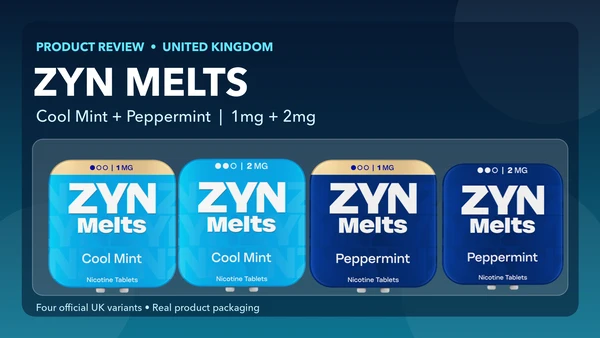
Philip Morris International (PMI) has launched ZYN Melts in the UK, introducing a fully dissolvable oral nicotine tablet format alongside the brand's existing nicotine pouches. The range includes Cool Mint and Peppermint, each offered at 1mg and 2mg of nicotine per tablet, creating four SKUs. Each can contains 20 tablets and is priced at £6.50 in the UK. Unlike ZYN nicotine pouches, Melts are placed between the upper lip and gum and dissolve completely during use.
News
Sep.29 by 2Firsts Perspectives
China Tobacco Supply-Chain Leader Huabao’s Three-Way Transformation Takes Hold as Overseas Revenue Jumps 216%, Non-Flavor Businesses Reach 42.2% and the Company Expands Into Global Next-Generation Tobacco Supply Chains
Huabao’s H1 2026 results show the company advancing across three connected fronts: international expansion, entry into next-generation tobacco supply chains and diversification beyond its traditional tobacco-related base. Overseas revenue rose 216.08% to CNY 96.02 million, while non-flavor businesses reached 42.2% of total revenue. Huabao also said it had entered the supply chains of leading global tobacco customers, as its nutrition, food ingredient, fragrance and personal-care businesses gained ground in Europe, Southeast Asia, Australia and New Zealand. However, adjusted net profit increased only 2.78%, and next-generation tobacco revenue was not separately disclosed, showing that the transformation is reshaping revenue and customer exposure but has yet to translate fully into underlying earnings.
Aug.28
2Firsts First Look|China to End VAT Export Rebates on Vape Devices and Nicotine in April 2027, Following Earlier Removal for HTP Devices and Nicotine Vapes
China's Ministry of Finance and State Taxation Administration announced on October 12, 2026, that value-added tax (VAT) export rebates for vape devices, nicotine and its salts, and certain non-combustible inhalation products will be eliminated from April 1, 2027. The measure adds four tobacco- and nicotine-related customs codes, including 8543400010, which covers vape devices and qualifying empty pods. China previously eliminated rebates for nicotine-containing vaping products and devices under code 8543400090 in April 2026. According to industry classification information held by 2Firsts, the latter currently corresponds to heated tobacco devices. Export excise tax refund and exemption arrangements will remain unchanged.
Special Report
Oct.12
U.S. Customs Plan to Require Foreign Export Declarations Could Deal ‘Devastating’ Blow to China’s Vape Exports, Logistics gl Expert Says
A U.S. Customs and Border Protection proposal to collect foreign export declarations and other overseas customs documents could expose discrepancies in the value, classification and description of China-made vape shipments entering the United States. A veteran Chinese logistics professional told 2Firsts that the measure, if implemented, could undermine the all-inclusive shipping model used by some unauthorized vape exporters and push parts of the trade toward costlier underground channels. The risk extends beyond higher duties: accurately declared products may also be more readily identified as unauthorized e-cigarettes subject to FDA enforcement.
Special Report
Sep.07