LKTN Cracks Down on Unlicensed Tobacco Retailers in Malaysia

Regulations by 2FIRSTS.ai
Aug.21.2024
LKTN Cracks Down on Unlicensed Tobacco Retailers in Malaysia
LKTN Chairman Datuk Wan Abd Rahim Wan Abdullah stated at a parade event today that Malaysia has issued 30,000 tobacco licenses nationwide, with 3,000 in Kelantan.

According to The Sun, on August 21, Datuk Wan Abd Rahim Wan Abdullah, chairman of Malaysia's National Kenaf and Tobacco Board (LKTN), announced at the "Jalur Gemilang" and Independence Day parade ceremony today that 30,000 tobacco distribution or production licenses have been registered and issued nationwide, with approximately 3,000 licenses approved in the state of Kelantan.


He pointed out that many warehouse owners, retailers, and distributors in rural areas have not yet applied for tobacco distribution or production licenses.


To address this issue and increase the license application rate, LKTN has implemented intelligent enforcement measures. These measures include conducting on-site inspections in key urban and rural areas to enhance understanding of license requirements.


We have identified several non-compliant business establishments, including retailers, which may face fines of up to RM 250,000 (USD 57,084) for selling and distributing tobacco products without proper authorization.


Media reports earlier indicated that from January 1, 2023, to July 15 of the same year, LKTN has approved 29,098 tobacco distribution or production licenses out of 38,067 registered establishments on the Malaysian peninsula.


According to reports, the Malaysia National Tobacco Board, established in 1973, was dissolved in 2010 and replaced by the National Kenaf and Tobacco Board (LKTN). The board's purpose is to regulate and coordinate activities related to the tobacco industry in Malaysia.


We welcome news tips, article submissions, interview requests, or comments on this piece.

Please contact us at info@2firsts.com, or reach out to Alan Zhao, CEO of 2Firsts, on LinkedIn


Notice

1.  This article is intended solely for professional research purposes related to industry, technology, and policy. Any references to brands or products are made purely for objective description and do not constitute any form of endorsement, recommendation, or promotion by 2Firsts.

2.  The use of nicotine-containing products — including, but not limited to, cigarettes, e-cigarettes, nicotine pouchand heated tobacco products — carries significant health risks. Users are responsible for complying with all applicable laws and regulations in their respective jurisdictions.

3.  This article is not intended to serve as the basis for any investment decisions or financial advice. 2Firsts assumes no direct or indirect liability for any inaccuracies or errors in the content.

4.  Access to this article is strictly prohibited for individuals below the legal age in their jurisdiction.


Copyright


This article is either an original work created by 2Firsts or a reproduction from third-party sources with proper attribution. All copyrights and usage rights belong to 2Firsts or the original content provider. Unauthorized reproduction, distribution, or any other form of unauthorized use by any individual or organization is strictly prohibited. Violators will be held legally accountable.

For copyright-related inquiries, please contact: info@2firsts.com


AI Assistance Disclaimer


This article may have been enhanced using AI tools to improve translation and editorial efficiency. However, due to technical limitations, inaccuracies may occur. Readers are encouraged to refer to the cited sources for the most accurate information.

We welcome any corrections or feedback. Please contact us at: info@2firsts.com

Cochrane 2026 Update Adds Nine Trials, Keeps High-Certainty Finding That Nicotine E-Cigarettes Improve Quit Rates Over NRT
Cochrane’s 2026 update of its living review on electronic cigarettes for smoking cessation included 80 randomized controlled trials involving 29,861 adult smokers, with nine trials added in this update. The review retained its high-certainty conclusion that nicotine e-cigarettes increase smoking cessation rates compared with nicotine replacement therapy. In absolute terms, about 10 in 100 people using nicotine e-cigarettes may quit smoking for at least six months, compared with about 6 in 100 using NRT. The review found no clear difference in serious adverse event rates between the two groups, while longer-term safety and the relative effectiveness of newer device types remain less certain.
Sep.07
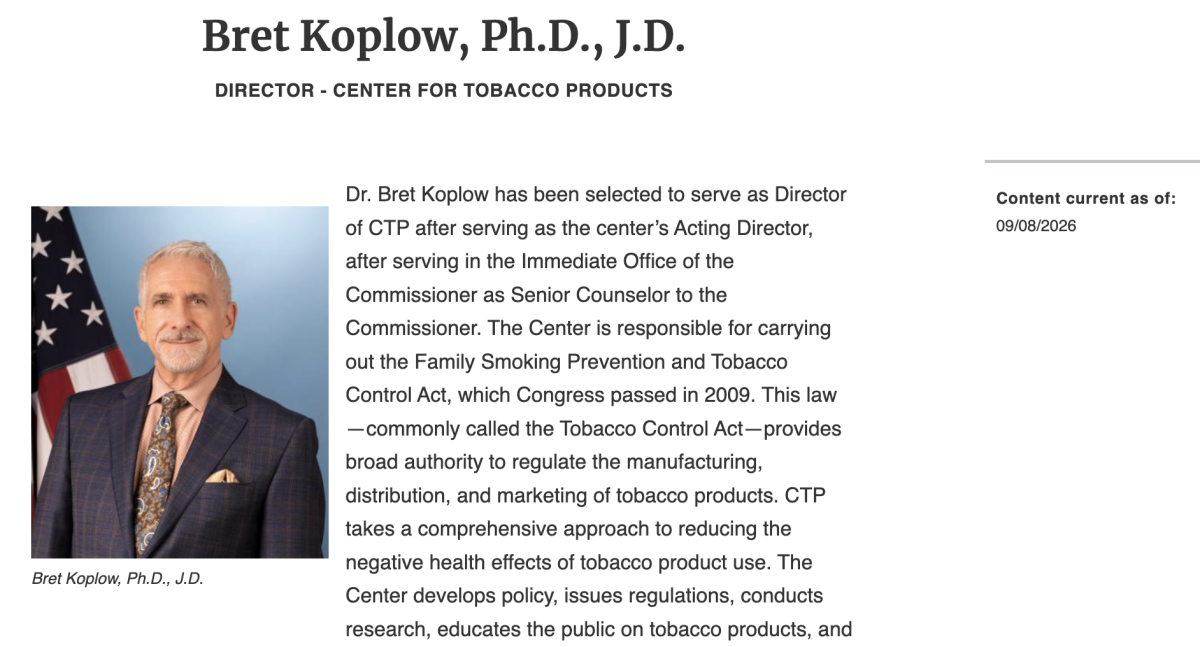
Bret Koplow Takes Permanent Charge of FDA Tobacco Center After Pushing Faster PMTA Reviews, as HHS Emphasizes Innovation and Access to Lower-Risk Alternatives
The U.S. Department of Health and Human Services has named Bret Koplow permanent director of the FDA’s Center for Tobacco Products, ending his period as acting chief. Koplow has spent years working on tobacco regulation, law and policy inside the FDA and, while serving as acting director, pushed for faster PMTA reviews and nicotine pouch review pilots. HHS also said CTP will prioritize innovation and access to less harmful alternatives for adult smokers while continuing efforts to protect youth.
Sep.09
Australia Tobacco Tax Debate Spreads Within Labor as NSW Premier Minns Reaffirms Support for a Cut
Australia’s tobacco excise debate is increasingly exposing differences within the governing Labor Party. New South Wales Labor Premier Chris Minns reaffirmed on September 8 that he supports reducing tobacco excise, arguing that current tax settings are pushing consumers toward cheaper black-market cigarettes. Federal Health Minister Mark Butler continues to oppose an excise cut, while Treasurer Jim Chalmers and Assistant Treasurer Daniel Mulino have recently stopped short of ruling out future changes. The divergence follows the opposition Coalition’s proposal to cut tobacco excise by 80%.
Sep.08
PMI Expands U.S. ZYN Portfolio With New 1.5 mg and 8 mg Strengths, Moves Toward a Unified 20-Pouch-Per-Can Format
Philip Morris International is expanding its U.S. ZYN nicotine pouch portfolio with new 1.5 mg and 8 mg strengths and plans to move its core 3 mg and 6 mg dry-pouch products from 15 to 20 pouches per can in the fourth quarter of 2026. ZYN ULTRA is also commercially available, with FDA authorization covering 10 products at 9 mg and one 11 mg Smooth product. PMI U.S. lists the new 1.5 mg and 8 mg strengths as commercially available, but as of September 10 they do not appear on the FDA’s public authorization list. Public materials do not identify which PMTA submissions cover the two new strengths or their current review status.
Sep.11
JUUL2 Sued Within a Week of FDA Authorization as AJ Marketing Alleges Infringement of Programmable Vape Patent
Less than a week after JUUL2 received U.S. FDA marketing authorization on August 28, 2026, JUUL Labs was sued for patent infringement in federal court in Delaware. AJ Marketing LLC filed the complaint on September 3, alleging that both JUUL 1 and JUUL2 infringe U.S. Patent No. 8,851,068 B2. The patent covers aspects of programmable electronic vaporization devices, including controls over dose delivery, usage frequency and operating parameters. The plaintiff is seeking reasonable royalties and ongoing royalties tied to the remaining life of the patent. JUUL has not yet publicly responded to the case.
Sep.10
Retail Case Study | Wisconsin Vape Market One Year After New Regulations: Johnny Vapes Reports 80% Sales Decline as Consumers Shift Online and Across State Lines
According to WNCY on August 24, 2026, some independent vape retailers in Wisconsin say they have faced significant business pressure one year after new vape regulations took effect. Johnny Vapes, a retailer operating in northeast Wisconsin, said its store count fell from seven locations to four, sales declined by about 80%, and roughly 90% of its inventory was affected. Retailers said some consumers have shifted to online purchases or traveled to neighboring Michigan to buy vape products. The case highlights how local regulations can reshape retail operations, inventory management and consumer purchasing patterns.
Aug.28