NYS Youth Tobacco Use Down 29% Since 2022, Lowest Since 2000

Oct.24
NYS Youth Tobacco Use Down 29% Since 2022, Lowest Since 2000
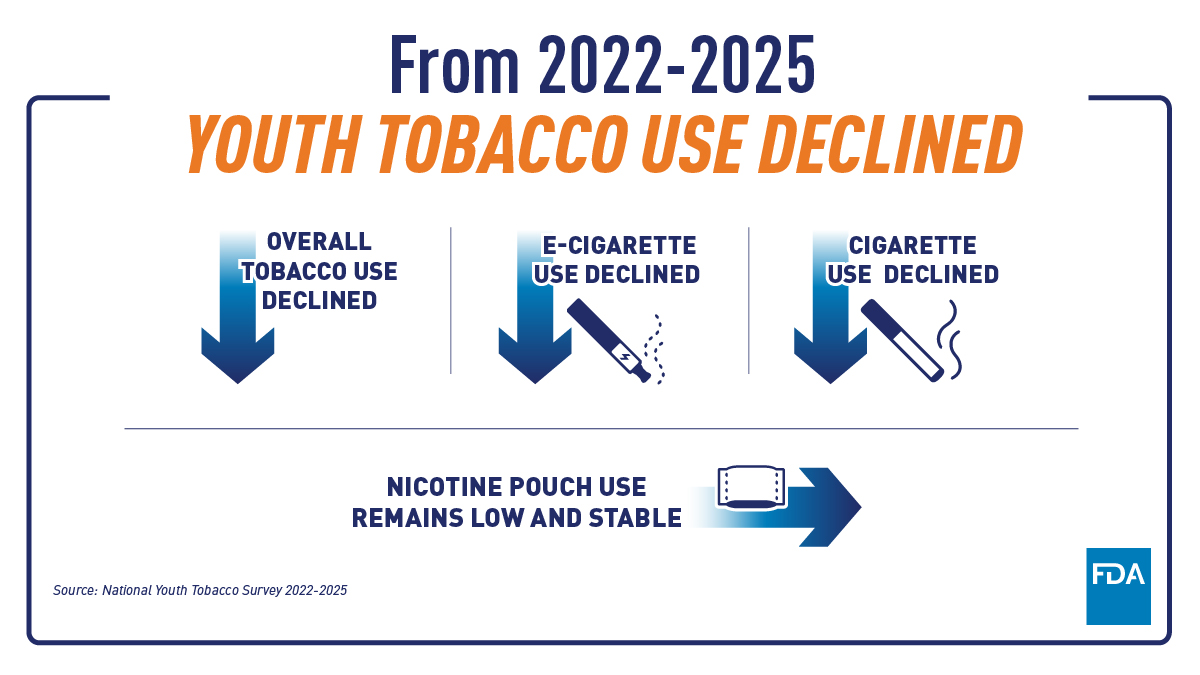
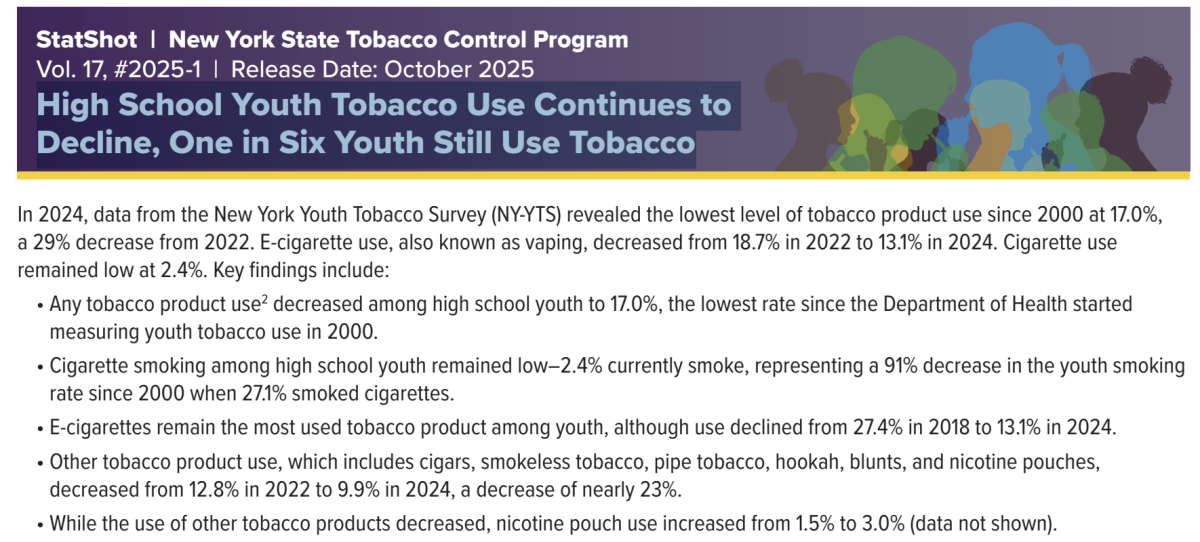
According to the New York State Department of Health’s latest StatShot (Vol.17, #2025-1), high school tobacco product use in 2024 fell to 17.0%, the lowest rate since 2000, marking a 29% decline from 2022. E-cigarette use decreased from 18.7% to 13.1%, while cigarette use remained low at 2.4%.However, nicotine pouch use increased from 1.5% to 3.0%.


Key Highlights (Expanded)


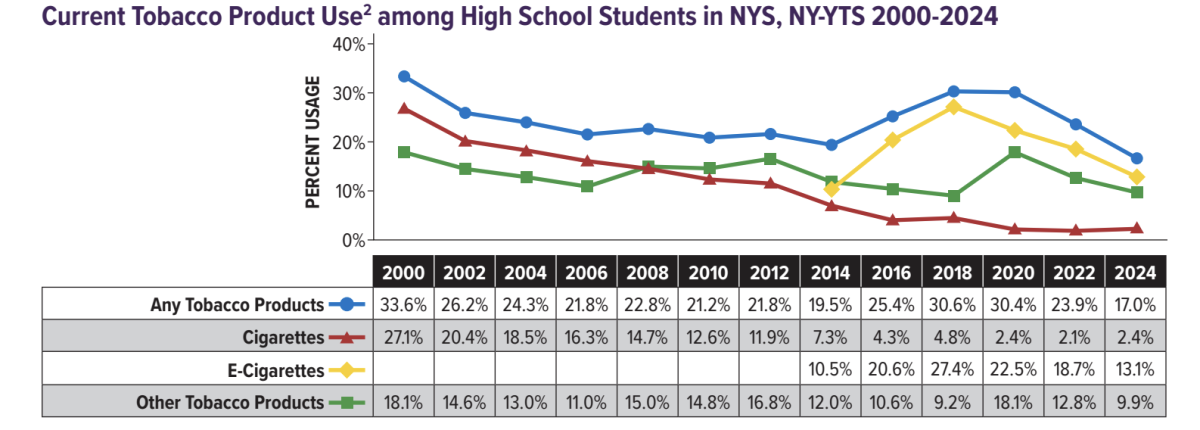
  • Overall youth tobacco use dropped to 17.0%, the lowest since data collection began in 2000 — a 29% decline since 2022.
  • E-cigarette use fell to 13.1%, down from 18.7% in 2022 and 27.4% in 2018.
  • Cigarette smoking remains low at 2.4%, a 91% decline from 27.1% in 2000.
  • Other tobacco use decreased to 9.9%, though nicotine pouch use doubled to 3.0%.
  • State laws since 2020 include bans on pharmacy tobacco sales, flavored vape products, and school-area advertising.


2Firsts, October 23, 2025 — According to the New York State Department of Health’s StatShot (Vol.17, #2025-1), youth tobacco use among high school students in New York reached a record low of 17.0% in 2024, down from 23.9% in 2022, marking a 29% decline.


E-cigarette use, though still the most prevalent form of tobacco consumption among teens, declined from 18.7% to 13.1% over the same period. Cigarette use held steady at 2.4%, a dramatic 91% drop from the 27.1% recorded in 2000.


Usage of other tobacco products, including cigars, smokeless tobacco, hookah, blunts, and nicotine pouches, decreased from 12.8% to 9.9%, while nicotine pouch use rose from 1.5% to 3.0%.
 

NYS Youth Tobacco Use Down 29% Since 2022, Lowest Since 2000
Report data | Source: StatShot


Health officials warn that nicotine exposure during adolescence leads to addiction and brain harm. Since 2020, the state has enforced pharmacy tobacco sales bans, flavor restrictions on vape products, and limitations on discounts and school-area advertising. The department stresses that continued surveillance is essential to track emerging nicotine products and ensure health equity.


Image source: New York State Department of Health / StatShot Vol.17.


We welcome news tips, article submissions, interview requests, or comments on this piece.

Please contact us at info@2firsts.com, or reach out to Alan Zhao, CEO of 2Firsts, on LinkedIn


Notice

1.  This article is intended solely for professional research purposes related to industry, technology, and policy. Any references to brands or products are made purely for objective description and do not constitute any form of endorsement, recommendation, or promotion by 2Firsts.

2.  The use of nicotine-containing products — including, but not limited to, cigarettes, e-cigarettes, nicotine pouchand heated tobacco products — carries significant health risks. Users are responsible for complying with all applicable laws and regulations in their respective jurisdictions.

3.  This article is not intended to serve as the basis for any investment decisions or financial advice. 2Firsts assumes no direct or indirect liability for any inaccuracies or errors in the content.

4.  Access to this article is strictly prohibited for individuals below the legal age in their jurisdiction.


Copyright


This article is either an original work created by 2Firsts or a reproduction from third-party sources with proper attribution. All copyrights and usage rights belong to 2Firsts or the original content provider. Unauthorized reproduction, distribution, or any other form of unauthorized use by any individual or organization is strictly prohibited. Violators will be held legally accountable.

For copyright-related inquiries, please contact: info@2firsts.com


AI Assistance Disclaimer


This article may have been enhanced using AI tools to improve translation and editorial efficiency. However, due to technical limitations, inaccuracies may occur. Readers are encouraged to refer to the cited sources for the most accurate information.

We welcome any corrections or feedback. Please contact us at: info@2firsts.com

South Korea’s National Assembly Passes Law Classifying E-Cigarettes as Tobacco Products with Full Equivalent Regulation
South Korea’s National Assembly recently passed a comprehensive package of 79 bills that, among other measures, formally classifies liquid vapes — e-cigarette products using nicotine-containing e-liquids — as tobacco products. These products will now be subject to the same taxation, sales restrictions and advertising controls as traditional cigarettes, and the vaping industry in South Korea is expected to face significant adjustments in compliance costs, market access and business strategy.
Dec.03
Imperial Brands FY25 Results: NGP Net Revenue Up 13.7%, Americas Surges Nearly 70%
Imperial Brands reported FY25 NGP net revenue of £368 million, up 13.7% at constant currency. Growth in the Americas accelerated sharply, with NGP revenue up 69.8%, driven by the expansion of the modern oral brand Zone. Europe delivered 8.8% growth, supported by blu’s double-digit vapour share across key markets. Adjusted NGP operating losses narrowed to £76 million, putting the category closer to breakeven.
Nov.18 by 2FIRSTS.ai
Echo Guo: The Accumulating Risks Behind the Surge in Chinese Vape Exports to the U.S.
Chinese vape exports to the U.S. jumped from about 2.2 million kg in June to 14.8 million kg in October 2025, despite tougher enforcement, the Washington Examiner reported. 2Firsts finds the surge reflects delayed bulk shipments, not demand recovery. With U.S. inventory exceeding 160 million devices and distributors paying ~10% upfront, cash-flow stress has shifted to Chinese manufacturers, and discounted stock is spilling into other markets.
Dec.14 by Echo Duo
Expert Warns in 2Firsts Op-ed: Proposed COP11 Ban on Nicotine Pouches Would Be a Global Public Health Mistake
As global delegates prepare for COP11, a leaked EU position paper has sparked fresh debate over the future of nicotine pouch regulation. In an exclusive op-ed submitted to 2Firsts, Dr. Nveed Chaudhary, Chair of GINN’s Scientific Committee, argues that banning nicotine pouches would be a profound public health mistake—one that ignores harm reduction science and risks reversing global progress in smoking cessation.
Nov.03
BAT Korea Launches Year-End Promotion for “glo hyper” as Demand for Odorless Heated Tobacco Rises
BAT Rothmans has announced a year-end promotion for its “glo hyper” heated tobacco series in response to growing consumer demand for odorless devices during the cold season. As indoor activity rises, more smokers are shifting to heated tobacco products that produce less smell and ash. Government data show HNB sales grew 8.3% last year, accounting for 18.4% of the tobacco market.
Nov.12 by 2FIRSTS.ai
Spain's Socialist Party proposes gradual decrease of nicotine pouch tax rate to 0.10 euros/gram by 2030
Spain’s Socialist Party (PSOE) has submitted a legal amendment to the Congress proposing a gradual reduction of the excise duty on nicotine pouches. The current rate of €0.10 per gram would be phased in progressively until 2030. The plan sets the rate at €0.02/g in 2026, rising by €0.02 annually until reaching €0.10/g in 2030. PSOE says this measure would mitigate price shocks and make the tax system more progressive.
Nov.04 by 2FIRSTS.ai