Key Takeaways
- Philip Morris International (PMI)’s heated tobacco patent was invalidated due to a lack of inventiveness.
- The challenger was Fontem Ventures BV, a subsidiary of Imperial Brands (owner of the Blu e-cigarette brand).
- The European Patent Office’s (EPO) Board of Appeal ruled that the patent was too similar to an earlier U.S. aerosol patent.
- Case number: T 0258/24, involving patent EP2654470.
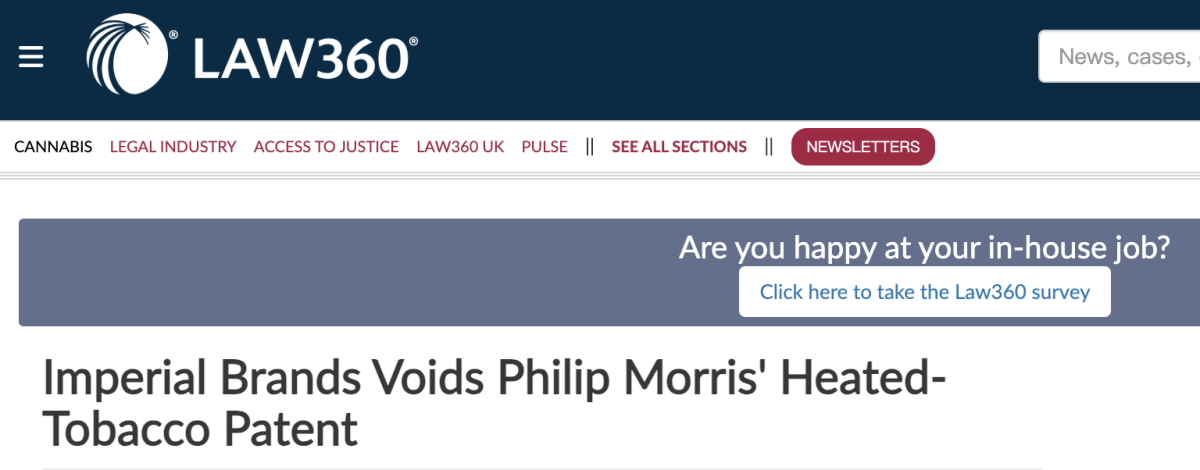
2Firsts, October 11, 2025 — According to Law360, a Philip Morris International (PMI) patent for heated tobacco technology has been invalidated by the European Patent Office’s Board of Appeal following a challenge from Fontem Ventures BV, a subsidiary of Imperial Brands (IMB). The board ruled that the patent lacked inventiveness. The decision was made on September 12 and published on October 10.
Case Overview
The patent in question, EP2654470, is held by Philip Morris Products SA, a wholly owned subsidiary of PMI. It covers a device technology that generates aerosols by heating liquids. Fontem argued before the EPO’s Board of Appeal that the patent was too similar to an earlier U.S. aerosol generator patent and therefore not innovative.
The Board found that the only substantial difference between PMI’s invention and the earlier patent lay in how the system detected the amount of liquid remaining:
- PMI’s system estimated remaining liquid based on the number of puffs taken.
- The earlier patent determined it by measuring the amount of liquid consumed per inhalation.
According to the Board, the only way to estimate the remaining liquid is by subtracting the amount consumed from the initial quantity. Therefore, combining the earlier patent with common technical knowledge would allow a skilled person to arrive at the same solution without creativity. The ruling stated:
“To estimate the remaining liquid amount, one simply calculates or estimates the liquid consumed in each heating cycle and subtracts it from the initial amount.”
Appeal and Ruling Details
Fontem Ventures BV successfully convinced the Board that PMI’s patent lacked genuine innovation over the earlier U.S. patent. Even if PMI’s design differed slightly, combining it with another prior art—an early medical inhaler patent—still would not constitute an inventive step.
The Board reasoned that a skilled technician would naturally reference the inhaler patent to address user-experience challenges, such as notifying users when to refill liquid. It further noted that whether the inhaler patent involved a heating element was “irrelevant,” as both inhalers and heated tobacco devices face the same issue of liquid-level detection.
Parties and Legal Representatives
In addition to Fontem, JT International SA (owner of brands including Camel, Silk Cut, and Nordic Spirit) also filed an opposition against the PMI patent but did not join Fontem’s appeal against the EPO’s decision to maintain the amended version of the patent.
The involved parties were represented by the following law firms:
- Fontem Ventures BV: Gulde & Partner Patent- und Rechtsanwaltskanzlei mbB
- JT International SA: Gill Jennings & Every LLP
- Philip Morris Products SA: HGF Ltd
The case, numbered T 0258/24, was heard by the Technical Board of Appeal of the European Patent Office.
We welcome news tips, article submissions, interview requests, or comments on this piece.
Please contact us at info@2firsts.com, or reach out to Alan Zhao, CEO of 2Firsts, on LinkedIn
Notice
1. This article is intended solely for professional research purposes related to industry, technology, and policy. Any references to brands or products are made purely for objective description and do not constitute any form of endorsement, recommendation, or promotion by 2Firsts.
2. The use of nicotine-containing products — including, but not limited to, cigarettes, e-cigarettes, nicotine pouchand heated tobacco products — carries significant health risks. Users are responsible for complying with all applicable laws and regulations in their respective jurisdictions.
3. This article is not intended to serve as the basis for any investment decisions or financial advice. 2Firsts assumes no direct or indirect liability for any inaccuracies or errors in the content.
4. Access to this article is strictly prohibited for individuals below the legal age in their jurisdiction.
Copyright
This article is either an original work created by 2Firsts or a reproduction from third-party sources with proper attribution. All copyrights and usage rights belong to 2Firsts or the original content provider. Unauthorized reproduction, distribution, or any other form of unauthorized use by any individual or organization is strictly prohibited. Violators will be held legally accountable.
For copyright-related inquiries, please contact: info@2firsts.com
AI Assistance Disclaimer
This article may have been enhanced using AI tools to improve translation and editorial efficiency. However, due to technical limitations, inaccuracies may occur. Readers are encouraged to refer to the cited sources for the most accurate information.
We welcome any corrections or feedback. Please contact us at: info@2firsts.com