Special Statement:
This article is limited to conducting research on relevant industries and overseas markets. It does not recommend any products or provide commentary on any domestic policies.
The legitimacy of the product mentioned in the article is only applicable to its overseas location. Domestic readers are advised to take note and strictly adhere to relevant laws and regulations in China.
This article does not constitute any investment or financial advice.
This article is not suitable for minors to read.
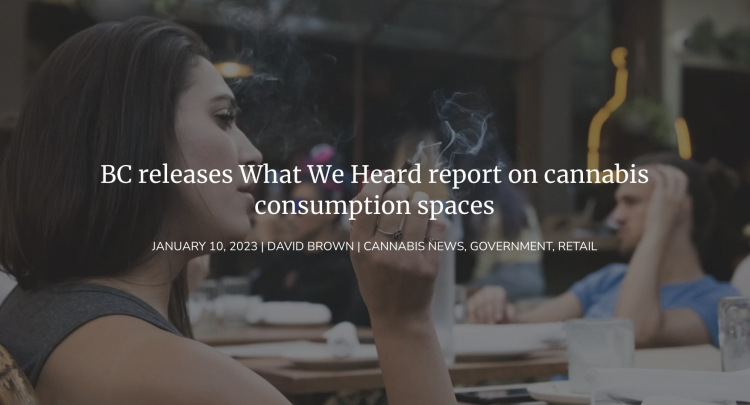
The province of British Columbia in Canada has released a report titled "What We Heard", based on a 2022 investigation into the feasibility of marijuana consumption spaces.
A recent survey conducted through online and telephone channels has shown a strong support among marijuana consumers for marijuana-specific consumption venues, as well as concerns regarding the potential unsafe driving behavior caused by marijuana and alcohol consumption.
A total of 61% of phone survey respondents and 34% of online survey respondents expressed support for marijuana consumption facilities, according to a recent report. The report also suggests that variations in support may be linked to self-selection biases, as phone sampling is random while online surveys may be more targeted.
Compared to older Canadians, young people are also more likely to support cannabis consumption venues.
The feedback from this survey will help the provincial government to decide whether or not to allow cannabis consumption sites and how to implement them.
Although many people often think of smoking rooms or electronic cigarette lounges, the province's definition of cannabis consumption venues is broader, including specific cannabis consumption locations, consumption during festivals or other events, and even cannabis consumption in "non-cannabis primary locations".
As indoor smoking and vaping are prohibited by law, such venues are not being considered.
Earlier this year, the British Columbia government sought feedback from the public on what cannabis consumption spaces in the province could look like.
When considering how provincial marijuana policy will evolve, our top priority is health and safety," said Mike Farnworth, Minister of Public Safety and Solicitor General. "This report provides valuable insights into people's perceptions of marijuana in BC and will help guide our work to support a strong, diverse, and safe legal cannabis industry throughout the province.
The majority of survey respondents who reported using marijuana also expressed support for consumption venues, as did industry associations for marijuana retailers, producers, and those providing written opinions.
However, non-cannabis consumers and certain public health and safety organizations, as well as local governments, generally do not support such establishments.
A total of 730 individuals participated in the telephone survey, 15,362 completed the online survey, and 66 individuals, companies, and organizations provided written comments.
Exploring the feasibility of cannabis consumption venues is another way the province of British Columbia is working to support the success of the industry, said Brittany Anderson, Secretary of the Tourism Council. "With the recent introduction of farm sales licenses, understanding public attitudes towards cannabis-related hospitality and agritourism activities is the next practical step. The feedback in this report will play an important role in shaping provincial policy.
The ability to purchase and consume marijuana products, such as food and drink, in places where alcohol is also sold and consumed is a controversial topic. Among respondents who participated in a telephone survey, 42% support this model while 41% oppose it. In an online survey, 64% of respondents oppose this model, while only 32% support it.
Public health officials who oppose the co-location of cannabis consumption facilities with alcohol establishments cite concerns over double consumption and addiction as their main concerns. However, most cannabis industry affiliated organizations support co-existence with alcohol consumption venues. It is not yet clear what regulations the province will implement next with regards to cannabis consumption facilities.
Disclaimer
This article is provided solely for professional research, industry discussion, and informational purposes. Any references to brands, companies, products, technologies, or policies are made for factual reporting and analytical purposes only, and do not constitute endorsement, recommendation, promotion, or advertising by 2Firsts.
Nicotine-containing products, including but not limited to cigarettes, e-cigarettes, heated tobacco products, and nicotine pouches, carry significant health risks. Readers are responsible for complying with all applicable laws and regulations in their respective jurisdictions, including age restrictions and access limitations.
The information contained in this article should not be regarded as investment, legal, medical, regulatory, or commercial advice. While 2Firsts strives to ensure the accuracy and reliability of its content, it does not assume liability for any direct or indirect loss arising from errors, omissions, inaccuracies, or reliance on the information contained herein.
This article is not intended for individuals below the legal age for accessing tobacco or nicotine-related information in their jurisdiction.
Copyright Notice
This article is either original content produced by 2Firsts or content reproduced, translated, summarized, or adapted from third-party sources with attribution where applicable. The intellectual property rights of the original content remain with 2Firsts or the respective original rights holders.
No individual or organization may copy, reproduce, distribute, republish, modify, translate, or otherwise use this content without prior authorization. Any unauthorized use may result in legal action.
For copyright-related inquiries, corrections, or removal requests, please contact: info@2firsts.com.
AI-Assisted Translation and Editing Notice
Portions of this article may have been translated, edited, or reviewed with the assistance of artificial intelligence tools to improve efficiency and readability. Due to the limitations of AI-assisted translation and editing, discrepancies, omissions, or inaccuracies may exist when compared with the original source.
Where applicable, readers are advised to refer to the original source for the most complete and accurate information. If you identify any errors or believe that any content infringes upon your rights, please contact us at info@2firsts.com, and we will review and address the matter promptly.