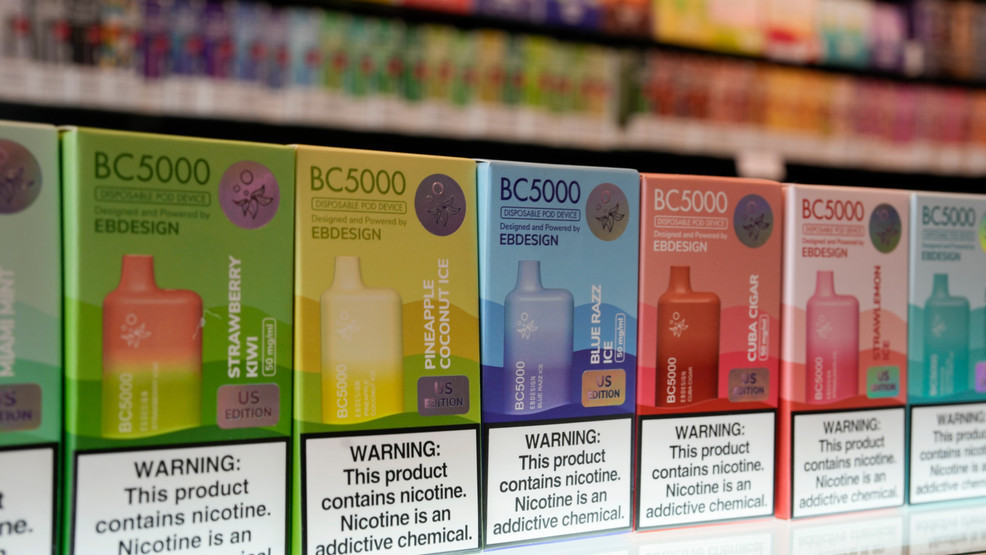
Tennessee Senate Passes Bill Imposing New Tax on E-Cigarettes

Apr.02.2025
Tennessee Senate Passes Bill Imposing New Tax on E-Cigarettes
Tennessee Senate passes e-cigarette tax bill to reduce youth usage, facing concerns over impact on businesses.

Key Points:

  • The Senate of Tennessee has passed a regulation imposing a new 10% tax on certain e-cigarette products, which will now be reviewed by the House of Representatives.
  • The bill aims to reduce youth e-cigarette use by creating an FDA authorized product directory and requiring individuals to be at least 21 years old to purchase.
  • Some legislators and business owners are concerned that the bill will impact operations, as 500 approved products may struggle to sustain business.

According to a report by Fox17 on April 2, the Tennessee Senate has passed a new regulation to impose taxes on certain e-cigarette products. The regulation will now be reviewed by the House of Representatives.


According to the fiscal note of the bill, the new tax is expected to generate over $16 million in revenue for the state's general fund. If passed, the bill will impose a 10% tax on e-cigarette products.


According to data from the Tennessee Health Advisory Board, the rate of young people using e-cigarettes in Tennessee is more than double the national average, reaching 22%.


Senator Ken Yager stated that House Bill 0968 aims to prevent e-cigarettes, which are flooding the market, from causing harm to children. If the bill passes, the law will create a catalog of e-cigarette products authorized by the FDA for sale in Tennessee. Additionally, young people must present identification to prove they are over 21 years old.


Senator Jeff Yarbro agrees that there needs to be regulation for e-cigarettes, but he doesn't believe that this bill will address the root of the problem. Instead, it may impact businesses' operations.


Phil Harrell, a member of the Smoke-Free Association, expressed concerns on behalf of 800 e-cigarette stores in Tennessee. He is worried that the approval of fewer than 500 e-cigarette products may not be enough to support their businesses.


We welcome news tips, article submissions, interview requests, or comments on this piece.

Please contact us at info@2firsts.com, or reach out to Alan Zhao, CEO of 2Firsts, on LinkedIn


Notice

1.  This article is intended solely for professional research purposes related to industry, technology, and policy. Any references to brands or products are made purely for objective description and do not constitute any form of endorsement, recommendation, or promotion by 2Firsts.

2.  The use of nicotine-containing products — including, but not limited to, cigarettes, e-cigarettes, nicotine pouchand heated tobacco products — carries significant health risks. Users are responsible for complying with all applicable laws and regulations in their respective jurisdictions.

3.  This article is not intended to serve as the basis for any investment decisions or financial advice. 2Firsts assumes no direct or indirect liability for any inaccuracies or errors in the content.

4.  Access to this article is strictly prohibited for individuals below the legal age in their jurisdiction.


Copyright


This article is either an original work created by 2Firsts or a reproduction from third-party sources with proper attribution. All copyrights and usage rights belong to 2Firsts or the original content provider. Unauthorized reproduction, distribution, or any other form of unauthorized use by any individual or organization is strictly prohibited. Violators will be held legally accountable.

For copyright-related inquiries, please contact: info@2firsts.com


AI Assistance Disclaimer


This article may have been enhanced using AI tools to improve translation and editorial efficiency. However, due to technical limitations, inaccuracies may occur. Readers are encouraged to refer to the cited sources for the most accurate information.

We welcome any corrections or feedback. Please contact us at: info@2firsts.com

Science | International Experts Propose a New Smoking Cessation Pathway, Citing Higher Quit Rates With E-Cigarettes Than Nicotine Replacement Therapy
A new expert paper in JAMA urges U.S. clinicians to include nicotine e-cigarettes in smoking-cessation discussions, citing higher quit rates than nicotine replacement therapy. It also stresses that products must deliver enough nicotine to replace cigarettes, dual use should be brief, and complete switching is the goal. 2Firsts argues the recommendations matter beyond clinics: public-health professionals should reassess relative risk, regulators should preserve sufficient product appeal for adult smokers, and manufacturers should focus on helping users quit cigarettes more sustainably.
SCIENCE
Aug.03 by 2Firsts Perspectives
Dutch NVWA Seizes Record 277,000 Illegal Vapes; Video Shows “AL FAKHER” Cartons
The Dutch Food and Consumer Product Safety Authority, known as the NVWA, seized more than 277,000 illegal vapes near Rotterdam and nearly 150,000 boxes of nicotine pouches in Utrecht and Rotterdam, calling them the largest batches of such products it has found to date. Video footage released by the NVWA shows some cartons in the warehouse bearing the “AL FAKHER / الفاخر” name, though the agency did not identify brands.
Jul.10
2Firsts Data | China’s Vape Exports Rise 3.1% in H1 2026 as 6-Methyl Nicotine-Related Products Surge 65.2%
China’s vape exports showed resilience in the first half of 2026 after a short-term shock from China’s export rebate adjustment. But customs data points to more than a simple recovery: the structure of growth is changing. Vaping devices and atomization hardware emerged as the strongest growth driver, while nicotine-containing vaping products remained broadly stable. Meanwhile, nicotine substitute-related products represented by 6-methyl nicotine expanded rapidly, becoming a new category to watch for both industry and regulators. After the U.S. market went through a cycle of shortages, replenishment and inventory rebuilding in 2025, China’s vape supply chain is entering a new phase of reallocation.
Special Report
Jul.20
PMI Q2 Call: ZYN Growth, IQOS Pricing and a Diverging Global Tobacco Market
Philip Morris International’s second-quarter earnings call offered new detail on its smoke-free strategy. Management said it would increase U.S. investment behind nicotine pouch brand ZYN, keep IQOS focused on volume before stronger pricing, and use SENTIA, DELIA, LEVIA, VEEV and ZYN to manage tax and regulatory pressure across Japan and Europe. Analysts from Goldman Sachs, Morgan Stanley, UBS and other firms also pressed PMI on profitability, market share, cigarette resilience and the durability of its global transformation over coming quarters.
Jul.24
PMI to Launch IQOS in Argentina by End-2026 After Regulatory Shift, Targeting About 7 Million Smokers
Philip Morris International (PMI) has confirmed plans to bring its IQOS heated tobacco device to Argentina by the end of 2026, after the Argentine government lifted long-standing restrictions and created a regulatory framework for heated tobacco, e-cigarettes and nicotine pouches.
News
Jun.26 by 2Firsts Perspectives
AHA Journal Study: WS-23 Triples Premature Heartbeats, Raising Concerns Over Vape Cooling Agents
A University of Louisville research team published a study in an American Heart Association journal suggesting that synthetic cooling agents used in e-cigarettes, including WS-3 and WS-23, may disrupt cardiac electrical activity and increase arrhythmia risk. In animal experiments, WS-23 tripled premature heartbeats.
Jun.16