USDA Delays DEA-Required Marijuana Testing Due to 'Insufficient Capacity'

Dec.13.2022
USDA Delays DEA-Required Marijuana Testing Due to 'Insufficient Capacity'
USDA delays cannabis testing rule due to insufficient DEA-certified labs, worrying about lab capacity for 2023 growing season.

The United States Department of Agriculture (USDA) is delaying the implementation of a rule requiring marijuana to be tested by laboratories certified by the Drug Enforcement Administration (DEA). This is due to concerns over the "inadequate capabilities" of such facilities.


The US Department of Agriculture announced last week in a notice that it is extending the deadline for the enforcement of regulations on marijuana. The notice explains that the DEA laboratory testing requirements will not take effect as planned on January 1st. This controversial regulation is set to take effect on December 31, 2023, at the earliest.


The department stated that they are delaying the implementation of these requirements due to issues with the DEA laboratory registration process, as well as input from state and tribal governments and third-party cannabis testing facilities. Due to these delays, the USDA is concerned that there may not be enough cannabis laboratory testing capacity for the 2023 growing season, which could hinder the growth of the US cannabis market during this critical phase. It is important that laboratory testing of cannabis is in compliance with all other regulatory requirements.


Industry stakeholders in the United States have been criticizing the proposed requirement that only facilities registered with the DEA should conduct THC testing of marijuana. They argue that limited capacity has caused a bottleneck and that testing can be done effectively even without certification from the federal drug administration.


Earlier this year, Representative Chellie Pingree (D-ME) introduced a bill that would make multiple modifications to cannabis regulations, including the elimination of the requirement for DEA-registered labs to conduct testing.


US Agriculture Secretary Tom Vilsack has ultimately approved a broad federal rule that established regulations for the marijuana industry last year, despite concerns raised by advocates over certain provisions. This comes two years after the federal legalization of marijuana crops under the 2018 Agriculture Act.


Meanwhile, the United States Department of Agriculture is conducting an investigation to gather more information on cannabis production and the industry's economy.


At the same time, the agency also took measures to improve the insurance policies of cannabis businesses, making them more flexible in responding to stakeholder feedback.


2FIRSTS will continue to follow and report on this topic. Further updates will be available on the "2FIRSTS APP". Scan the QR code below to download the app.


Disclaimer

This article is provided solely for professional research, industry discussion, and informational purposes. Any references to brands, companies, products, technologies, or policies are made for factual reporting and analytical purposes only, and do not constitute endorsement, recommendation, promotion, or advertising by 2Firsts.

Nicotine-containing products, including but not limited to cigarettes, e-cigarettes, heated tobacco products, and nicotine pouches, carry significant health risks. Readers are responsible for complying with all applicable laws and regulations in their respective jurisdictions, including age restrictions and access limitations.

The information contained in this article should not be regarded as investment, legal, medical, regulatory, or commercial advice. While 2Firsts strives to ensure the accuracy and reliability of its content, it does not assume liability for any direct or indirect loss arising from errors, omissions, inaccuracies, or reliance on the information contained herein.

This article is not intended for individuals below the legal age for accessing tobacco or nicotine-related information in their jurisdiction.


Copyright Notice

This article is either original content produced by 2Firsts or content reproduced, translated, summarized, or adapted from third-party sources with attribution where applicable. The intellectual property rights of the original content remain with 2Firsts or the respective original rights holders.

No individual or organization may copy, reproduce, distribute, republish, modify, translate, or otherwise use this content without prior authorization. Any unauthorized use may result in legal action.

For copyright-related inquiries, corrections, or removal requests, please contact: info@2firsts.com.


AI-Assisted Translation and Editing Notice

Portions of this article may have been translated, edited, or reviewed with the assistance of artificial intelligence tools to improve efficiency and readability. Due to the limitations of AI-assisted translation and editing, discrepancies, omissions, or inaccuracies may exist when compared with the original source.

Where applicable, readers are advised to refer to the original source for the most complete and accurate information. If you identify any errors or believe that any content infringes upon your rights, please contact us at info@2firsts.com, and we will review and address the matter promptly.


Former Roche Neuroscience and Rare Diseases Communications Director Ria Kioupritzi Joins PMI as Scientific Affairs Director
Eleftheria (Ria) Kioupritzi, a biopharmaceutical professional with more than 15 years of experience, has joined Philip Morris International as Director Scientific Affairs within Corporate Affairs. She previously served at Roche as Senior Scientific Communications Director for Neuroscience and Rare Diseases and worked extensively in spinal muscular atrophy. Her earlier career also covered competitive intelligence, clinical and regulatory monitoring, pipeline development and launch preparation. During her time working in Roche's SMA field, Evrysdi passed through several U.S. FDA milestones, including its initial approval, an expanded indication for younger infants and approval of a tablet formulation. Public records do not show that Kioupritzi herself led the FDA submissions.
Sep.22
California Lawmakers Pass Disposable Nicotine Vape Ban, With Sales Prohibition Set for 2028
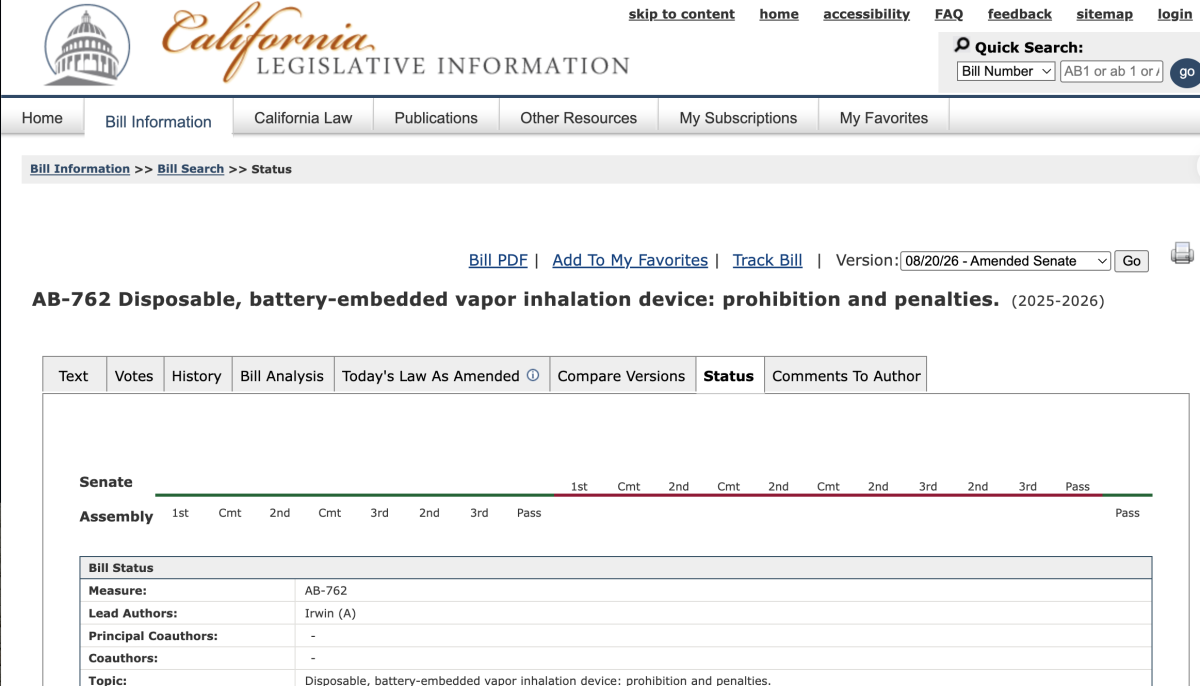
According to CBS Los Angeles on August 27, 2026, California lawmakers have passed Assembly Bill 762, which would phase out disposable, battery-embedded nicotine vapes in the state. If signed by Governor Gavin Newsom, manufacturing and importation of the covered products would be prohibited beginning January 1, 2027, followed by a sales ban on January 1, 2028. Driven primarily by concerns over electronic waste, lithium-battery fires and environmental pollution, the legislation would further shift California’s legal vape market toward rechargeable, refillable or replaceable-pod devices.
Aug.28
China’s HTP Exports Fell 14.3% in H1 2026 as Russia and Belarus Accounted for 76% Lead
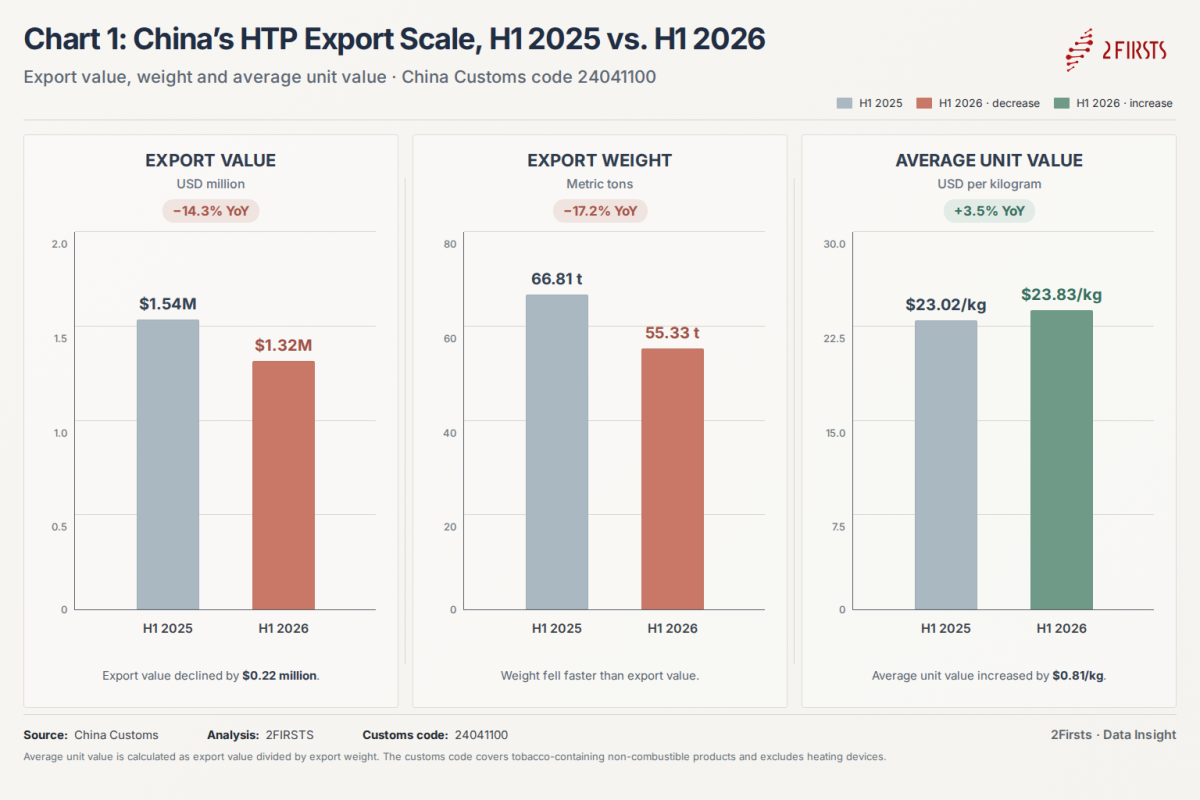
In H1 2026, China’s HS 24041100 exports stood at $1.32 million, down 14.3% YoY, with volume falling 17.2% to 55.33 tons. Market distribution shifted drastically amid overall export drops. Exports to Russia and Belarus totaled $1 million, taking 76.0% of all shipments versus 29.5% in H1 2025. Belarus became the top destination with export value jumping 177.5%, while the Philippines, Singapore and Indonesia’s combined share slumped from 49.3% to 11.2%.Domestically, Yunnan led exporter registrations; Jiangsu and Shanghai were key suppliers, yet Anhui and Sichuan had no exports. Heavy concentration means order or declaration changes for Russia/Belarus greatly affect national aggregate data. The data shows customs entry points (not end markets), covering tobacco consumables only, excluding heating equipment and the complete HTP supply chain.
Aug.11
JAMA Study: U.S. Vape Directories Fail to Sustainably Curb Unlisted Sales as Product Shifts May Redistribute Brand Share 2Firsts Recommended
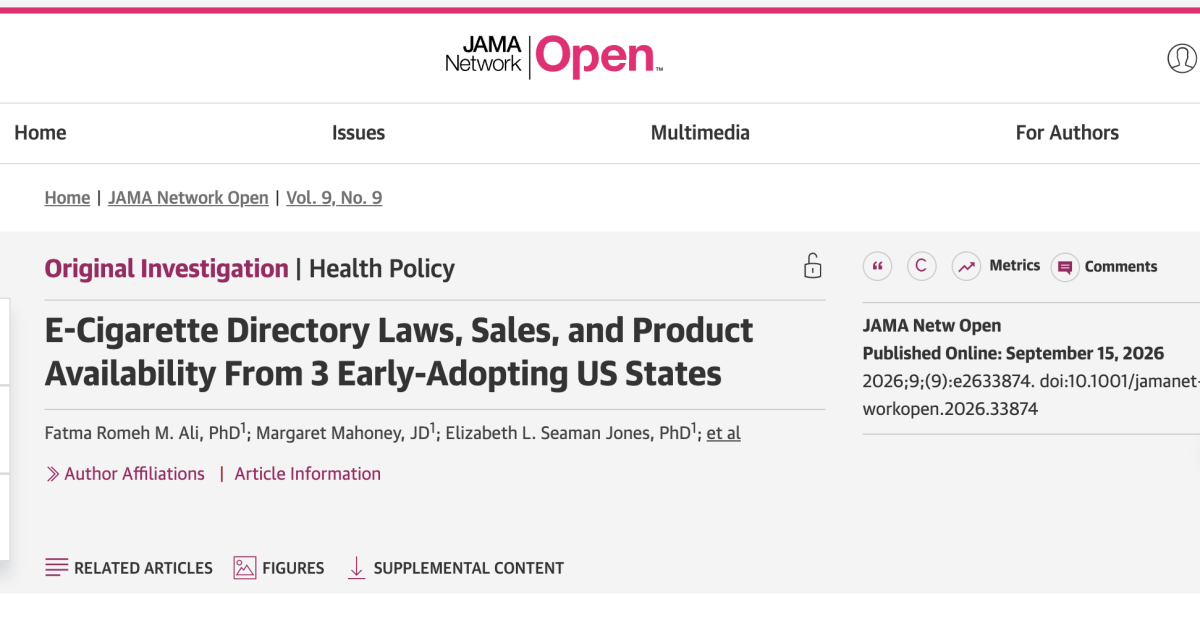
A study by CDC Foundation researchers found no sustained decline in e-cigarette sales across Alabama, Oklahoma and Louisiana, the first three U.S. states to implement e-cigarette directory laws. Louisiana initially saw a significant sales decline, followed by a rebound and a persistent reduction in product availability. Sales also shifted from nontobacco-flavored disposables toward prefilled cartridges, with Vuse Alto driving much of the increase in menthol cartridges. By April 2025, unlisted products still accounted for more than half of e-cigarette nicotine sales in all three states.
Sep.18
Kuwait Tightens Tobacco and Nicotine Rules, Bans Under-21 Sales and Extends Public Smoking Restrictions to Vapes and Heated Tobacco
Kuwait has issued a comprehensive new regulatory framework covering tobacco, e-cigarettes, heated tobacco and other nicotine products. Ministerial Decision No. 237 of 2026, signed by Health Minister Ahmad Al-Awadhi, will take effect on January 1, 2027. The rules prohibit sales to people under 21 and ban sales through websites, apps, social media and delivery services. E-cigarettes and heated tobacco products will also be treated as smoking in public and enclosed places where smoking is prohibited. Nicotine pouches and other oral nicotine products not registered as medicines are banned.
Regulations
Aug.17 by 2Firsts Perspectives
Wall Street Journal: U.S. FDA Plans Faster Vape and Nicotine Pouch Reviews, Revisit of 2021 PMTA Rule
The Trump administration is preparing changes intended to accelerate FDA market authorization reviews for e-cigarettes and nicotine pouches, according to The Wall Street Journal. The FDA is expected to revisit its 2021 PMTA rule and may simplify some scientific study requirements and shorten review times. The agency has not formally announced the changes. Over the past year, the FDA has already accelerated nicotine-pouch reviews, expanded ENDS authorizations and upgraded its CTP Portal NextGen application system. As of August 2026, 43 nicotine pouch products and 48 e-cigarette products had received FDA marketing authorization.
Sep.24