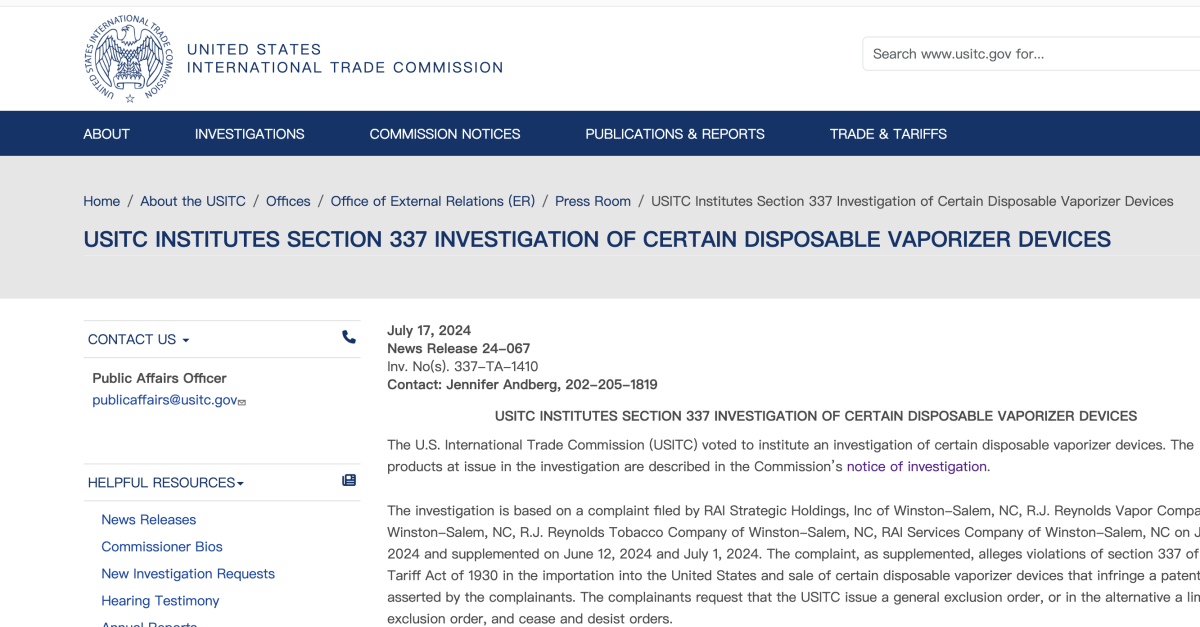
On July 17th, the United States International Trade Commission (USITC) voted to initiate an investigation into certain disposable atomization devices. The products involved in the investigation are detailed in the committee's investigation notice.
This survey is based on the complaints filed by RAI Strategic Holdings, Inc., RJ Reynolds Vapor Company, RJ Reynolds Tobacco Company, and RAI Services Company, all based in Winston-Salem, North Carolina on June 11, 2024. Supplementary complaints were filed on June 12, 2024, and July 1, 2024.
It is worth noting that the mentioned companies, RAI Strategic Holdings, Inc., R.J. Reynolds Vapor Company, R.J. Reynolds Tobacco Company, and RAI Services Company, are all subsidiaries of Reynolds American Inc. (RAI).
A supplementary appeal alleges that the United States violated Section 337 of the Tariff Act of 1930 by importing and selling certain disposable atomizer devices that infringe upon a patent claimed by the appellant. The appellant is requesting the U.S. International Trade Commission to issue a general exclusion order or limited exclusion order, as well as a cease and desist order.
The United States International Trade Commission has identified the defendants in this investigation, totaling 36 in total.
- Breeze Smoke LLC, West Bloomfield, MI
- Dongguan (Shenzhen) Shikai Technology Co., Ltd., Guangdong Province, China
- Vapeonly Technology Co. Ltd., San Po Kong, Kowloon, Hong Kong
- iMiracle (Shenzhen) Technology Co. Ltd., Luohu District, Shenzhen, China
- Guangdong Qisitech Co., Ltd., Dongguan, Guangdong Province, China
- Fewo Intelligent Manufacturing Ltd., Dongguan City, Guangdong Province, China
- Nevera (HK) Ltd., San Po Kong, Kowloon, Hong Kong
- Guangdong Cellular Workshop Electronics Technology Co., Ltd,
- Dongguan City, Guangdong Province, China
- Wonder Ladies Ltd., Tortola, British Virgin Islands
- Sailing South Ltd., Tortola, British Virgin Islands
- Marea Morada Ltd., Tortola, British Virgin Islands
- Social Brands, LLC, Dallas, TX
- Zhuhai Qisitech Co., Ltd., Zhuhai, Guangdong Province, China
- Shenzhen Han Technology Co., Ltd., Shenzhen, Guangdong Province, China
- Palma Terra Ltd., Tortola, British Virgin Islands
- Shenzhen IVPS Technology Co., Ltd., Shenzhen, Guangdong Province, China
- Heaven Gifts International Ltd., San Po Kong, Kowloon, Hong Kong
- Maduro Distributors d/b/a The Loon, Minneapolis, MN
- Bidi Vapor, LLC, Orlando, FL
- Kimsun Technology (HuiZhou) Co., Ltd., Shenzhen, Guangdong Province, China
- Shenzhen Yanyang Technology Co., Ltd., Shenzhen, Guangdong Province, China
- Pastel Cartel, LLC, Austin, TX
- American Vape Company, LLC, Pflugerville, TX
- Affiliated Imports, LLC, Austin, TX
- Shenzhen LC Technology Co., Ltd., Shenzhen, Guangdong Province, China
- LCF Labs, Inc., Ontario, CA
- Shenzhen Kangvpe Technology Co., Ltd., Bao’an District, Shenzhen, Guangdong Province, China
- Flumgio Technology Ltd., Tuen Mun, N.T., Hong Kong
- Shenzhen Pingray Technology, Shenzhen, Guangdong Province, China
- SV3, LLC d/b/a Mi-One Brands, Phoenix, AZ
- Price Point Distributors Inc. d/b/a Price Point NY, Farmingdale, NY
- Flawless Vape Shop Inc, Anaheim, CA
- Flawless Vape Wholesale & Distribution Inc., Anaheim, CA
- TheSy, LLC d/b/a Element Vape, Alhambra, CA
- VICA Trading Inc. d/b/a Vapesourcing, Tustin, CA
Through the initiation of this investigation (337-TA-1410), the United States International Trade Commission has not made any substantive decisions on the case. The Chief Administrative Law Judge of the United States International Trade Commission will assign the case to an Administrative Law Judge (ALJ), who will arrange and conduct an evidentiary hearing. The ALJ will issue an initial determination on whether there is a violation of Section 337; this initial determination will be subject to review by the Commission.
The United States International Trade Commission will soon make a final determination on the investigation. Within 45 days of the start of the investigation, the United States International Trade Commission will set a target date for completion of the investigation. Remedial orders for Section 337 cases issued by the United States International Trade Commission will take effect upon publication and become final within 60 days of publication, unless the US Trade Representative rejects approval within the 60-day deadline for policy reasons.
337 investigation
Section 337 investigation is a type of investigation conducted by the United States International Trade Commission (USITC) under Section 337 of the Tariff Act of 1930. Its main goal is to address unfair import practices, especially those involving the infringement of United States intellectual property, including patents, trademarks, and copyrights.
Initiate investigation:
337 investigations are typically initiated by patent holders or other interested parties in the United States. After receiving a complaint, the USITC will decide within 30 days whether to launch an investigation. If an investigation is initiated, the USITC will appoint an Administrative Law Judge (ALJ) to oversee the case and establish a timetable and rules for the investigation.
Investigation process:
During the investigation, administrative judges will hold an evidentiary hearing where both parties can submit evidence, question witnesses, and present arguments. The administrative judges will then issue a preliminary ruling to determine if there has been a violation of Section 337. The preliminary ruling will be reviewed by the USITC.
Judgement and Remedial Measures:
If the USITC determines that there is a violation of Section 337, it can issue an Exclusion Order prohibiting the import of infringing products. In addition, it can also issue a Cease and Desist Order, prohibiting the sale of these products in the United States.
The exclusion order is divided into a General Exclusion Order and a Limited Exclusion Order. The former applies to all infringing products, while the latter only applies to specific defendants or specific products.
Difference between federal courts
No Damages: The USITC cannot award damages like a federal court, but can issue exclusion orders more quickly. Tight Schedule: Processing times for 337 investigations are typically shorter, usually completed within 12 to 15 months.
We welcome news tips, article submissions, interview requests, or comments on this piece.
Please contact us at info@2firsts.com, or reach out to Alan Zhao, CEO of 2Firsts, on LinkedIn
Notice
1. This article is intended solely for professional research purposes related to industry, technology, and policy. Any references to brands or products are made purely for objective description and do not constitute any form of endorsement, recommendation, or promotion by 2Firsts.
2. The use of nicotine-containing products — including, but not limited to, cigarettes, e-cigarettes, nicotine pouchand heated tobacco products — carries significant health risks. Users are responsible for complying with all applicable laws and regulations in their respective jurisdictions.
3. This article is not intended to serve as the basis for any investment decisions or financial advice. 2Firsts assumes no direct or indirect liability for any inaccuracies or errors in the content.
4. Access to this article is strictly prohibited for individuals below the legal age in their jurisdiction.
Copyright
This article is either an original work created by 2Firsts or a reproduction from third-party sources with proper attribution. All copyrights and usage rights belong to 2Firsts or the original content provider. Unauthorized reproduction, distribution, or any other form of unauthorized use by any individual or organization is strictly prohibited. Violators will be held legally accountable.
For copyright-related inquiries, please contact: info@2firsts.com
AI Assistance Disclaimer
This article may have been enhanced using AI tools to improve translation and editorial efficiency. However, due to technical limitations, inaccuracies may occur. Readers are encouraged to refer to the cited sources for the most accurate information.
We welcome any corrections or feedback. Please contact us at: info@2firsts.com