Editor's note: The Guardian has previously reported on disposable e-cigarettes from a health, underage, and regulatory perspective. Now, The Guardian is putting pressure on the UK e-cigarette market regarding environmental concerns, which is also a significant challenge facing the industry. At the Birmingham exhibition in May, 2FIRSTS learned that several e-cigarette industry-related manufacturers are implementing green action plans to promote the industry's sustainable development. This includes Smore and Yueshe's full-chain recycling system, ELUX's recycling bin, and Flonq Plus-E, a recyclable e-cigarette device from Flonq.
Below is the full translation of an article from The Guardian.
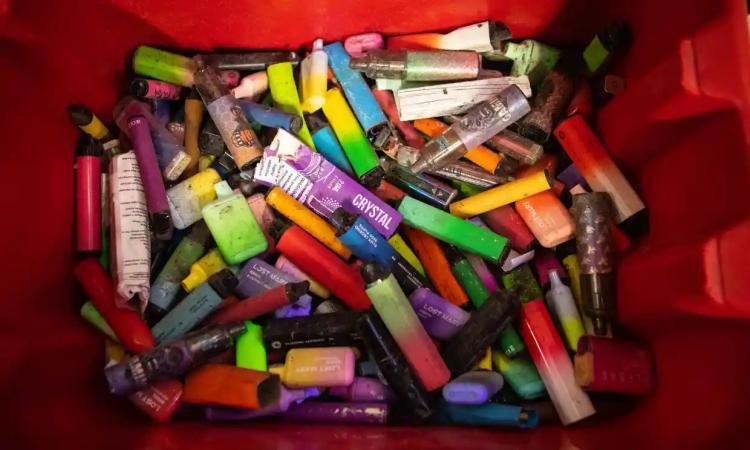
Industry experts have warned that disposable e-cigarettes in the UK are responsible for a sharp increase in fires at recycling plants last year, raising the risk of toxic smoke and air pollution.
The recycling industry is currently facing a challenge as it deals with an increasing number of e-cigarettes, to the point that insurance is becoming a concern for their facilities. Some companies are now utilizing artificial intelligence to detect e-cigarettes and their lithium-ion batteries, and installing thermal imaging cameras and automatic foam sprayers.
The presence of hazardous materials that have been processed by waste and recycling plants means that they could potentially ignite fires, similar to the 2020 Bradford tire fire that burned for a week, causing the closure of 20 schools and requiring every firefighter in West Yorkshire to participate in the firefighting efforts.
In the UK, approximately 1.3 million disposable electronic cigarettes are now being thrown away every week - a staggering increase since they were first sold in 2019 - with many of them being discarded in roadside or general waste. These devices contain lithium-ion batteries which can easily catch fire if ruptured, and some e-cigarette users have suffered serious injuries following battery explosions.
A non-profit organization called Material Focus, which carries out "recycling electronic products" activities, has found through research that more than 700 fires in garbage trucks and recycling centers were caused by batteries dumped in regular garbage.
Grundon annually collects approximately 80,000 tonnes of household and municipal waste. The quantity of disposable electronic cigarettes collected by road sweepers has increased, with their circular brushes typically gathering leaves and stones.
They are sold as disposable products, so people just throw them on the ground," said Owen George, Department Manager at Grundon. "About a year ago, we didn't see anything, but now they are everywhere. We might pick up 100 to 150 of them during an 8-hour shift.
The garbage they don't catch will eventually end up in the non-recyclable waste stream alongside items like Pringles cans, plastic wrappers, and disposable coffee cups. These items are shredded and compacted into bales, a process that can puncture lithium-ion batteries and easily cause fires. In just the past year, Grundon has experienced three to four fires at one site.
We have managed to phase them out, but the frequency is indeed increasing," said George. "This is not just affecting us - it's affecting everyone in the industry.
Grundon has installed fire detection equipment worth approximately £250,000 in each of its facilities. "We have installed thermal imaging cameras and, in certain areas, automatic fire cannons that can target and extinguish fires with water and foam," said a company spokesperson.
Due to the risk of fires, insurance companies are no longer willing to provide coverage for the waste disposal industry. Premiums have continued to rise, and expensive fire safety systems are now required. Artificial intelligence offers an alternative solution.
Approximately 70% of recycling facilities in the UK are now utilizing artificial intelligence developed by Greyparrot.
According to Greyparrot's CEO, Druckman, "We have a box with a camera inside that captures continuous images of waste movement. We then use AI to detect and analyze these images.
The system can identify 67 types of materials and sort them accordingly. Steel can be picked up using magnetic force, while lighter PET plastic bottles can be blown away by an air current.
We are working on several projects, primarily in Austria, but now also in the UK, where we are identifying batteries in waste streams," said Druckman.
Justin Guest, co-founder of Archipelago Eco, an investment recovery technology company, has stated that a ban on e-cigarettes would be a blunt instrument in addressing the issue. He added, "This won't solve the problem because it's not just e-cigarettes - there are a lot of devices that contain batteries.
There will be other consumer trends emerging, resulting in certain materials ending up in the waste stream. It is therefore necessary to have safeguard measures in place and utilize technology to address this issue.
Currently, approximately 138 million disposable e-cigarettes are sold each year in the UK. The lithium content in these devices is sufficient to power around 1,200 electric car batteries.
Disclaimer
This article is provided solely for professional research, industry discussion, and informational purposes. Any references to brands, companies, products, technologies, or policies are made for factual reporting and analytical purposes only, and do not constitute endorsement, recommendation, promotion, or advertising by 2Firsts.
Nicotine-containing products, including but not limited to cigarettes, e-cigarettes, heated tobacco products, and nicotine pouches, carry significant health risks. Readers are responsible for complying with all applicable laws and regulations in their respective jurisdictions, including age restrictions and access limitations.
The information contained in this article should not be regarded as investment, legal, medical, regulatory, or commercial advice. While 2Firsts strives to ensure the accuracy and reliability of its content, it does not assume liability for any direct or indirect loss arising from errors, omissions, inaccuracies, or reliance on the information contained herein.
This article is not intended for individuals below the legal age for accessing tobacco or nicotine-related information in their jurisdiction.
Copyright Notice
This article is either original content produced by 2Firsts or content reproduced, translated, summarized, or adapted from third-party sources with attribution where applicable. The intellectual property rights of the original content remain with 2Firsts or the respective original rights holders.
No individual or organization may copy, reproduce, distribute, republish, modify, translate, or otherwise use this content without prior authorization. Any unauthorized use may result in legal action.
For copyright-related inquiries, corrections, or removal requests, please contact: info@2firsts.com.
AI-Assisted Translation and Editing Notice
Portions of this article may have been translated, edited, or reviewed with the assistance of artificial intelligence tools to improve efficiency and readability. Due to the limitations of AI-assisted translation and editing, discrepancies, omissions, or inaccuracies may exist when compared with the original source.
Where applicable, readers are advised to refer to the original source for the most complete and accurate information. If you identify any errors or believe that any content infringes upon your rights, please contact us at info@2firsts.com, and we will review and address the matter promptly.