Key Points
·Poland's tobacco industry is grappling with a slew of new laws, including bans, age restrictions and new excise taxes.
·The government has banned flavored heated tobacco products and plans to outlaw disposable e-cigarettes. These moves have sparked public and industry backlash, with concerns about unintended consequences.
·Experts warn that prohibition of alternative nicotine products could backfire, pushing consumers back to traditional cigarettes and fueling illicit markets rather than promoting healthier choices.
·Tobacco is a vital sector in Poland, accounting for around 8% of the state budget’s income. Poland is a major global exporter and importer of tobacco, and large firms like Philip Morris International continue to invest in domestic production facilities.
·Regulatory uncertainty and product bans have contributed to a spike in black-market tobacco. In 2024, Poland lost €312 million in tax revenue due to illegal cigarette sales, highlighting the financial impact of regulatory missteps.
·The government has enacted sharp excise tax increases and plans further hikes through 2027. Meanwhile, EU-level proposals could force additional price adjustments, compounding the uncertainty for the Polish tobacco market.
[2Firsts, Vladislav Vorotnikov reporting from Europe ] The Polish tobacco market is buckling under a plethora of new rules, some of them inconsistent with others. Observers warn that the regulatory uncertainty not only threatens to deter investment but may also fuel the illicit trade.
In April 2025, Polish President Andrzej Duda signed an amendment to the tobacco law that bans the sale of flavored heated tobacco products, in line with EU requirements. On June 11, 2025, the national senate adopted an amendment to the act prohibiting the sale of e-cigarettes without nicotine and nicotine pouches to persons under the age of 18. Lawmakers also approved amendments to the excise duty act this year, aiming to impose tax on new product categories, including single-use and reusable e-cigarettes.
All those initiatives are dwarfed, however, by a health ministry plan to ban disposable e-cigarettes altogether. The government is expected to adopt the legislation in the third quarter of 2025.
Already, the proposal has elicited a fierce public backlash.
“The policy of prohibition often leads to a grey area,” warned Anna Dela, president of the Institute of Conscious Humanity, a nongovernmental organization promoting health awareness. “If we completely ban all alternative products, such as e-cigarettes or nicotine pouches, we will most likely return to traditional tobacco products, because regular cigarettes will still be easily accessible to the average Pole. I don't believe that people who have used alternative products will stop using nicotine."
Meanwhile, Polish businesses have voiced concerns about the large number of initiatives under discussion, which has created uncertainty for investors. Jakub Binkowski, director of the Department of Law and Legislation and a board member of the Union of Entrepreneurs and Employers, lamented the “unprecedented chaos” in recent nicotine regulation.
"On the one hand, there are calls for complete bans on certain product categories; on the other, there are calls for additional taxation of certain product categories,” Binkowski told a Polish news outlet. “At the same time, there are ideas about eliminating flavorings and fragrance additives from specific product categories, such as tobacco pouches, where flavorings are an essential product feature.”
Stakeholders have also expressed fears that the new initiatives could hurt the industry, whose role in the national economy is hard to overestimate. Poland is the world's second-largest exporter of tobacco products, according to the country’s Ministry of Economic Development and Technology, and one of the world's largest importers of leaf tobacco. The industry accounts for approximately 8% of the state budget's income.
Moreover, the industry continues to attract new investments. For instance, in April 2025, Philip Morris completed the modernization of its Krakow factory. The upgrade cost nearly PLN1 billion ($275 million) and included the installation of new production lines for tobacco heating sticks. The Krakow plant manufactures for domestic and international markets, primarily in Europe, Asia, Africa and the Middle East.
Black Market Rebound
Regulatory uncertainty has already impacted on the local tobacco market. According to KPMG, Poland ranked fourth in the European Union in terms of the volume of illegal tobacco products in 2024, with 1.85 billion cigarettes from illicit sources. As a result, the state missed out on €312 million ($367 million) of tax earnings in 2024, up €114 million from the previous year.
Local business groups are urging the government to reconsider its plans to raise the excise rate or ban certain products. “The complete elimination of legal products from the market results in demand shifting to the grey market,” Jaroslaw Antychowicz, president of the Bialystok Chamber of Commerce and Industry, told local press.
"We're already seeing this phenomenon in countries like Belgium and the Netherlands, where, after the ban on nicotine pouches was introduced, these products are still available—albeit illegally and in concentrations significantly exceeding the Polish limit of 20 mg of nicotine per pouch,” he said.
He emphasized that instead of protecting citizens' health, the prohibitions boost illegal trade, increase crime and result in uncontrolled consumption of products with unknown composition.
Adding Uncertainty
On top of other initiatives, Poland's government recently announced a plan to gradually increase in the excise rate on tobacco products. In 2025, the levy already jumped by 25%, pushing the minimum price per pack of cigarettes from PLN17 to PLN 20. In 2026, the excise tax is set to increase further by 20%, and in 2027 by an additional 15%. As a result, the minimum price per pack will reach PLN26. Cigars, smoking tobacco and e-cigarette liquids will be subjected to similar tax increases.
The growing uncertainty is aggravated by initiatives at the European level. For example, the European Commission recently proposed an amendment to the Tobacco Excise Directive to equalize the prices of tobacco products across member states through a sharp increase in the minimum excise tax. While some member states in Western Europe already meet the new proposed minimum levels, the measure would require substantial upward adjustments in countries such as Poland, Bulgaria and Romania.
Given the plethora of initiatives, the Polish nicotine industry and its customers are bracing for significant changes in the coming months.
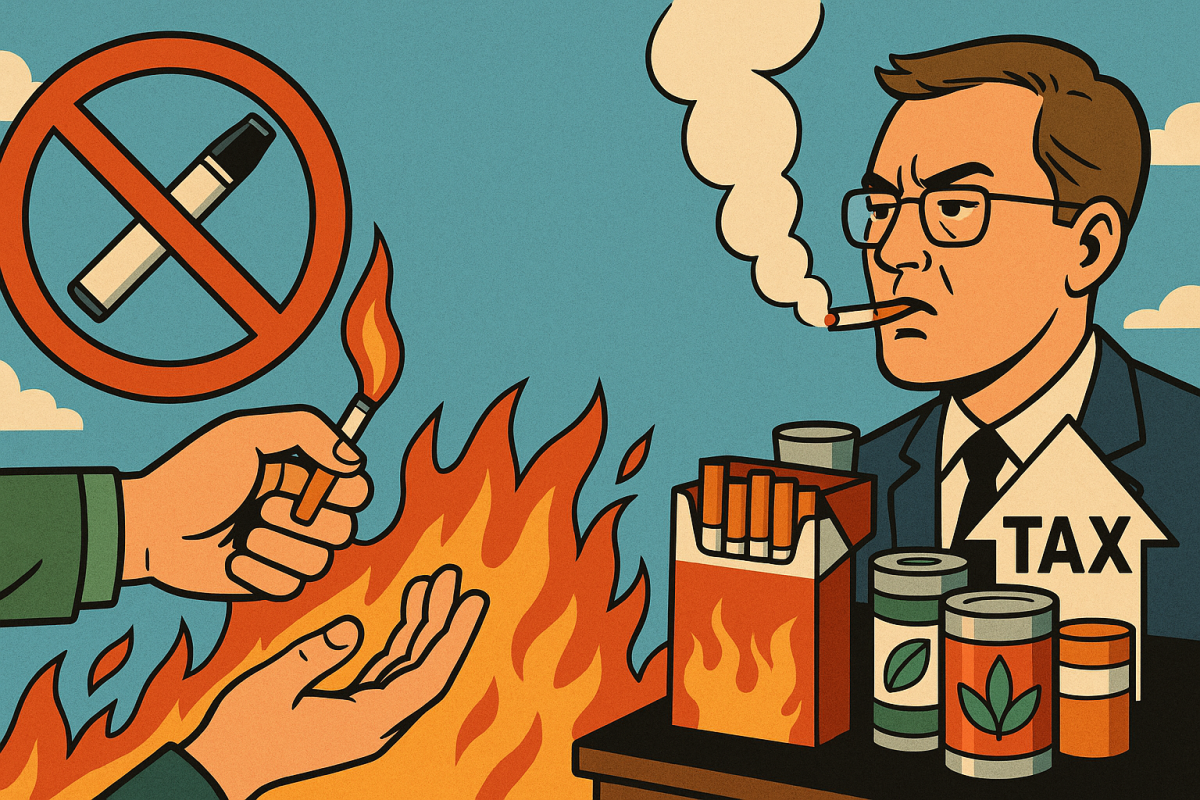
Cover image generated by AI.
We welcome news tips, article submissions, interview requests, or comments on this piece.
Please contact us at info@2firsts.com, or reach out to Alan Zhao, CEO of 2Firsts, on LinkedIn
Notice
1. This article is intended solely for professional research purposes related to industry, technology, and policy. Any references to brands or products are made purely for objective description and do not constitute any form of endorsement, recommendation, or promotion by 2Firsts.
2. The use of nicotine-containing products — including, but not limited to, cigarettes, e-cigarettes, nicotine pouchand heated tobacco products — carries significant health risks. Users are responsible for complying with all applicable laws and regulations in their respective jurisdictions.
3. This article is not intended to serve as the basis for any investment decisions or financial advice. 2Firsts assumes no direct or indirect liability for any inaccuracies or errors in the content.
4. Access to this article is strictly prohibited for individuals below the legal age in their jurisdiction.
Copyright
This article is either an original work created by 2Firsts or a reproduction from third-party sources with proper attribution. All copyrights and usage rights belong to 2Firsts or the original content provider. Unauthorized reproduction, distribution, or any other form of unauthorized use by any individual or organization is strictly prohibited. Violators will be held legally accountable.
For copyright-related inquiries, please contact: info@2firsts.com
AI Assistance Disclaimer
This article may have been enhanced using AI tools to improve translation and editorial efficiency. However, due to technical limitations, inaccuracies may occur. Readers are encouraged to refer to the cited sources for the most accurate information.
We welcome any corrections or feedback. Please contact us at: info@2firsts.com