Over 65% of Nicotine Products in Russia Are Illicit; Officials Call for Total E-cigarette Ban

Jul.30.2025
Over 65% of Nicotine Products in Russia Are Illicit; Officials Call for Total E-cigarette Ban
Illicit nicotine products make up 65.8% of Russia’s market, reaching up to 100% in small towns. About 30% of teens buy e-cigarettes online, raising concerns over access and rising risks. A 2024 tax hike halved legal producers. Experts urge lower taxes, stricter regulation, and stronger youth education.

Key points:


·Illegal circulation proportion: In Russia, illegal circulation of nicotine products accounts for 65.8%, reaching as high as 95% to 100% in small towns. 


·Youth risk: 30% of adolescents purchase e-cigarettes online, and the shadow market makes it difficult to control sales to minors. 


·Consumption tax impact: By 2024, the consumption tax on nicotine e-liquid will double, leading to a sharp decrease in the number of legal manufacturers from 117 to 5. 


·Expert suggestions: Implementing a reduction in consumption tax, introducing strict supervision, and strengthening youth education among other comprehensive measures.


【2Firsts News Flash】According to a report on July 29th, based on data from the National Science and Technology Center (NSCC), the current illegal circulation of nicotine products in Russia accounts for 65.8%, while the illegal circulation of regular cigarettes is only one fifth of that amount. In small towns, the situation is usually very serious – the proportion of illegal products is not 65%, but 95% or even 100%. This means that the composition of products purchased by consumers is almost completely out of control.


Anna Sorochinskaya of the Public Tobacco Committee pointed out that approximately 30% of teenagers are purchasing e-cigarettes online, primarily through social networks and channels like Telegram. As the e-cigarette market moves underground, controlling the sale to minors has become increasingly difficult, leading to an increased risk of youth turning to more dangerous products.


In 2024, the consumption tax on e-liquids containing nicotine doubled. According to data from Vladislav Zaslavsky, the director of the Russian Ministry of Industry and Trade's Digital Tagging System, the number of legal manufacturers of these products decreased by 23 times in one year, from 117 to 5.


“The high consumption tax has already taken effect, causing the entire market to head towards darkness. Under such a high consumption tax, legitimate market participants cannot compete with illegal businesses that do not pay these taxes. The Ministry of Finance needs to make a decision - either completely ban these activities or introduce strict regulations, including licensing, while at the same time lowering the consumption tax.”


He said.


In June 2025, Russian Minister of Industry and Trade Anton Alikhanov publicly supported a complete ban on e-cigarettes.


“Prohibition cannot cover all areas, but in my opinion, e-cigarettes are an exception. I personally advocate for a complete ban.”


He said that Vyacheslav Volodin, Chairman of the State Duma, unconditionally supports this idea. He stated that if the government proposes such an initiative, the parliament will give it priority consideration.


At the same time, experts insist that bans will not be effective. The issue can be solved through comprehensive actions. Firstly, a competitive environment should be created for legal businesses - by lowering consumption taxes and issuing licenses. Secondly, inspections should be carried out and concrete sanctions should be imposed - violations should be precisely investigated. Thirdly, prevention measures should be taken for adolescents - through school education, publicity campaigns, and training and warnings in retail stores.


We welcome news tips, article submissions, interview requests, or comments on this piece.

Please contact us at info@2firsts.com, or reach out to Alan Zhao, CEO of 2Firsts, on LinkedIn


Notice

1.  This article is intended solely for professional research purposes related to industry, technology, and policy. Any references to brands or products are made purely for objective description and do not constitute any form of endorsement, recommendation, or promotion by 2Firsts.

2.  The use of nicotine-containing products — including, but not limited to, cigarettes, e-cigarettes, nicotine pouchand heated tobacco products — carries significant health risks. Users are responsible for complying with all applicable laws and regulations in their respective jurisdictions.

3.  This article is not intended to serve as the basis for any investment decisions or financial advice. 2Firsts assumes no direct or indirect liability for any inaccuracies or errors in the content.

4.  Access to this article is strictly prohibited for individuals below the legal age in their jurisdiction.


Copyright


This article is either an original work created by 2Firsts or a reproduction from third-party sources with proper attribution. All copyrights and usage rights belong to 2Firsts or the original content provider. Unauthorized reproduction, distribution, or any other form of unauthorized use by any individual or organization is strictly prohibited. Violators will be held legally accountable.

For copyright-related inquiries, please contact: info@2firsts.com


AI Assistance Disclaimer


This article may have been enhanced using AI tools to improve translation and editorial efficiency. However, due to technical limitations, inaccuracies may occur. Readers are encouraged to refer to the cited sources for the most accurate information.

We welcome any corrections or feedback. Please contact us at: info@2firsts.com

Special Report | From New York to Washington: How FDA’s Tobacco Center Is Reworking Product Review
FDA’s Center for Tobacco Products is reshaping how it approaches tobacco product review. Based on 2Firsts’ on-site reporting in New York and Washington, this report traces CTP’s emerging direction: stronger links between PMTA and tobacco harm reduction, more category-specific review, greater emphasis on decision-relevant science, more predictable timelines and expanded use of sPMTA for product modifications. CTP also acknowledged major constraints, including just nine PMTA review teams, persistent backlogs and limits on hiring capacity.
Regulations
Oct.08
US ITC Judge Finds Glas Infringed Two JUUL Vape Patents, Recommends Restrictions on Related Imports——Glas Received FDA Marketing Authorization for Four Vape Pods in May 2026; Proposed Restrictions Remain Under Commission Review
A U.S. International Trade Commission (USITC) administrative law judge issued an initial determination on October 20, 2026, finding that certain Glas vaping devices, cartridges and components infringed 12 claims across two patents asserted by JUUL, constituting a violation of Section 337 of the Tariff Act of 1930. The judge recommended a limited exclusion order and a cease and desist order against the Glas respondents. Five months earlier, the FDA authorized four Glas e-cigarette pods, including mango, blueberry and two menthol variants. The patent investigation concerns device and cartridge structures and is separate from FDA premarket review. The proposed import restrictions have not become final, and their product-level scope remains unresolved.
company
Nov.05
Japan's Heated Tobacco Use Rises From 0.1% to 14.9% Over a Decade as Growth Extends Beyond Cigarette Switching
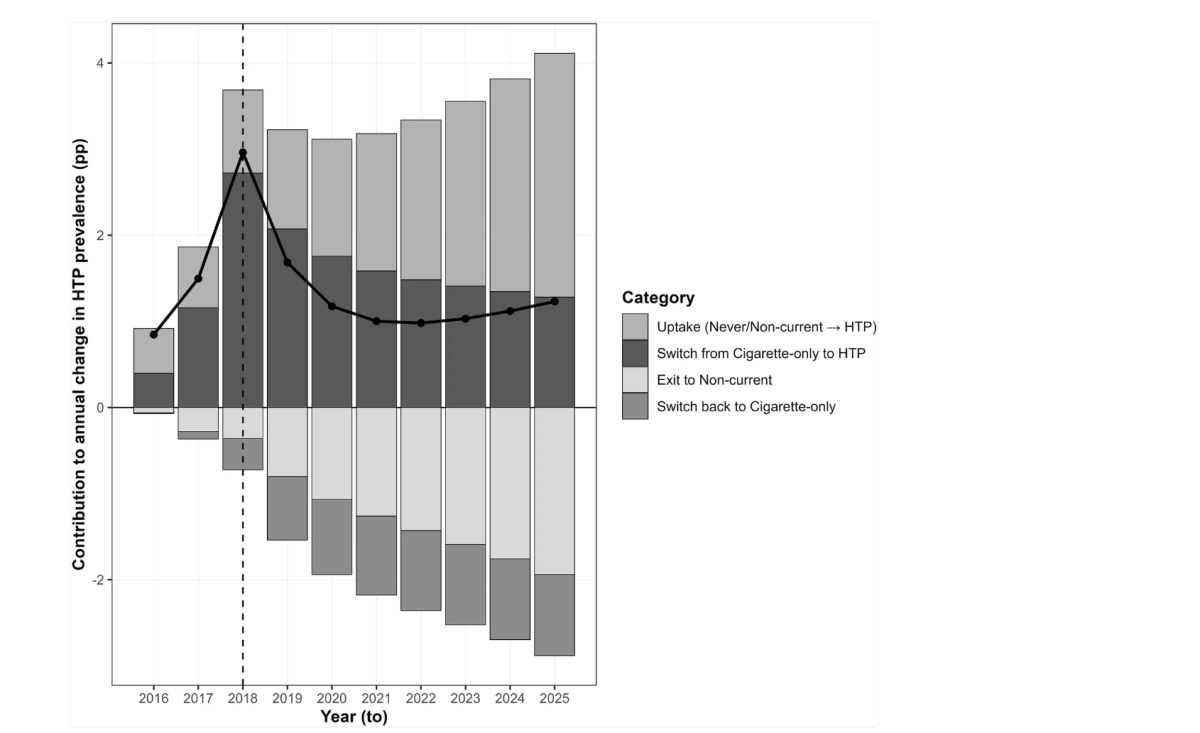
A decade-long study published in The Lancet Regional Health – Western Pacific found that heated tobacco product use in Japan increased from 0.1% in 2015 to 14.9% in 2025, although growth slowed after 2018. Switching from conventional cigarettes remained an important source of HTP uptake, while the contribution from previously non-current users increased. Approximately 56% of HTP users also smoked conventional cigarettes in 2025. Separate industry data show that Japan's heated tobacco sales reached 73.4 billion units in fiscal 2025, approaching conventional cigarette sales of 78.2 billion units.
SCIENCE
Nov.10
Ukraine Raises Excise Stamp Fees for Tobacco, Heated Tobacco and Vape Liquids by 30.5% as Parliament Backs E-Excise Delay to 2027
Ukraine's Cabinet of Ministers adopted Resolution No. 1259 on October 15, 2026, increasing excise stamp production fees for tobacco products and e-cigarette liquids by approximately 30.5%, from UAH 0.1643 to UAH 0.2144 per stamp. Fees for alcoholic beverages rose by about 30.2%. Separately, Ukraine's parliament passed Bill No. 15532 on October 13, proposing to postpone the full implementation of electronic excise stamps and traceability for alcohol, tobacco and e-cigarette liquids from November 1, 2026, to July 1, 2027. Parliament cited additional testing, configuration and integration requirements. The bill was sent to the president for signature on October 19.
Regulations
Oct.21
Imperial Brands Sees Double-Digit NGP Growth as Sixth Year of Tobacco Revenue Gains Backs £1.5 Billion Buyback
Imperial Brands reaffirmed its FY26 guidance in its October 8 pre-close trading update, forecasting double-digit net revenue growth in next-generation products and share gains across heated tobacco, vape and modern oral. Tobacco net revenue is expected to grow at a low-single-digit rate, marking a sixth consecutive year of growth. The company has completed its £1.45 billion FY26 share repurchase and announced a £1.5 billion buyback for FY27. Group adjusted operating profit is expected to increase 3% to 5%, while free cash flow is forecast to exceed £2.2 billion.
Oct.09
Product | KUMI SCENIC 50K Offers Nicotine and 6-Methyl Nicotine Versions as 6-MN Products Appear in Multiple U.S. State Directories, With Louisiana Listing FDA Exemption
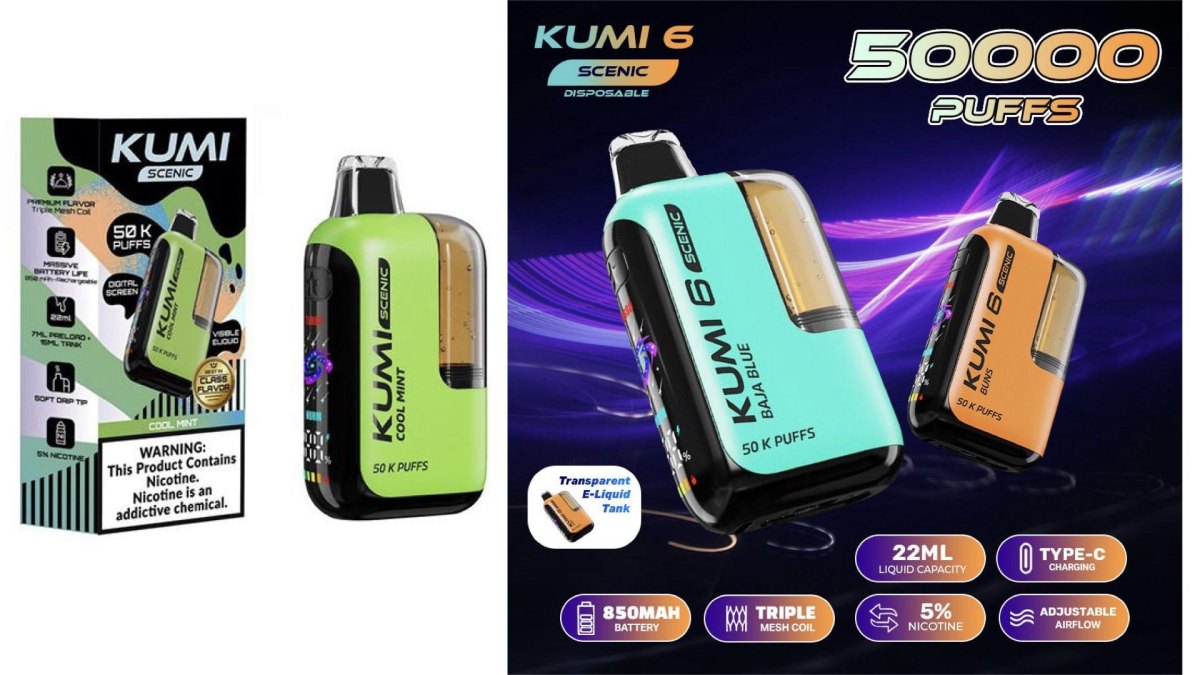
An October 2026 review of U.S. state vapor product directories found KUMI 6 SCENIC 50K listed in Louisiana and Nebraska. Louisiana classifies 20 related product entries as “FDA EXEMPTION.” The SCENIC platform is marketed in both conventional nicotine-salt and NoNic6 formulations, each advertised with 22mL e-liquid capacity and up to 50,000 puffs. U.S. wholesaler Midwest Goods listed both versions in August 2025 with a suggested retail price of $19.99 each. The NoNic6 version is associated with 6-methylnicotine and is also marketed by some distributors as “nicotine-free.”
product
Oct.27