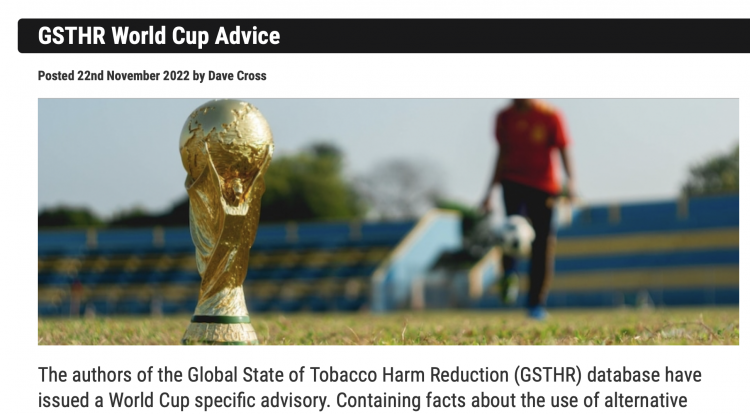
The authors of the Global State of Tobacco Harm Reduction (GSTHR) database have released specific advice for the World Cup. They have included facts about using alternative nicotine products in Qatar to ensure the safety of travelers, but they strongly emphasize that this advice does not constitute legal advice.
The author states that the GSTHR database is regularly updated by their team. However, it should be noted that the information provided does not constitute legal advice. The accuracy of the information cannot be guaranteed as regulatory status for different product categories may change within a short period of time and is rarely publicly available.
Electronic cigarettes
According to Article 7 of the 10th Tobacco Control and Tobacco Products Law, importing, selling, purchasing, and using e-cigarettes are all considered illegal. Violating this regulation can result in a fine of up to 10,000 Qatari riyals (2,700 US dollars) or three months' imprisonment.
Dr. Kholood al-Mutawaa, Director of Non-Communicable Diseases at the Ministry of Public Health, has stated that Qatar prohibits the sale or possession of electronic cigarettes (or nicotine-based electronic cigarette products).
According to a department order in 2014, e-cigarettes are prohibited in Qatar. We also have a GCC agreement on this issue," said the official.
We have instructed all supermarkets, pharmacies, and other stores not to sell them. We have also communicated with customs departments at airports, seaports, and borders to prohibit e-cigarettes from entering Qatar. People cannot bring them into the country or order them from other countries. They also cannot be sent to the country. Customs has been instructed to confiscate such products.
We are conducting research on the GCC to determine the impact of these cigarettes. Anyone who possesses an electronic cigarette may be charged with taking appropriate action.
The Gulf Cooperation Council is a regional political and economic alliance that includes all Arab countries in the Gulf except for Iraq.
Heated Tobacco Products (HTP)
The handling of HTP in Qatar is similar to that of electronic cigarettes.
Nasal snuff and other smokeless tobacco products.
Snuff and other smokeless tobacco products are permitted and sold, but subject to the same restrictions as smoked tobacco. This means that usage is restricted in certain locations and their availability and advertising are also limited.
Nicotine pouches that are free of tobacco.
Nicotine pouches without tobacco are allowed and sold, but the Global State of Tobacco Harm Reduction (GSTHR) is unsure of any specific limitations on their use. However, for safety reasons, nicotine consumers are advised to purchase pouches locally or only carry the minimum amount of pouches while traveling.
Chewing tobacco.
It is illegal to import, circulate, display, sell, distribute or manufacture chewing tobacco in any form or under any name. "Sweika" is a type of chewing tobacco which, although it may exist in Qatar, is prohibited by law.
Nicotine Replacement Therapy (NRT)
In Qatar, NRT products such as nicotine patches, gum, or inhalers can only be purchased from pharmacies with a prescription. These products may be considered medication and thus subject to pharmaceutical regulations. To avoid confiscation, arrest, or imprisonment, travelers using NRT products should carry an official medical prescription, as well as a letter from their general practitioner or hospital explaining the medication, quantity and dosage regulations.
The smoking rate in Qatar.
Smoking is legal in Qatar, but it is subject to some restrictions. Overall smoking rates in Qatar have decreased since 2000. Currently, smokers account for 13.1% of the adult population in Qatar, compared to 17% in 2000. This means there are now approximately 315,080 smokers in the country. 25.5% of men smoke, while only 0.6% of women smoke.
According to the latest data, 286 people die each year due to smoking - 32 women and 254 men. The annual percentage of deaths caused by smoking is 8.87% (3.5% for women and 9.5% for men).
General Tobacco Restrictions
It is illegal to sell cigarettes and all tobacco products, including derivatives, to anyone under the age of 18. Ignorance of the law is not an excuse, and sellers must take all necessary precautions to verify the age of the buyer.
Smoking is prohibited in enclosed public places, such as:
Schools, education and training centers, universities, hospitals, health centers, as well as other educational institutions and healthcare facilities.
Government departments, other government agencies, public organizations and institutions, sports clubs, association venues, public shops, hotels, elevators, cinemas and theaters.
Industrial facilities and shopping centers.
Restaurants and other venues that offer food and beverages for sale to the public.
Penalty.
Anyone caught smoking or allowing smoking in enclosed public places where smoking is banned will face a fine of no less than 1,000 riyals (approximately $275) and up to 3,000 riyals (approximately $825).
Anyone caught smoking while driving a vehicle with passengers under the age of 18 will be fined up to 3,000 riyals (approximately $825).
Statement:
This article is compiled from third-party information and is intended for industry exchange and learning purposes only.
This article does not represent the views of 2FIRSTS, and 2FIRSTS cannot confirm the authenticity or accuracy of the article's content. The compilation of this article is intended only for industry exchange and research.
Due to limitations in our ability to translate, the translated article may differ from the original in expression. Please refer to the original article for accuracy.
2FIRSTS maintains complete alignment with the Chinese government on any domestic, Hong Kong, Macau, Taiwan, or foreign-related statements and positions.
The copyright of compiled information belongs to the original media and author. If there is any infringement, please contact us for deletion.
Disclaimer
This article is provided solely for professional research, industry discussion, and informational purposes. Any references to brands, companies, products, technologies, or policies are made for factual reporting and analytical purposes only, and do not constitute endorsement, recommendation, promotion, or advertising by 2Firsts.
Nicotine-containing products, including but not limited to cigarettes, e-cigarettes, heated tobacco products, and nicotine pouches, carry significant health risks. Readers are responsible for complying with all applicable laws and regulations in their respective jurisdictions, including age restrictions and access limitations.
The information contained in this article should not be regarded as investment, legal, medical, regulatory, or commercial advice. While 2Firsts strives to ensure the accuracy and reliability of its content, it does not assume liability for any direct or indirect loss arising from errors, omissions, inaccuracies, or reliance on the information contained herein.
This article is not intended for individuals below the legal age for accessing tobacco or nicotine-related information in their jurisdiction.
Copyright Notice
This article is either original content produced by 2Firsts or content reproduced, translated, summarized, or adapted from third-party sources with attribution where applicable. The intellectual property rights of the original content remain with 2Firsts or the respective original rights holders.
No individual or organization may copy, reproduce, distribute, republish, modify, translate, or otherwise use this content without prior authorization. Any unauthorized use may result in legal action.
For copyright-related inquiries, corrections, or removal requests, please contact: info@2firsts.com.
AI-Assisted Translation and Editing Notice
Portions of this article may have been translated, edited, or reviewed with the assistance of artificial intelligence tools to improve efficiency and readability. Due to the limitations of AI-assisted translation and editing, discrepancies, omissions, or inaccuracies may exist when compared with the original source.
Where applicable, readers are advised to refer to the original source for the most complete and accurate information. If you identify any errors or believe that any content infringes upon your rights, please contact us at info@2firsts.com, and we will review and address the matter promptly.