Key Points:
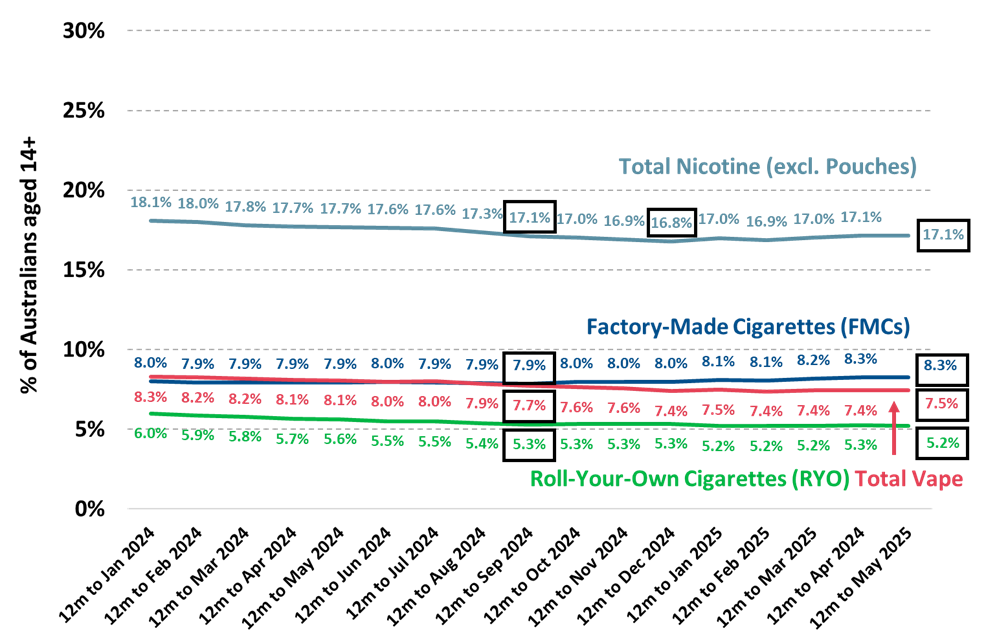
·Ban Lifted: Following the implementation of the e-cigarette ban in July 2024, the national smoking (or e-cigarette use) rate has increased from 16.8% to 17.1%, with e-cigarette use only slightly decreasing by 0.2%.
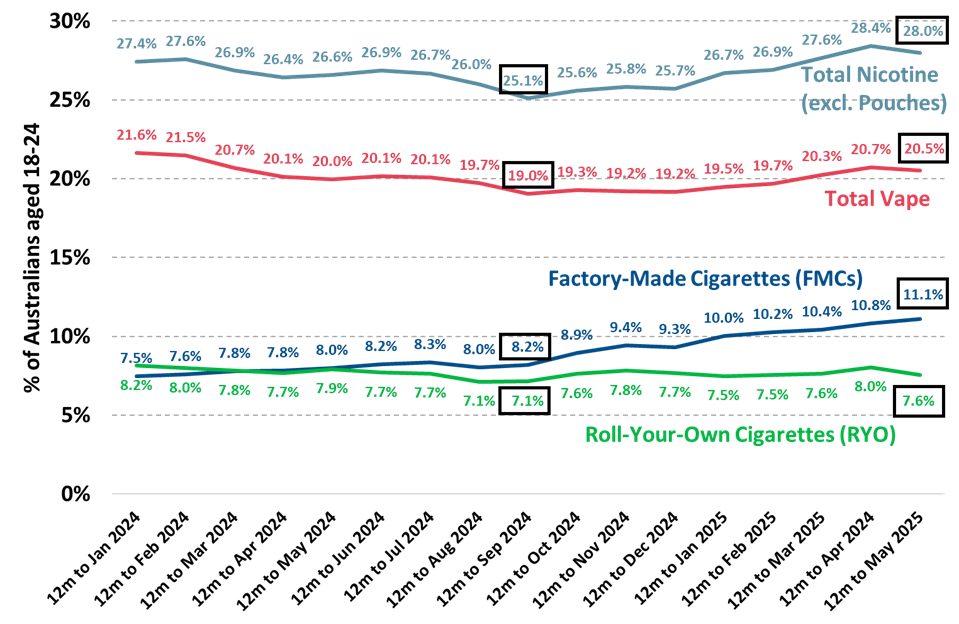
·Rebound in the younger demographic: The smoking (or e-cigarette use) rate among individuals aged 18-24 has surged by 2.9% to reach 28%, with factory-made cigarette use increasing by 2.9% to 11.1%, and e-cigarette use rising by 1.5% to 20.5%.
·Significant age differences: Smoking rates have decreased in most age groups above 25, remained stable in the 35-49 age group, highlighting the limited effectiveness of the policy on young people.
·Policy reflection: The ban failed to curb overall nicotine consumption, and instead may have led some young people to turn to traditional tobacco.
【2Firsts news flash】According to a report by Roy Morgan on July 1st, the latest data from Roy Morgan, an Australian market research company, shows that smoking rates in Australia have slightly increased since the mid-2024 implementation of the "e-cigarette sales ban", especially in factory-made cigarettes (FMC), mainly due to the rise in smoking rates among individuals aged 18-24.
A survey conducted by Roy Morgan has shown that in the year leading up to December 2024, the consumption rate of FMC, roll-your-own (RYO) tobacco, or e-cigarettes among Australians aged 18 and over decreased to 16.8% (3.59 million people). Following this, the smoking (or vaping) rate among Australians increased to 17.1% (3.70 million people), an increase of 0.3 percentage points (+110,000 people).
The factor driving this growth is the increasing consumption of factory manufactured cigarettes (FMC). Since September 2024, the proportion of Australians consuming FMC has risen from 7.9% (1.67 million people) to 8.3% (1.79 million people), an increase of 0.4 percentage points (adding 120,000 people).
On July 1, 2024, new legislation was implemented in Australia banning the import, domestic production, supply, commercial possession, and promotion of disposable and non-therapeutic e-cigarettes. However, the impact of this legislation on overall e-cigarette usage has been minimal. Currently, the e-cigarette usage rate in Australia stands at 7.5% (1.61 million), only decreasing by 0.2 percentage points (-40,000) since September 2024.
The Smoking and E-cigarette Usage Rate Among Australians Aged 18 and Above
28% of 18-24 Year Old Australians Currently smoke or Use E-cigarettes
Since the legislation banning the import, domestic manufacturing, supply, commercial holding, and advertising of disposable and non-therapeutic e-cigarettes was introduced in mid-2024, there has been an increase in smoking rates and e-cigarette use among the 18-24 age group.
In the year ending September 2024, the proportion of 18-24 year olds in Australia who smoked (or used e-cigarettes) dropped to 25.1% (620,000 people). However, this figure has since increased to 28% (700,000 people), showing a rise of 2.9 percentage points (+80,000 people). This is the highest smoking (or e-cigarette use) rate among all age groups.
Despite the introduction of new regulations, the smoking and e-cigarette usage rates among the 18-24 age group have continued to rise. Currently, over one-fifth of individuals in this age group use e-cigarettes, accounting for 20.5% (510,000 people), higher than the previous year's low of 19% (470,000 people) as of September 2024. In less than a year, this percentage has increased by 1.5 percentage points (an increase of 40,000 people). This is the highest e-cigarette usage rate among the 18-24 age group since March 2024 (20.7% or 500,000 people).
Furthermore, currently 11.1% (280,000 people) of the 18-24 age group report consuming factory-made cigarettes (FMC), which is higher than the 8.2% (200,000 people) reported in September 2024, marking an increase of 2.9 percentage points (+80,000 people).
The proportion of individuals aged 18-24 who consume roll-your-own (RYO) cigarettes has slightly increased from 7.1% (180,000 cigarettes) in the year ending September 2024 to 7.6% (190,000 cigarettes) currently, with an increase of 0.5 percentage points (+10,000 cigarettes) since mid-2024.
Smoking and E-cigarette Usage Rates Among Australians Aged 18-24 Years Old
Chief Executive Officer of Roy Morgan, Michele Levine, stated that the legislation banning the sale of disposable and non-therapeutic e-cigarettes in Australia in 2024 has had little impact on the usage of e-cigarettes, coinciding with a rise in smoking rates among young Australians.
We welcome news tips, article submissions, interview requests, or comments on this piece.
Please contact us at info@2firsts.com, or reach out to Alan Zhao, CEO of 2Firsts, on LinkedIn
Notice
1. This article is intended solely for professional research purposes related to industry, technology, and policy. Any references to brands or products are made purely for objective description and do not constitute any form of endorsement, recommendation, or promotion by 2Firsts.
2. The use of nicotine-containing products — including, but not limited to, cigarettes, e-cigarettes, nicotine pouchand heated tobacco products — carries significant health risks. Users are responsible for complying with all applicable laws and regulations in their respective jurisdictions.
3. This article is not intended to serve as the basis for any investment decisions or financial advice. 2Firsts assumes no direct or indirect liability for any inaccuracies or errors in the content.
4. Access to this article is strictly prohibited for individuals below the legal age in their jurisdiction.
Copyright
This article is either an original work created by 2Firsts or a reproduction from third-party sources with proper attribution. All copyrights and usage rights belong to 2Firsts or the original content provider. Unauthorized reproduction, distribution, or any other form of unauthorized use by any individual or organization is strictly prohibited. Violators will be held legally accountable.
For copyright-related inquiries, please contact: info@2firsts.com
AI Assistance Disclaimer
This article may have been enhanced using AI tools to improve translation and editorial efficiency. However, due to technical limitations, inaccuracies may occur. Readers are encouraged to refer to the cited sources for the most accurate information.
We welcome any corrections or feedback. Please contact us at: info@2firsts.com