BAT Launches "Omni™" Report Resource for Tobacco Harm Reduction.

Sep.19.2024
BAT Launches "Omni™" Report Resource for Tobacco Harm Reduction.
British American Tobacco (BAT) launches report resource "Omni™" on reducing tobacco harm, aiming to shift smokers to low-risk products.

On September 17, British American Tobacco (BAT) launched a report resource called "Omni™" on its official website.
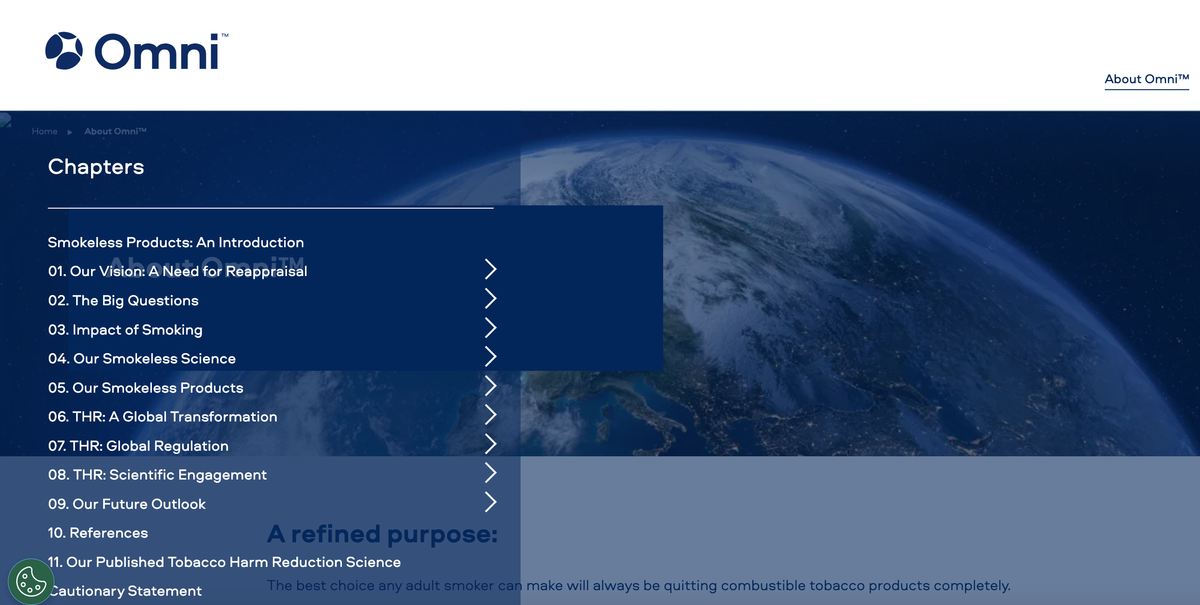
BAT Launches
Omni™" Nine Chapter Screenshots | Image Source: BAT Official Website


According to BAT, The Omni™ is mainly aimed at scientists, public health organizations, regulators, policymakers, and investors. It gathers the latest progress made by BAT in Tobacco Harm Reduction, with the goal of helping adult smokers transition to smoke-free alternatives by providing products with lower risks compared to traditional cigarettes.


The "Omni™" report consists of nine chapters, discussing key issues related to tobacco harm reduction and providing evidence from the past decade of global efforts to reduce tobacco-related harm.


BAT has stated that its goal is to have 50 million new tobacco product users by 2030, with the revenue from these products accounting for 50% by 2035.


At the same time, BAT also acknowledges that in the process of promoting a smoke-free world, they face many challenges, including opposition from regulatory agencies and non-governmental organizations, market sales restrictions, heavy regulatory frameworks, industry research being questioned, and public misunderstandings about the risks of nicotine and smoke-free products. The company emphasizes that it will continue to reduce the health risks of traditional tobacco products through science and innovation.


We welcome news tips, article submissions, interview requests, or comments on this piece.

Please contact us at info@2firsts.com, or reach out to Alan Zhao, CEO of 2Firsts, on LinkedIn


Notice

1.  This article is intended solely for professional research purposes related to industry, technology, and policy. Any references to brands or products are made purely for objective description and do not constitute any form of endorsement, recommendation, or promotion by 2Firsts.

2.  The use of nicotine-containing products — including, but not limited to, cigarettes, e-cigarettes, nicotine pouchand heated tobacco products — carries significant health risks. Users are responsible for complying with all applicable laws and regulations in their respective jurisdictions.

3.  This article is not intended to serve as the basis for any investment decisions or financial advice. 2Firsts assumes no direct or indirect liability for any inaccuracies or errors in the content.

4.  Access to this article is strictly prohibited for individuals below the legal age in their jurisdiction.


Copyright


This article is either an original work created by 2Firsts or a reproduction from third-party sources with proper attribution. All copyrights and usage rights belong to 2Firsts or the original content provider. Unauthorized reproduction, distribution, or any other form of unauthorized use by any individual or organization is strictly prohibited. Violators will be held legally accountable.

For copyright-related inquiries, please contact: info@2firsts.com


AI Assistance Disclaimer


This article may have been enhanced using AI tools to improve translation and editorial efficiency. However, due to technical limitations, inaccuracies may occur. Readers are encouraged to refer to the cited sources for the most accurate information.

We welcome any corrections or feedback. Please contact us at: info@2firsts.com

NAS 2026 | Cliff Douglas: Risk Continuum Should Play a Central Role in Tobacco Policy
Cliff Douglas, a veteran U.S. tobacco-control and public health policy figure, told NAS 2026 that the “continuum of risk” should play a central role in tobacco policy. He called for clearer market pathways, stronger risk communication, differentiated regulation and enforcement, and said possible FDA reforms to PMTA reviews could be a “welcome correction” if they create a more efficient, predictable route for scientifically substantiated lower-risk products. Read 2Firsts’ on-site coverage.
Sep.26
AIR Global Starts Debt Refinancing Four Months After Nasdaq Listing With About $400 Million Notes Expected
AIR Limited, a wholly owned subsidiary of AIR Global, has launched an offering of U.S. dollar-denominated senior unsecured notes, with proceeds primarily intended to repay its existing term loan and revolving credit facility. AIR has not disclosed the final size, maturity or coupon; Refinitiv, citing Moody's, reported an expected issuance of approximately $400 million and a Ba3 rating. AIR had about $412.4 million outstanding under the two bank facilities at June 30 and net debt of $344.8 million. In the first half of 2026, AIR's Al Fakher-led flavored shisha molasses business generated about 99% of company revenue, while New Growth Categories including Crown Switch produced $2.2 million in revenue and remained loss-making on an adjusted EBITDA basis.
Sep.23
Scottish Vape Display Rules Could Cost Businesses £61 Million, Affecting More Than 11,000 Retail Outlets
A Scottish government impact assessment estimates that proposed vape display and packaging rules could create up to £61 million ($82 million) in compliance costs for businesses, affecting more than 11,000 retail outlets. The estimated costs are mainly linked to inventory adjustments, retail storage changes and the resources required for businesses to understand and implement the new requirements. The measures form part of the UK’s broader efforts to tighten vape regulation, particularly around product displays, packaging and sales practices.
Aug.10
Kantar Study Finds More Than 93% of Vape Products in Ukraine Fail Regulatory Requirements
According to Interfax-Ukraine, a study conducted by market research firm Kantar Ukraine at the request of major tobacco companies found that more than 93% of vape products in Ukraine did not fully comply with regulatory requirements. The research examined product categories, brand distribution and consumer purchasing channels, showing that pod systems and disposable vapes represent major segments of the market, while offline retail remains the dominant purchasing channel. The findings highlight ongoing compliance challenges in Ukraine’s vape market.
Aug.26
U.S. Military Could Test Nicotine Pouches and Vapes for Smoking Cessation as Washington Examiner Cites ZYN and Potential $4 Billion Reduction in Related Defense Costs
The House-passed FY2027 National Defense Authorization Act includes a provision authorizing the defense secretary to conduct a one-year smoking-cessation pilot for active-duty service members. Section 707 lists counseling, nicotine gum and patches alongside what the bill calls "electric nicotine delivery systems," nicotine pouches and heat-not-burn products. A recent Washington Examiner op-ed cited ZYN as an example in arguing for the provision, but the legislation does not name any commercial brand or supplier. ZYN is made by PMI-owned Swedish Match USA, with specified products holding FDA marketing authorizations and modified risk orders.
Sep.20
How Many Nicotine Pouch Factories Does Europe Need? 2Firsts Interviews AIRSCREAM on the OEM Market
At InterTabac 2026, nicotine pouch growth was visible not only in brands but across equipment, raw materials and OEM manufacturing. 2Firsts interviewed AIRSCREAM commercial head Steve Moore on how many pouch factories Europe may ultimately need and where manufacturers can differentiate, from formulation and flavour to pouch materials, production consistency and customer service. The category continues to expand, but questions remain over future capacity, consolidation and the long-term structure of the supply chain.
Sep.18