Key Points
- Approving Authority: California Office of Administrative Law (OAL).
- Regulation Sponsor: California Department of Justice (DOJ).
- Regulatory Content: Establishes the application process, listing of products, and oversight of the UTL.
- Effective Period: Effective August 25, 2025, expires February 24, 2026.
- Compliance Requirement: DOJ must submit a Certificate of Compliance by February 23, 2026.
- Significance: Ensures effective enforcement of California’s flavored tobacco ban and strengthens market supervision.
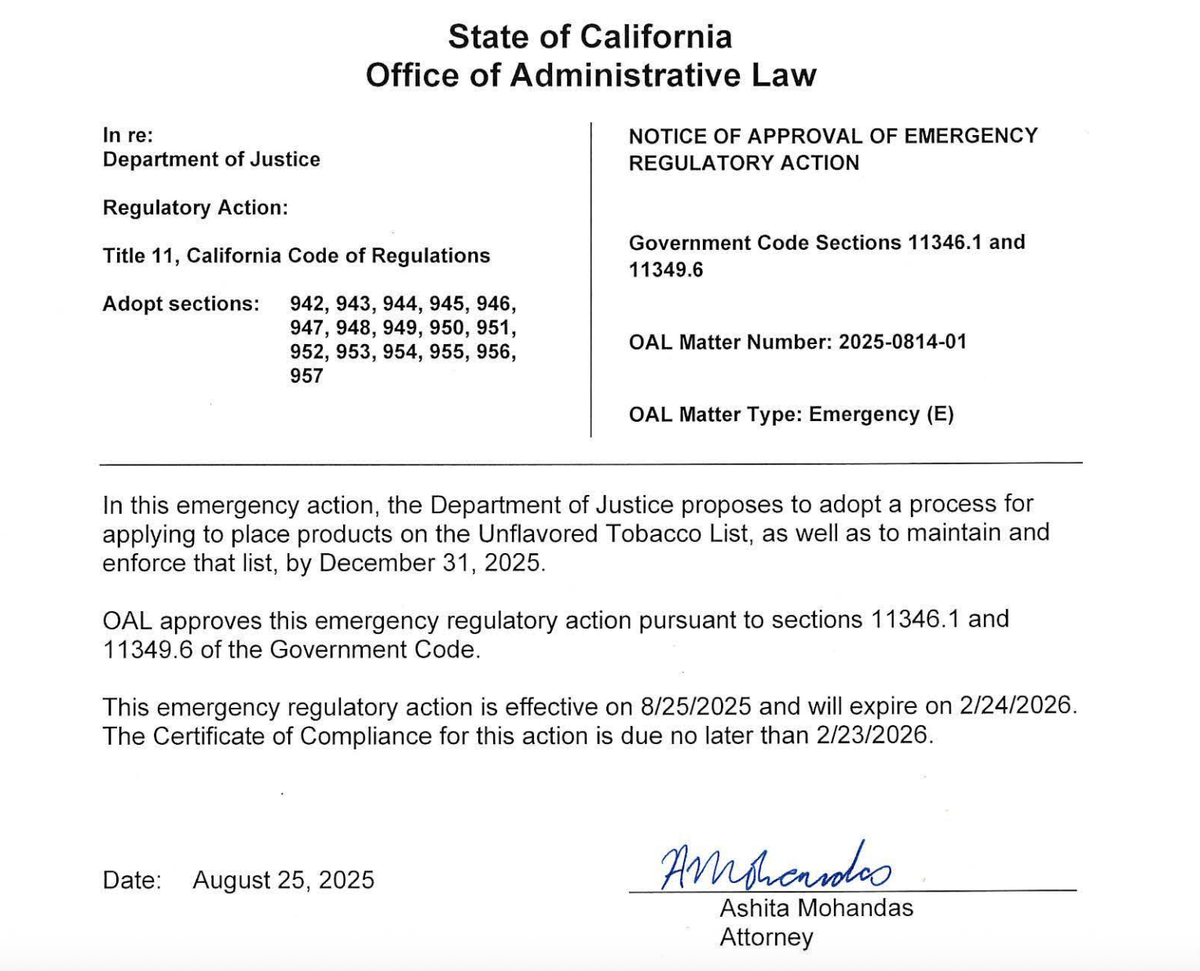
2Firsts, August 28, 2025 —— According to the approval letter issued by the California Office of Administrative Law (OAL) on August 25, the California Department of Justice (DOJ) has officially secured approval for its emergency regulation establishing the management framework of the Unflavored Tobacco List (UTL).
The emergency regulation stipulates that the DOJ will be responsible for receiving and reviewing applications from companies, listing qualifying products on the UTL, and carrying out ongoing maintenance and enforcement of the list. The list must be finalized no later than December 31, 2025.
According to the OAL’s approval letter, the regulation falls under the authority of California Government Code Sections 11346.1 and 11349.6. The regulation became effective on August 25, 2025, and will expire on February 24, 2026. The DOJ is required to submit a Certificate of Compliance by February 23, 2026, to allow the rule to continue in force.
The approval letter was signed by OAL attorney Ashita Mohandas, on behalf of OAL Director Kenneth J. Pogue, and copied to California Attorney General Rob Bonta.
Draft Provisions
Scope and Objectives
The draft applies to all categories of tobacco and nicotine products, including cigarettes, cigars, heated tobacco products, e-cigarette devices and e-liquids, smokeless tobacco, and nicotine pouches.
The UTL will become the only legal sales registry in California. Retailers may only sell products included on the list.
Definition of Characterizing Flavor
While the regulation does not provide a detailed classification, under California Health & Safety Code §104559.5 (2024), a “characterizing flavor” is defined as any taste or aroma, other than tobacco, that can be identified by a consumer before or during consumption, including but not limited to fruit, chocolate, vanilla, honey, candy, cocoa, dessert, alcoholic beverages, menthol, mint, wintergreen, herbs, or spices, as well as cooling sensations.
Visuals, marketing language, or imagery such as fruit icons or dessert-themed names may also be considered violations.
Application Process and Information Requirements
Applications must be submitted online through a dedicated portal by a Certifying User authorized to make legal declarations.
Required information includes: brand name, sub-brand, product category, packaging design files or high-resolution photos, ingredient information, nicotine source and concentration.
For e-cigarette products, applicants must also disclose device type, whether it contains a lithium-ion battery and its capacity, and whether the device is open or closed system.
All products must submit a physical sample of the largest retail package for inspection.
FDA Approval Status and State Eligibility
Most new tobacco products (especially e-cigarettes) must comply with FDA’s Premarket Tobacco Product Application (PMTA), Substantial Equivalence (SE), or exemption pathways.
Transitional provisions: products marketed before key dates and currently under FDA review may be temporarily listed.
If an FDA application is denied and not overturned, delayed, or stayed by a court, the product will be removed from the list.
Variant Management
Products with the same formulation but differing in packaging, quantity, language, or promotional format may apply through a simplified Variant Form.
For multi-pack products containing electronic devices, applicants must provide device model, type, and battery details to prevent regulatory evasion.
Timeline and Fees
Initial deadline: September 1, 2025, or 45 days after the regulation takes effect (whichever is later).
First list publication: no later than December 31, 2025.
Application fees: US$300 per product; US$150 per variant; annual renewal fee US$150.
Renewals must be submitted between April 1–15 each year; late renewals may result in removal after June 30.
Enforcement and Removal Mechanism
The Attorney General may require additional materials at any time, including sensory testing or marketing evidence.
If a product is found to contain a characterizing flavor, loses FDA eligibility, or provides false information, removal proceedings will be initiated and publicly announced.
Retail sale of products not included on the UTL will be subject to civil penalties or litigation.
We welcome news tips, article submissions, interview requests, or comments on this piece.
Please contact us at info@2firsts.com, or reach out to Alan Zhao, CEO of 2Firsts, on LinkedIn
Notice
1. This article is intended solely for professional research purposes related to industry, technology, and policy. Any references to brands or products are made purely for objective description and do not constitute any form of endorsement, recommendation, or promotion by 2Firsts.
2. The use of nicotine-containing products — including, but not limited to, cigarettes, e-cigarettes, nicotine pouchand heated tobacco products — carries significant health risks. Users are responsible for complying with all applicable laws and regulations in their respective jurisdictions.
3. This article is not intended to serve as the basis for any investment decisions or financial advice. 2Firsts assumes no direct or indirect liability for any inaccuracies or errors in the content.
4. Access to this article is strictly prohibited for individuals below the legal age in their jurisdiction.
Copyright
This article is either an original work created by 2Firsts or a reproduction from third-party sources with proper attribution. All copyrights and usage rights belong to 2Firsts or the original content provider. Unauthorized reproduction, distribution, or any other form of unauthorized use by any individual or organization is strictly prohibited. Violators will be held legally accountable.
For copyright-related inquiries, please contact: info@2firsts.com
AI Assistance Disclaimer
This article may have been enhanced using AI tools to improve translation and editorial efficiency. However, due to technical limitations, inaccuracies may occur. Readers are encouraged to refer to the cited sources for the most accurate information.
We welcome any corrections or feedback. Please contact us at: info@2firsts.com