The Centers for Disease Control and Prevention (CDC) of the United States released its annual report for 2020, based on a sample size of approximately 400,000 individuals. The report revealed that:
According to official statistics, Kentucky and West Virginia have the highest smoking rates in the United States for 2020. The states with the lowest smoking rates are Utah, due to its large population of Mormons who avoid the habit, and California, which has been a leader in anti-smoking campaigns. Roughly one in ten Americans smoke, resulting in approximately 480,000 deaths each year according to CDC data. This high smoking rate in Kentucky and West Virginia may be due to their history with tobacco farming and slower adoption of smoking restrictions, while western states like California and Utah have comparatively lower rates.
An official report interviewed over 400,000 adults from all 50 states in the United States to estimate the percentage of residents who smoked at least once a week in 2020, the latest available data year. It was found that two southern states topped the list, with over one-fifth of adults stating that they currently smoke.
Experts say that compared to their northern neighbors, the history of tobacco plantations has resulted in slower progress towards anti-smoking legislation. Two years ago, both countries only raised the minimum smoking age to 21, and their tobacco taxes are often lower and there are fewer restrictions on where people can smoke.
On the other hand, Utah and California have the lowest per capita smoking rates, with California being one of the first states in 1995 to ban smoking in most workplaces and all indoor public spaces. Utah is an outlier with its low rate, driven by its sizable Mormon community which prohibits alcohol, coffee, and smoking due to the risk of addiction.
According to official data, approximately one in ten Americans (or 30 million people) are smokers. However, smoking is a leading cause of preventable deaths in the United States, causing diseases including cancer and lung diseases, resulting in around 480,000 deaths annually.
The proportion of people in each of the 50 states in the United States who smoke at least once a week in 2020, according to the CDC.
The CDC reported that they used data based on the 2020 Behavioral Risk Factor Surveillance System (BRFSS) survey, which is the latest available data.
It defines "current smokers" as individuals who have smoked at least 100 cigarettes throughout their lifetime and have smoked on at least a few days within the past year.
West Virginia has been found to have the highest percentage of smokers in the country, with 22.6% of the population admitting to currently smoking. Kentucky ranks second (21.4%), followed by Arkansas (20.5%) and Mississippi (20.1%).
On the other hand, Utah (8.2%), California (8.9%), and New Jersey (10.8%) have the lowest rates.
Dr. Jonathan Felds, a public health expert at Pennsylvania State University, explained in an email to DailyMail that state tax rates are determined by social and political factors, such as whether they have tobacco plantations or the composition of their local population.
The legislation on tobacco control in tobacco-growing states is typically the weakest (due to the influence of the industry on state lawmakers)," he said. "Kentucky is an example of this. However, some states have a long history of passing strong tobacco control legislation targeted to their specific state (such as high cigarette taxes and strong laws prohibiting smoking in public places), while others do not.
California and Massachusetts were early adopters of such policies, with other states following suit more recently, such as New York and New Jersey, resulting in a decrease in smoking rates.
He added that states also benefit from the influx of immigrant populations, such as those of Hispanic descent, who traditionally have lower smoking rates.
Some areas have a higher elderly population and lower smoking rates, while others such as Colorado attract people specifically seeking an outdoor and healthy lifestyle.
Overall, the level of strict tobacco control policies implemented by each state (such as high cigarette taxes, comprehensive smoke-free laws, and mandated coverage for quitting smoking in health insurance policies) over time is the biggest determinant of variation in tobacco control among states. "Smoking," Foulds adds.
Before 1990, Kentucky did not have a minimum age for smoking, while some states raised it to 19 years old.
Prior to 1990, the minimum age in West Virginia was 18 years old. It wasn't until President Trump passed legislation at the end of 2019 that the minimum age was raised to 21 years old in these two states and other areas throughout the United States.
Their cigarette taxes are also lower than other countries. Currently, Kentucky charges around $1.10 in taxes for every 20 cigarettes, while West Virginia charges $1.20. This is far lower than the highest tax collector, including Oregon, whose tax rate is $3.33, which is lower than the national average of about $1.80 per pack.
According to data, Kentucky remains the second-largest tobacco-producing state in the United States, only surpassed by approximately 120,000 pounds of tobacco sold last year. Initially, Kentucky and West Virginia were major export countries for European tobacco.
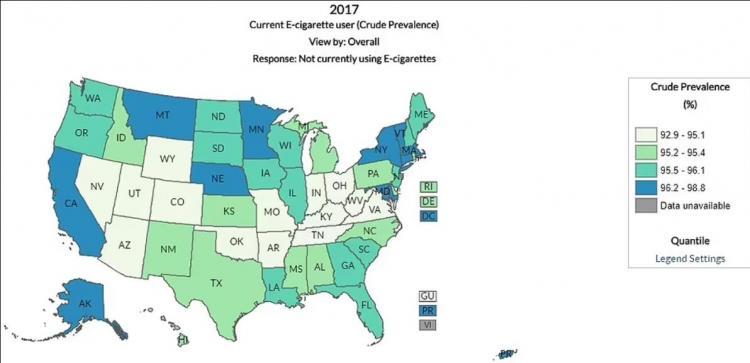
According to the Behavioral Risk Factor Surveillance System, electronic cigarette usage across various states in the United States in 2017 was analyzed.
North Carolina is a leading tobacco producer in the United States with sales of over 350,000 pounds, but it only ranks 20th in the list of states with high smoking rates, with 16.5% of its population being smokers. The success of the anti-smoking campaign is partly due to its faster decline in smoking rates compared to other areas.
On the other hand, California has consistently been at the forefront of promoting reduced usage of cigarettes among residents.
In 1995, it became the first state in the country to ban smoking in virtually all workplaces and indoor public places. It still exists today and is one of the strictest in the nation. It also has no history of tobacco production.
The report did not take into account the usage rates of electronic cigarettes in individual states. However, data released by the CDC in 2017 indicates that the states with the highest smoking rates also have the highest usage rates of electronic devices.
Oklahoma has the highest percentage of adult usage (7.1%) followed by Kentucky (6.1%) and Indiana (6%). California and Vermont have the lowest rates at 3%, with Connecticut coming in second lowest at 3.2%.
The NiceRx report also examined data on smoking-related mortality rates per 100,000 people in each state released by the U.S. Centers for Disease Control and Prevention in 2014.
It has been discovered that the states of West Virginia and Kentucky have reported the highest number of deaths due to cigarette smoking, with 241 and 197 deaths per 100,000 people respectively. On the other end of the spectrum are Utah (39) and Alaska (82) with the lowest number of reported deaths.
According to the Centers for Disease Control and Prevention, smoking is a leading cause of preventable deaths and disabilities in the United States.
It is estimated that 16 million Americans suffer from this chronic illness, with a total annual medical cost of $170 billion.
Disclaimer: 1. This article is compiled from third-party information and is for industry communication and learning purposes only. 2. The views expressed in this article do not represent those of 2FIRSTS, and 2FIRSTS cannot confirm the authenticity or accuracy of the article's content. The compilation of this article is for industry communication and research only. 3. Due to limitations in translation, the compiled article may not fully convey the original intent of the author. Please refer to the original article for accuracy. 4. Regarding any statements or positions regarding national, Hong Kong, Macao, Taiwan, and foreign issues, 2FIRSTS fully aligns with the Chinese government. 5. The copyright of the compiled information belongs to the original media and author. If there is any infringement, please contact us for deletion.
Disclaimer
This article is provided solely for professional research, industry discussion, and informational purposes. Any references to brands, companies, products, technologies, or policies are made for factual reporting and analytical purposes only, and do not constitute endorsement, recommendation, promotion, or advertising by 2Firsts.
Nicotine-containing products, including but not limited to cigarettes, e-cigarettes, heated tobacco products, and nicotine pouches, carry significant health risks. Readers are responsible for complying with all applicable laws and regulations in their respective jurisdictions, including age restrictions and access limitations.
The information contained in this article should not be regarded as investment, legal, medical, regulatory, or commercial advice. While 2Firsts strives to ensure the accuracy and reliability of its content, it does not assume liability for any direct or indirect loss arising from errors, omissions, inaccuracies, or reliance on the information contained herein.
This article is not intended for individuals below the legal age for accessing tobacco or nicotine-related information in their jurisdiction.
Copyright Notice
This article is either original content produced by 2Firsts or content reproduced, translated, summarized, or adapted from third-party sources with attribution where applicable. The intellectual property rights of the original content remain with 2Firsts or the respective original rights holders.
No individual or organization may copy, reproduce, distribute, republish, modify, translate, or otherwise use this content without prior authorization. Any unauthorized use may result in legal action.
For copyright-related inquiries, corrections, or removal requests, please contact: info@2firsts.com.
AI-Assisted Translation and Editing Notice
Portions of this article may have been translated, edited, or reviewed with the assistance of artificial intelligence tools to improve efficiency and readability. Due to the limitations of AI-assisted translation and editing, discrepancies, omissions, or inaccuracies may exist when compared with the original source.
Where applicable, readers are advised to refer to the original source for the most complete and accurate information. If you identify any errors or believe that any content infringes upon your rights, please contact us at info@2firsts.com, and we will review and address the matter promptly.