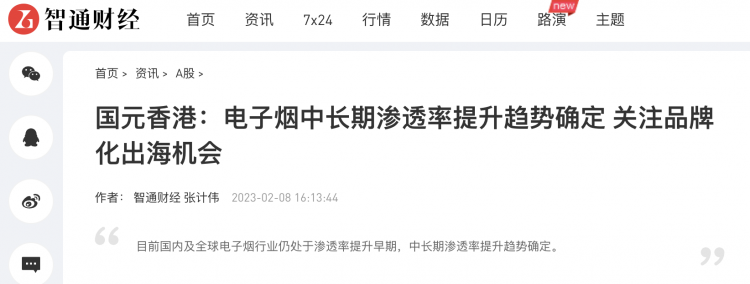
According to the news from the Wisdom Finance and Economics app, Guoyuan Hong Kong has released a research report stating that the domestic and global electronic cigarette industries are still in the early stages of penetration rate improvement, and the long-term trend of improving penetration rates is certain. Domestic e-cigarette sales are currently under short-term pressure, but are expected to improve compared to the fourth quarter of 2022, with short-term potential depending on regulatory practices. The overseas market, including the United States, is expected to usher in a policy clearance in 2023. Manufacturing companies with overseas production capacity layout advantages and global production capacity operation and management capabilities will have a competitive advantage in the future. The firm believes that relying on the advantage of the supply chain, branding e-cigarettes for overseas markets will be an important investment opportunity. It will focus on the leading brand Wuxin Technology (RLX.US), and pay attention to the manufacturing leader SMIC International (06969).
The main viewpoints of Guoyuan Hong Kong are as follows:
Domestic Market: Short-term Pressure on Domestic Sales, China's E-Cigarette Supply Chain Possesses Irreplaceable Advantages.
(1) Domestic Market: With the implementation of regulatory policies in 2022, the electronic cigarette industry in China will enter a period of legalization and orderly development. However, with flavor restrictions, license requirements, and consumption taxes, the domestic electronic cigarette market may experience short-term pressure. It is expected to recover in 2023, but this depends on regulatory practice. In the medium to long term, the industry will favor the stronger players under strict regulations, as it is still in its early stages of penetration. With harm reduction and smoke substitution features, the medium to long-term trend in industry penetration is expected to continue. (2) Overseas Market: China supplies 95% of the global electronic cigarette market, which gives the Chinese electronic cigarette industry an irreplaceable advantage in technology research and development, product design, and manufacturing. Policies encourage electronic cigarette companies to export and generate income, with electronic cigarette manufacturing for international brands being the main source of revenue. Leveraging this supply chain advantage, branding electronic cigarettes for international markets will be an important business opportunity in this phase.
Global: Increasing penetration rate, mid-term market worth billions of dollars, regulatory trends becoming more organized.
In 2021, the global vape and heat-not-burn (HNB) industries had sizes of $22.8 billion and $28.8 billion, respectively, representing penetration rates of only 2.9% and 3.7% based on their respective sizes. However, due to their harm-reducing properties, the mid- to long-term trend is expected to see an increase in penetration rates. The most critical variable determining the development of these industries is regulatory policies.
(1) Worldwide regulations are becoming stricter, but this will not change the long-term development trend of new tobacco products. The direction of regulation is to encourage the industry to return to the essence of harm reduction, and stricter regulation trends benefit industry leaders. The United States has a strict and high threshold, Europe is relatively lenient, Japan prohibits nicotine-containing vapes but supports HNB, and some Southeast Asian countries have lenient regulations. (2) The characteristics of the US regulatory system serve as a model for global regulation: (1) FDA PMTA has a high threshold and requires a full chain pre-market review; (2) flavor restrictions (FDA bans the sale of vapes other than tobacco and menthol flavors, but so far no menthol vape product has been approved; California currently only allows tobacco-flavored vapes and bans flavored ones); (3) in regulatory practice, PMTA emphasizes the harm reduction and safety stability of products, and has a higher tolerance for product forms.
Pay close attention to investment opportunities related to the branding of electronic cigarettes for expansion overseas.
(1) Brand side: Leveraging high-quality supply chains, electronic cigarette branding goes global in its golden age. Looking back at China's advantageous supply chains in industries such as daily light industry and consumer electronics, brands like Miniso, Huawei, and Xiaomi have evolved into global brands leveraging high-quality supply chains. Chinese electronic cigarette brands that have strong product capabilities and branding capabilities while adhering to compliance standards have the opportunity to emerge as winners in this competition.
Manufacturing side: China's share in the global electronic cigarette manufacturing market is extremely high (over 90%), therefore, the growth of China's electronic cigarette manufacturing industry mainly depends on global market expansion. In the future, manufacturing companies with advantageous overseas production layout and global production and operation management capabilities will gain a competitive edge.
Disclaimer
This article is provided solely for professional research, industry discussion, and informational purposes. Any references to brands, companies, products, technologies, or policies are made for factual reporting and analytical purposes only, and do not constitute endorsement, recommendation, promotion, or advertising by 2Firsts.
Nicotine-containing products, including but not limited to cigarettes, e-cigarettes, heated tobacco products, and nicotine pouches, carry significant health risks. Readers are responsible for complying with all applicable laws and regulations in their respective jurisdictions, including age restrictions and access limitations.
The information contained in this article should not be regarded as investment, legal, medical, regulatory, or commercial advice. While 2Firsts strives to ensure the accuracy and reliability of its content, it does not assume liability for any direct or indirect loss arising from errors, omissions, inaccuracies, or reliance on the information contained herein.
This article is not intended for individuals below the legal age for accessing tobacco or nicotine-related information in their jurisdiction.
Copyright Notice
This article is either original content produced by 2Firsts or content reproduced, translated, summarized, or adapted from third-party sources with attribution where applicable. The intellectual property rights of the original content remain with 2Firsts or the respective original rights holders.
No individual or organization may copy, reproduce, distribute, republish, modify, translate, or otherwise use this content without prior authorization. Any unauthorized use may result in legal action.
For copyright-related inquiries, corrections, or removal requests, please contact: info@2firsts.com.
AI-Assisted Translation and Editing Notice
Portions of this article may have been translated, edited, or reviewed with the assistance of artificial intelligence tools to improve efficiency and readability. Due to the limitations of AI-assisted translation and editing, discrepancies, omissions, or inaccuracies may exist when compared with the original source.
Where applicable, readers are advised to refer to the original source for the most complete and accurate information. If you identify any errors or believe that any content infringes upon your rights, please contact us at info@2firsts.com, and we will review and address the matter promptly.