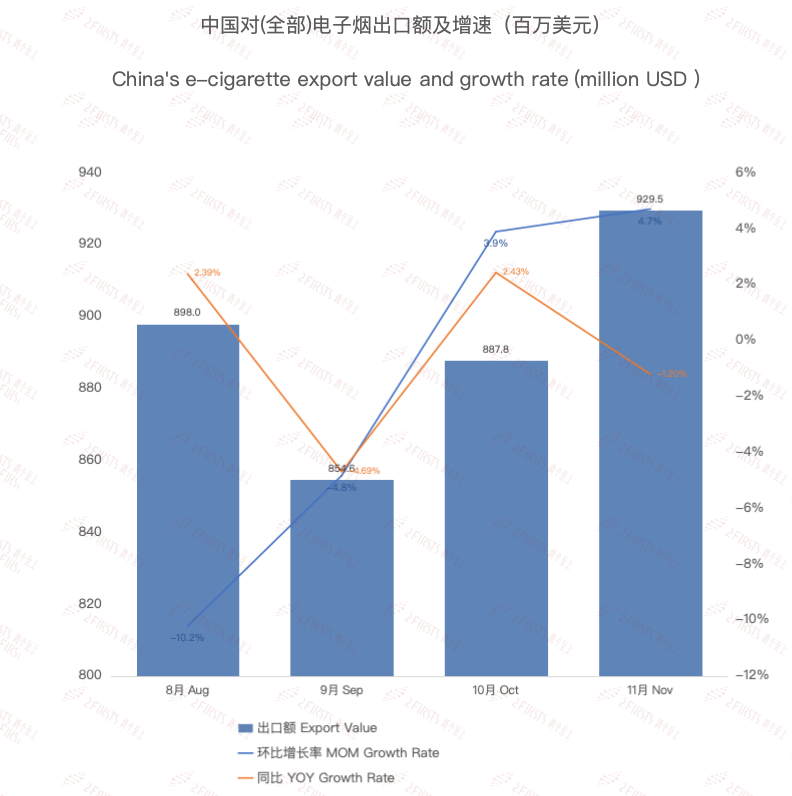
On November 20, the General Administration of Customs of China released updated e-cigarette export trade data for November 2024. The data shows that in November, China's total e-cigarette export value was approximately $930 million, representing a month-on-month increase of 4.7% and a year-on-year decrease of 1.2%. The export volume was around 22,000 tons, with a month-on-month increase of 6.37% and a year-on-year increase of 0.37%.
US Continues to Lead, while Germany Surpasses South Korea to Move into 3rd Place
Data shows that the top five export markets are the United States, United Kingdom, Germany, South Korea, and Malaysia.
The United States took the top spot with $327 million, accounting for 35.20% of the global market share. It achieved double-digit growth year-on-year and quarter-on-quarter, with a 16.69% increase compared to the previous quarter and a 22.53% increase compared to the previous year.
Following behind is the United Kingdom and Germany, ranking second and third with $88.05 million and $64.96 million respectively. The export volume to the UK has decreased by 22.57% compared to the previous period and by 7.56% compared to the same period last year. Although the UK's export amount is not even one-third of the United States', it still remains a leader in the European region.
Exports to Germany increased by 14.58% month-on-month and 43.44% year-on-year, moving from 4th place in October to 3rd place this month, making it the largest e-cigarette market in the European Union. Exports to South Korea reached $61.2 million, increasing by 6.96% month-on-month but decreasing by 19.52% year-on-year. Exports to Malaysia amounted to $31.5 million, decreasing by 16.84% compared to the previous month but increasing by 16.01% compared to the same period last year.
In addition, the other five countries that made it into the top 10 are Canada (28.87 million dollars), Russia (25.70 million dollars), the United Arab Emirates (25.58 million dollars), the Netherlands (24.64 million dollars), and Indonesia (22.80 million dollars).
The specific data is as follows:
Canada's month-on-month growth increased by 24.86% and year-on-year growth increased by 7.4%, making it the country with the highest month-on-month growth among the top 10 countries. It moved up from 10th place in October to 6th place this month.
Russia's monthly index decreased by 18.11% and annually by 62.88%, while its ranking remained unchanged.
In the United Arab Emirates, there was a month-on-month growth of 3.09% and a year-on-year growth of 54.56%, maintaining its ranking unchanged.
In the Netherlands, the month-on-month decrease was 25.47% and the year-on-year decrease was 31.66%. It was the country with the largest month-on-month decline among the top 10 countries. In October, it was ranked 6th, but in November, it dropped to 9th place.
Indonesia's month-on-month decrease was 6.59%, with a year-on-year growth of 249.74%, making it the country with the largest year-on-year increase among the top 10 countries. It ranked 9th in October but dropped to 10th in November.
According to the data above, there are changing trends in the e-cigarette market among different regions. The North American market (United States, Canada) remains a key consumer market for e-cigarettes, with consumer demand continuing to grow. Within the European market (United Kingdom, Germany, Netherlands), Germany is experiencing strong growth, while the UK and Netherlands are declining. In the Southeast Asian market (Malaysia, Indonesia), it continues to be an important export region for Chinese e-cigarettes, but demand fluctuates greatly, with month-on-month data showing decreases in both Malaysia and Indonesia. In the Middle East market (UAE), the UAE has maintained double-digit growth year-on-year since July, with both October and November surpassing 50%.
Demand for E-cigarettes Increasing in Regions such as Latin America, Central Europe, and Western Asia, with Many Markets Experiencing Notable Growth
2Firsts also found that in addition to the more stable traditional popular e-cigarette markets mentioned above, there is a growing demand for e-cigarettes in regions such as Central Europe, Latin America, and Western Asia.
The summary can be outlined as follows:
Central European region: Exports to Romania amounted to $3.82 million, up 20.94% month-on-month and 120.59% year-on-year; exports to Serbia amounted to $3.71 million, down 7.80% month-on-month but up 548.97% year-on-year; exports to Austria amounted to $3.17 million, up 21.55% month-on-month and 373.95% year-on-year.
In the West Asian region, exports to Azerbaijan amounted to $7.67 million, an increase of 16.60% compared to the previous period and an increase of 144.55% compared to the same period last year. Exports to Armenia amounted to $1.76 million, an increase of 211.95% compared to the previous period and an increase of 409.98% compared to the same period last year.
Latin America region: Mexico's export volume reached 1.97 million US dollars, an increase of 158.56% month-on-month and 546.50% year-on-year; Panama's export volume reached 1.71 million US dollars, an increase of 65.53% month-on-month and 882.12% year-on-year.
In other regions, Greek exports totaled $2.82 million, a decrease of 2.28% compared to the previous period and an increase of 126.51% compared to the same period last year. Exports to Israel totaled $1.77 million, a decrease of 32.07% compared to the previous period and an increase of 125.03% compared to the same period last year. Exports to Papua New Guinea totaled $4.05 million, with a decrease of 4.31% compared to the previous period, but a significant increase of 54,833.81% compared to the same period last year. It is worth noting that Papua New Guinea is located in the northern part of Australia and is Australia's maritime neighbor. The two countries are separated by the Torres Strait and are approximately 150 kilometers apart at their closest point.
Furthermore, the average export unit price is $41.33 per kilogram, a decrease of 1.57% compared to the previous period and a decrease of 1.57% compared to the same period last year; the average price of "e-cigarettes and similar personal electronic vaporizing devices" is $4.4 per unit.
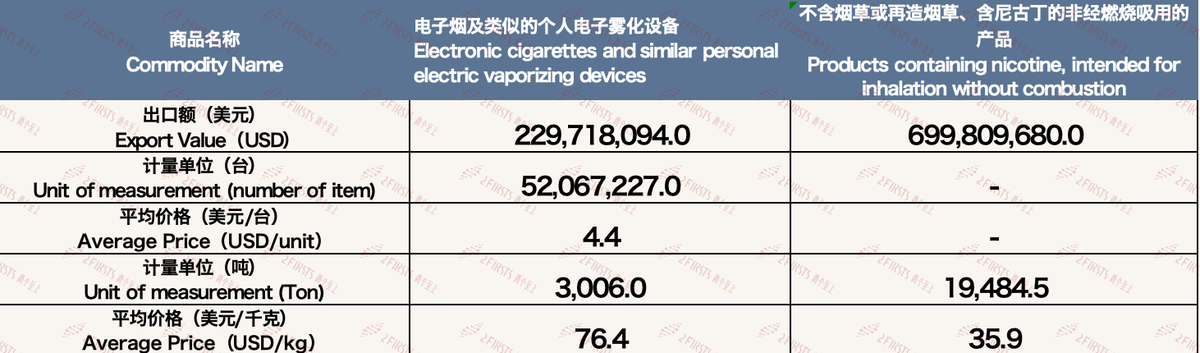
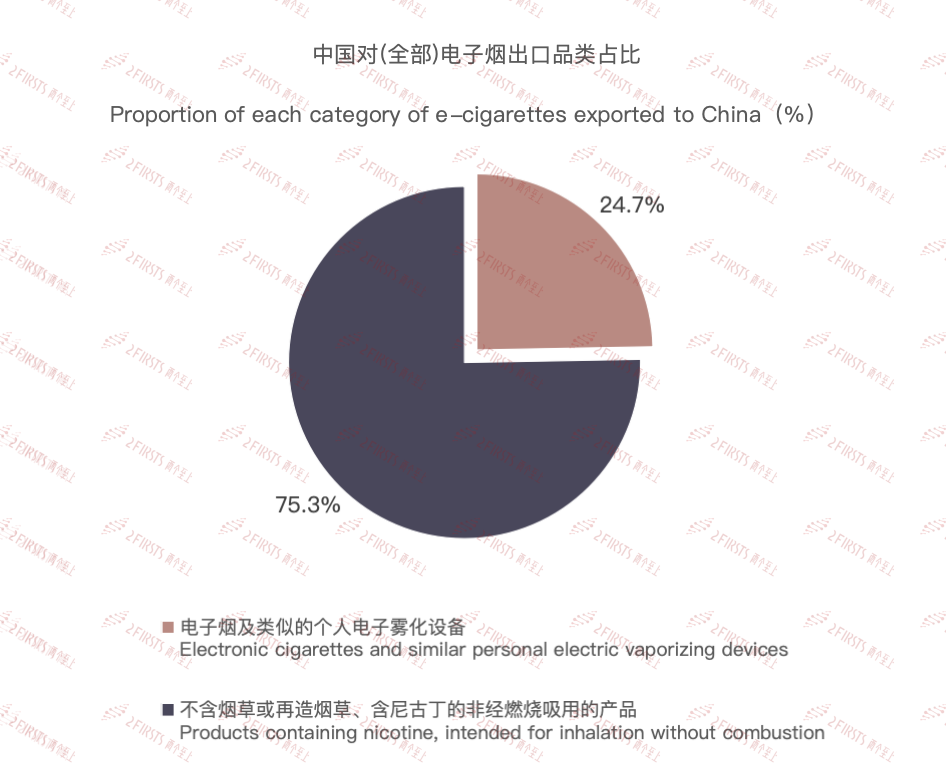
Among them, "e-cigarettes and similar personal electronic vapor devices" account for 24.7% of the export product category, while "products not containing tobacco or reconstituted tobacco, containing nicotine and intended for non-combustible use" account for 75.3%.
We welcome news tips, article submissions, interview requests, or comments on this piece.
Please contact us at info@2firsts.com, or reach out to Alan Zhao, CEO of 2Firsts, on LinkedIn
Notice
1. This article is intended solely for professional research purposes related to industry, technology, and policy. Any references to brands or products are made purely for objective description and do not constitute any form of endorsement, recommendation, or promotion by 2Firsts.
2. The use of nicotine-containing products — including, but not limited to, cigarettes, e-cigarettes, nicotine pouchand heated tobacco products — carries significant health risks. Users are responsible for complying with all applicable laws and regulations in their respective jurisdictions.
3. This article is not intended to serve as the basis for any investment decisions or financial advice. 2Firsts assumes no direct or indirect liability for any inaccuracies or errors in the content.
4. Access to this article is strictly prohibited for individuals below the legal age in their jurisdiction.
Copyright
This article is either an original work created by 2Firsts or a reproduction from third-party sources with proper attribution. All copyrights and usage rights belong to 2Firsts or the original content provider. Unauthorized reproduction, distribution, or any other form of unauthorized use by any individual or organization is strictly prohibited. Violators will be held legally accountable.
For copyright-related inquiries, please contact: info@2firsts.com
AI Assistance Disclaimer
This article may have been enhanced using AI tools to improve translation and editorial efficiency. However, due to technical limitations, inaccuracies may occur. Readers are encouraged to refer to the cited sources for the most accurate information.
We welcome any corrections or feedback. Please contact us at: info@2firsts.com