Han Zhanwu Meets with BAT Executive Committee Members Murphy and McCrory

Jul.04.2025
Han Zhanwu Meets with BAT Executive Committee Members Murphy and McCrory
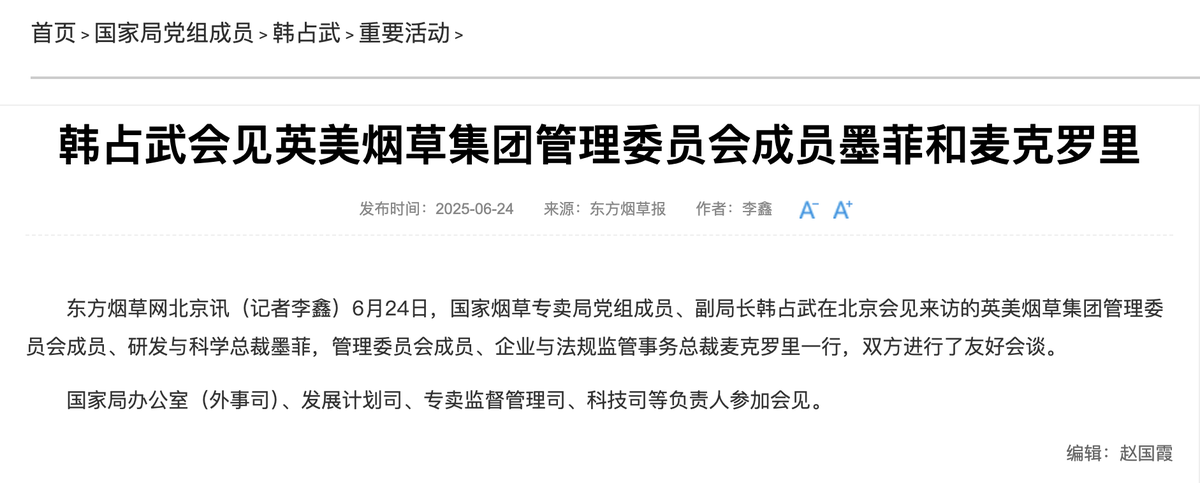
Han Zhanwu, Vice Director of State Tobacco Monopoly Administration, met with members of British American Tobacco's management committee in Beijing on June 24.

[Reprinted by 2Firsts from ETNs]On June 24th, Han Zhanwu, a member of the Communist Party group and deputy director of the State Tobacco Monopoly Administration, met with members of the Management Committee of the British American Tobacco Group, including Murphy, Chief of Research and Science, and McCrory, Chief of Corporate and Regulatory Affairs. The two sides engaged in friendly discussions during the meeting in Beijing.


Officials from the National Bureau of Administration (Foreign Affairs Department), the Development Planning Department, the Supervision and Management Department of Monopoly, and the Science and Technology Department attended the meeting.


We welcome news tips, article submissions, interview requests, or comments on this piece.

Please contact us at info@2firsts.com, or reach out to Alan Zhao, CEO of 2Firsts, on LinkedIn


Notice

1.  This article is intended solely for professional research purposes related to industry, technology, and policy. Any references to brands or products are made purely for objective description and do not constitute any form of endorsement, recommendation, or promotion by 2Firsts.

2.  The use of nicotine-containing products — including, but not limited to, cigarettes, e-cigarettes, nicotine pouchand heated tobacco products — carries significant health risks. Users are responsible for complying with all applicable laws and regulations in their respective jurisdictions.

3.  This article is not intended to serve as the basis for any investment decisions or financial advice. 2Firsts assumes no direct or indirect liability for any inaccuracies or errors in the content.

4.  Access to this article is strictly prohibited for individuals below the legal age in their jurisdiction.


Copyright


This article is either an original work created by 2Firsts or a reproduction from third-party sources with proper attribution. All copyrights and usage rights belong to 2Firsts or the original content provider. Unauthorized reproduction, distribution, or any other form of unauthorized use by any individual or organization is strictly prohibited. Violators will be held legally accountable.

For copyright-related inquiries, please contact: info@2firsts.com


AI Assistance Disclaimer


This article may have been enhanced using AI tools to improve translation and editorial efficiency. However, due to technical limitations, inaccuracies may occur. Readers are encouraged to refer to the cited sources for the most accurate information.

We welcome any corrections or feedback. Please contact us at: info@2firsts.com

South Korea Vape Strategies Diverge as BAT Reconsiders Exit and PMI Takes VEEV to About 14,000 Stores
BAT Rothmans says it previously considered exiting South Korea's vaping market because of competitive pressure from unregulated products, but is now reassessing conditions following changes to the country's nicotine regulatory framework. Vuse and other BAT vaping products remain available through existing distribution channels. The statement followed a South Korean media report that interpreted BAT's broader withdrawal from selected Vapour markets as a full exit from South Korea. Meanwhile, Philip Morris International launched VEEV inPRIME in the country in June and began expanding distribution to around 14,000 convenience stores and other retail channels in July. The contrasting moves highlight differing investment strategies as South Korea's regulated vaping market evolves.
Aug.14
Nicotine Pouches Gain Ground in U.S. Convenience Stores as Vape Unit Sales Fall 14%
According to convenience retail publication CStore Decisions, U.S. convenience store tobacco categories are undergoing a structural shift. Based on Circana OmniMarket Total U.S. Convenience data for the 52 weeks ending June 14, 2026, cigarettes remained the largest category with $50.8 billion in sales, but unit sales declined 5.3%. Electronic smoking devices and vaping products also declined, while modern oral nicotine products continued to grow, with nicotine pouch sales rising 29% in dollars and 17% in units. Retailers said changing consumer preferences are reshaping tobacco product assortments at convenience stores.
Regulations
Aug.07
BAT Expands ITC Infotech Partnership Across Poland, Romania and India to Advance AI
ITC Infotech has expanded its multi-year strategic technology partnership with British American Tobacco (BAT), providing technology services across Poland, Romania and India while continuing to support BAT's newly launched Future Capabilities Centre in India and existing technology hubs in Malaysia and Mexico. The companies said the agreement will focus on AI-enabled innovation, technology capability building and greater operational efficiency. The partnership also aligns with BAT's broader Fit2Win transformation programme, under which the group is expanding the use of external technology and business-services partners to simplify its global operating model.
Aug.13
Special Report|South Korean Lawmaker Queries China Tobacco Regulator Over Synthetic Nicotine as Export-Rule Gaps Emerge
A South Korean lawmaker has asked China’s tobacco regulator to clarify rules for e-cigarettes containing synthetic nicotine amid questions over product declarations and possible tax losses. The dispute exposes gaps between Chinese export requirements and destination-market rules, while underscoring the global impact of China’s licensing and traceability policies.
Jul.10
Illegal Vape Sellers Still Use TikTok and Other Platforms to Drive Sales Despite Australia’s Ad Ban
Illegal vape sellers are still promoting nicotine products on TikTok, Instagram and YouTube despite Australia’s 2024 advertising ban, while illicit tobacco sales are increasingly moving from physical stores to online marketplaces.
Jul.15
Philip Morris Italia Invests €1 Million to Upgrade Retail Network, Supporting 45,000 Tobacco Shops in Smoke-Free Shift
Philip Morris Italia has launched the Trade Academy program, investing €1 million to provide training and development support for approximately 45,000 tobacco retailers in Italy. The initiative aims to strengthen retailers’ capabilities in heated tobacco products, digital tools and consumer services. The move reflects how nicotine companies are increasingly investing in retail networks and frontline capabilities as new nicotine products become more important in the market.
Jul.28