Key Points
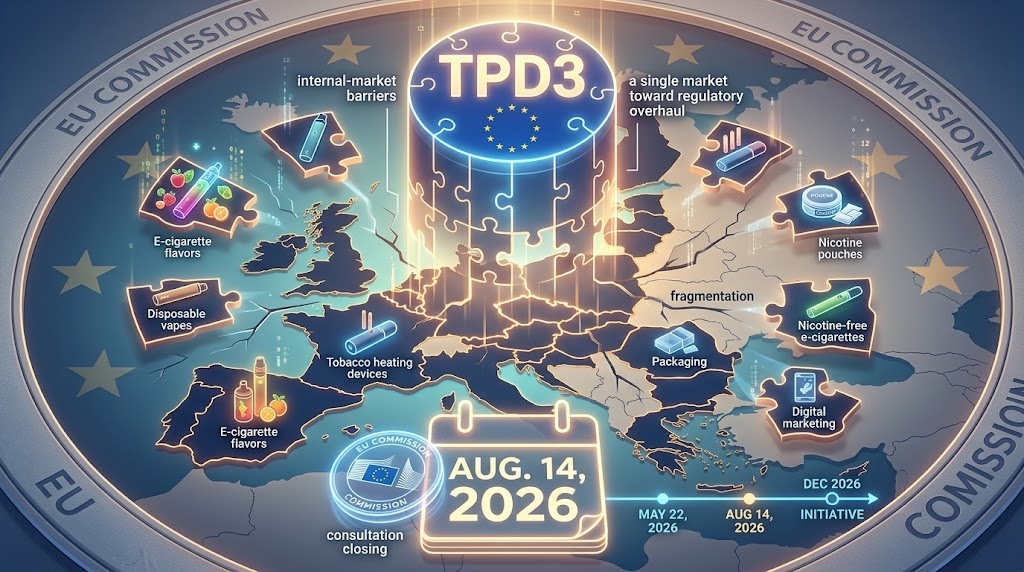
- The Commission launched the TPD/TAD public consultation on May 22, 2026, with the consultation closing on Aug. 14. A legislative initiative is currently indicated for December 2026.
- Possible policy areas include e-cigarette flavours, disposable vapes, tobacco heating devices, nicotine pouches, nicotine-free e-cigarettes, packaging and digital marketing. No final “TPD3” text has yet been published.
- The Commission says divergent national rules on vape flavours, disposables, plain packaging and other nicotine products are fragmenting the EU internal market.
- Nicotine pouches are not comprehensively covered by the current TPD in the same way as nicotine-containing e-cigarettes, making an expansion of the framework a major issue in the review.
- National divergence is already visible in vaping, with several member states adopting or advancing restrictions on disposable or certain e-cigarettes.
- Political positions also differ, with some countries favouring tighter controls while others have called for decisions on novel products to rest on robust scientific evidence.
2Firsts
August 14, 2026
A European Commission public consultation on revising the bloc's tobacco and nicotine regulatory framework is due to close on Aug. 14, 2026, moving the process toward the preparation of new rules covering the Tobacco Products Directive (TPD) and Tobacco Advertising Directive (TAD).
The Commission currently lists December 2026 as the indicative timetable for the legislative initiative, while stressing that both the timing and final content remain subject to change.
The potential scope goes well beyond combustible cigarettes. The Commission has explicitly identified e-cigarette flavours, disposable e-cigarettes, tobacco heating devices, nicotine pouches, electronic non-nicotine delivery systems, packaging and digital marketing as areas around which policy options will be developed.
The central question is increasingly whether the EU can establish a more harmonised framework for a nicotine market that member states have already begun regulating in markedly different ways.
National Vape Rules Are Already Diverging
The Commission's April 2026 evaluation of the TPD and TAD concluded that the framework has not fully kept pace with changes in products, consumption and digital marketing.
A central concern is fragmentation across national markets.
The Commission specifically identified divergent national rules covering e-cigarette flavours, plain packaging, disposable e-cigarettes, tobacco heating devices, nicotine products other than e-cigarettes and electronic non-nicotine delivery systems as creating barriers and disrupting the internal market.
Vaping provides one of the clearest examples.
The existing TPD sets product standards for nicotine-containing e-cigarettes and refill containers, but there is no EU-wide prohibition on e-cigarette flavours. Member states have consequently developed different approaches.
The divide is particularly visible with disposable vapes.
European Commission records under Article 24(3) of the TPD show that Belgium and France have adopted national measures involving disposable or certain e-cigarettes. In 2026, Bulgaria and Austria also advanced measures targeting disposable e-cigarettes, while Ireland and Spain have pursued national restrictions involving certain e-cigarette products.
The result is a market in which products may face materially different rules depending on the EU country in which they are sold.
Flavours and Disposable Vapes Move Into Formal Policy Options
The current revision process brings those divisions directly into the EU-level debate.
The Commission's call for evidence states that it will develop policy options for rules covering flavours in e-cigarettes, disposable e-cigarettes, tobacco heating devices and other novel products including nicotine pouches and electronic non-nicotine delivery systems.
It is also considering stronger labelling and packaging rules, as well as tighter regulation of digital marketing and advertising.
The public consultation questionnaire goes further in testing stakeholder views on measures including prohibiting flavours, restricting flavour descriptions and packaging visuals, changing nicotine requirements, strengthening device-safety standards, introducing design requirements and restricting or banning disposable e-cigarettes.
Those questions should not, however, be read as decisions already taken.
The EU has not announced an EU-wide vape flavour ban or disposable vape ban as part of a final revised TPD.
No formal legislative text for the next version of the TPD/TAD has yet been published. “TPD3” or “TPD 3.0” remains a widely used shorthand for the coming revision rather than the title of an adopted law.
Nicotine Pouches Raise a Different Regulatory Question
For nicotine pouches, the issue begins one step earlier.
The existing EU framework does not comprehensively regulate nicotine pouches as it does nicotine-containing e-cigarettes. The Commission's evaluation identifies the limited coverage of newer nicotine products as one of the shortcomings of the current system.
The Commission is therefore considering extending the scope of EU legislation to novel products and introducing greater flexibility to address future product developments.
Nicotine pouches are explicitly included among the products being considered in that process.
That helps explain growing debate around the possibility of future EU rules on pouch flavours, nicotine content, packaging and marketing.
It does not, however, mean that an EU nicotine-pouch flavour ban has already been agreed.
Some industry websites have claimed that 12 EU member states are jointly seeking a nicotine-pouch flavour ban. 2Firsts has not found an EU Council, European Commission or member-state government document confirming that specific “12-country” claim, and it should therefore not be treated as an established fact.
Member States Differ Over How Far Regulation Should Go
The difficulty for Brussels is not only that national laws differ. Governments also differ over the regulatory philosophy that should guide new nicotine products.
Euractiv reported in March that a group led by France and the Netherlands favours tighter restrictions, while countries including Italy and Greece have argued that decisions on newer products should be supported by robust scientific evidence and should consider whether those products differ from conventional cigarettes.
Those divisions could become important once the Commission moves from consultation to an actual legislative proposal.
For vaping, the debate could cover flavours, disposables, nicotine rules, device design and packaging.
For nicotine pouches, the issues include whether and how they should enter a harmonised EU product framework, potentially followed by common rules on nicotine content, flavours, packaging and promotion.
Heated tobacco is already covered by the TPD, but the Commission has also identified uncertainty around the treatment of heating devices when sold separately from heated tobacco consumables.
Attention Turns to the Legislative Proposal
After the consultation closes, the Commission is expected to analyse submissions alongside the findings of its TPD/TAD evaluation, call for evidence and impact assessment before developing its legislative proposal.
The Commission currently indicates December 2026 for the initiative. The eventual proposal should provide the first concrete indication of how far Brussels intends to go in harmonising rules on vape flavours, disposable products, nicotine pouches and other novel categories.
That proposal would still need to proceed through the EU legislative process involving the European Parliament and the Council. Aug. 14 is therefore not the date on which new restrictions are decided, but an important procedural milestone before the regulatory options are narrowed into legislative text.
For BAT, PMI, JTI, independent vaping companies and nicotine-pouch manufacturers, the potential impact extends across multiple categories. Rules covering the scope of regulated products, flavours, packaging, devices and marketing could all affect how nicotine products are developed and commercialised across the EU.
The Commission has already identified regulatory fragmentation as a problem the revision is intended to address. The next question is how far Brussels will seek to harmonise those national rules — and how differences among member states over the treatment of newer nicotine products will shape the final proposal.
Follow 2Firsts for the latest updates on global tobacco and nicotine regulation, policy developments and industry trends.
Cover Image generated by AI
Disclaimer
This article is provided solely for professional research, industry discussion, and informational purposes. Any references to brands, companies, products, technologies, or policies are made for factual reporting and analytical purposes only, and do not constitute endorsement, recommendation, promotion, or advertising by 2Firsts.
Nicotine-containing products, including but not limited to cigarettes, e-cigarettes, heated tobacco products, and nicotine pouches, carry significant health risks. Readers are responsible for complying with all applicable laws and regulations in their respective jurisdictions, including age restrictions and access limitations.
The information contained in this article should not be regarded as investment, legal, medical, regulatory, or commercial advice. While 2Firsts strives to ensure the accuracy and reliability of its content, it does not assume liability for any direct or indirect loss arising from errors, omissions, inaccuracies, or reliance on the information contained herein.
This article is not intended for individuals below the legal age for accessing tobacco or nicotine-related information in their jurisdiction.
Copyright Notice
This article is either original content produced by 2Firsts or content reproduced, translated, summarized, or adapted from third-party sources with attribution where applicable. The intellectual property rights of the original content remain with 2Firsts or the respective original rights holders.
No individual or organization may copy, reproduce, distribute, republish, modify, translate, or otherwise use this content without prior authorization. Any unauthorized use may result in legal action.
For copyright-related inquiries, corrections, or removal requests, please contact: info@2firsts.com.
AI-Assisted Translation and Editing Notice
Portions of this article may have been translated, edited, or reviewed with the assistance of artificial intelligence tools to improve efficiency and readability. Due to the limitations of AI-assisted translation and editing, discrepancies, omissions, or inaccuracies may exist when compared with the original source.
Where applicable, readers are advised to refer to the original source for the most complete and accurate information. If you identify any errors or believe that any content infringes upon your rights, please contact us at info@2firsts.com, and we will review and address the matter promptly.