Key Points
- FDA revised Import Alert 98-07 to incorporate its May risk-based enforcement policy for certain unauthorized ENDS into import detention procedures.
- DWPE remains in place, while some detention or refusal decisions require review by the Center for Tobacco Products.
- The May policy does not apply automatically to every product with a pending PMTA; application status, supporting data and product risk characteristics remain relevant.
- PACHA and Vuse Pro have emerged as company-level examples of the May policy, but the products have not gained marketing authorization as a result.
2Firsts
September 28, 2026
The U.S. Food and Drug Administration has revised the rules under Import Alert 98-07 to incorporate its May 2026 enforcement-priority policy for certain electronic nicotine delivery systems, or ENDS, marketed without required premarket authorization.
FDA's current Import Alert 98-07 page lists a publication date of September 18 and states that a September 4 revision updated the “Reason for Alert” and “Guidance” sections.
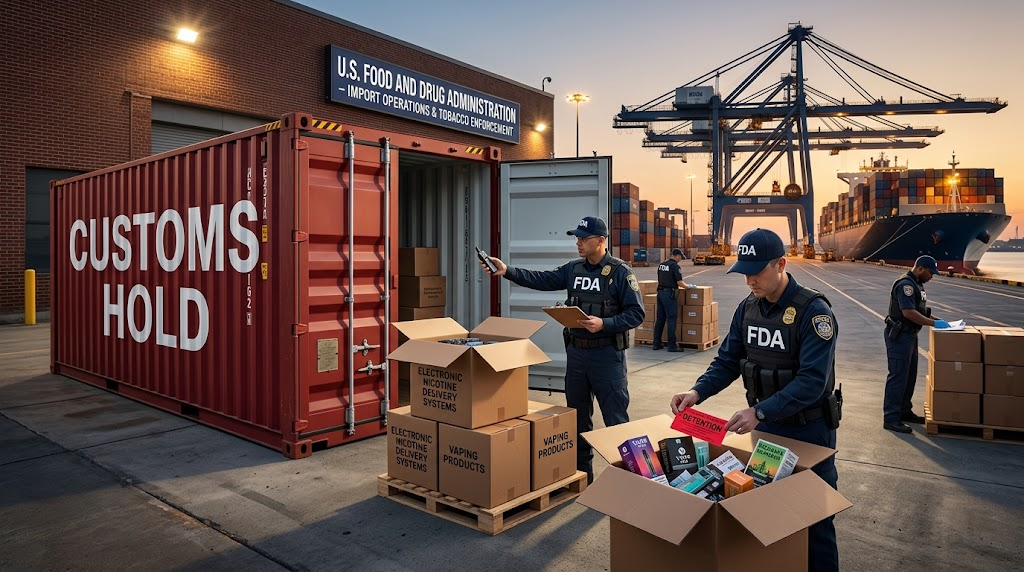
The alert continues to use detention without physical examination, or DWPE, for ENDS lacking required FDA marketing authorization. Field divisions are now directed to apply FDA's enforcement-prioritization framework, with Center concurrence required when necessary before certain detention or refusal decisions.
May Enforcement Policy Added to Import Alert 98-07
FDA issued its final guidance, Enforcement Priorities for Certain New Tobacco Products Marketed Without Premarket Authorization, in May 2026.
The policy covers certain unauthorized ENDS and oral nicotine pouch products and describes how the agency intends to prioritize enforcement resources.
The revised Import Alert 98-07 now explicitly references the May guidance.
FDA states that field divisions may detain ENDS lacking required marketing authorization without physical examination in accordance with the agency's enforcement-prioritization framework.
When Center concurrence is needed, compliance officers are instructed to create a case and submit it to the Center for Tobacco Products for a “Center Review of Detained Shipment for Refusal.”
The review is used to determine whether the ENDS product is subject to the May guidance or should not be detained or refused for another reason, such as a court order.
A Pending PMTA Does Not Automatically Remove Enforcement Priority
FDA's May policy applies only to certain products that meet specified conditions.
The agency has said it generally does not intend to prioritize enforcement against some products whose applications have reached qualifying stages of FDA review, including certain accepted and filed applications and qualifying supplemental PMTAs.
For non-tobacco-flavored ENDS, the application must also contain information FDA considers sufficient to evaluate whether the product meets the statutory appropriate-for-the-protection-of-public-health standard.
Products may remain enforcement priorities based on other characteristics, including designs or presentations FDA considers particularly appealing to youth.
The policy governs FDA's enforcement priorities and does not grant marketing authorization.
PACHA and Vuse Pro Show How May Policy Is Affecting the Market
Company disclosures since May show the policy beginning to affect product and commercial decisions.
2Firsts previously reported that Charlie's Holdings said FDA notified the company on June 23 that 30 PACHA e-cigarette SKUs with submitted PMTAs had been tentatively identified for inclusion on a planned public-facing FDA webpage.
The page is intended to identify certain unauthorized products for which FDA generally does not intend to prioritize enforcement of premarket-authorization requirements.
The PACHA products were only tentatively identified for inclusion and did not receive FDA marketing authorization as a result.
A separate example involves R.J. Reynolds Vapor Company, part of British American Tobacco.
The company has introduced four flavored Vuse Pro pods in selected U.S. markets: Peach, Berry, Watermelon and Fresh Mint.
R.J. Reynolds told 2Firsts that the products are under FDA scientific review and are being marketed pursuant to the agency's May 2026 enforcement guidance.
The four pods had not received FDA marketing authorization at the time of the disclosure.
BAT previously said it planned to reach about 25,000 U.S. retail outlets with Vuse Pro in the third quarter of 2026 and add roughly another 25,000 in the fourth quarter.
These cases show the May policy affecting product launches and distribution decisions, while the latest Import Alert 98-07 revision applies the same enforcement framework to import detention procedures.
DWPE Remains the Core Import Enforcement Tool
Import Alert 98-07 covers ENDS lacking required premarket authorization, including devices that deliver aerosolized e-liquid when inhaled as well as related components and parts.
Under DWPE, FDA may detain covered products based on the import alert and other relevant information without first physically examining each shipment.
The alert identifies grounds for refusal where a tobacco product appears to lack an effective FDA marketing order and therefore appears adulterated under the Federal Food, Drug, and Cosmetic Act, or where required notices or information appear not to have been provided.
OASIS charge codes include:
- TP NO PMTA — lack of required premarket tobacco marketing authorization;
- TP NO SE — failure to provide required substantial-equivalence-related notice or information.
FDA lists the country coverage as “MULTIPLE COUNTRIES.” The alert is not a China-specific or single-country measure.
Legal Status of Unauthorized Products Remains Unchanged
The revision does not change the statutory status of new tobacco products that lack required marketing authorization.
Under federal tobacco law, new tobacco products generally must obtain the applicable FDA marketing authorization before lawful marketing.
FDA's decision not to prioritize enforcement against a particular product does not grant that product marketing authorization and does not constitute FDA approval of its safety or regulatory status.
That distinction applies to PACHA, Vuse Pro and other products that may qualify under the May enforcement framework.
Import Enforcement Aligns With May Risk-Based Framework
FDA's May guidance first changed how the agency prioritizes enforcement against certain unauthorized ENDS and nicotine pouch products.
Companies have since begun making product and distribution decisions under that framework, while FDA has also proposed a public-facing webpage identifying products for which it generally does not intend to prioritize enforcement of premarket requirements.
The Import Alert 98-07 revision now specifies how that framework applies at the border: unauthorized ENDS remain subject to DWPE, but field divisions must apply the May enforcement priorities, with some cases subject to additional CTP review.
For ENDS manufacturers relying on overseas production and U.S. imports, marketing-authorization status, PMTA review status, product characteristics and FDA's current enforcement priorities may all affect how shipments are handled at entry.
Follow 2Firsts for updates on U.S. FDA tobacco regulation, PMTA policy and e-cigarette import enforcement.
Cover Image: generated by AI