Statement:
This article is solely focused on conducting research on related industries and foreign markets. It does not make recommendations on any products, nor does it provide commentary on any domestic policies pertaining to the industry.
The legality of the product mentioned in the article is limited to overseas only. Domestic readers are reminded to strictly abide by relevant laws and regulations in China.
This article does not provide any investment or consumption advice.
This article is not suitable for minors.
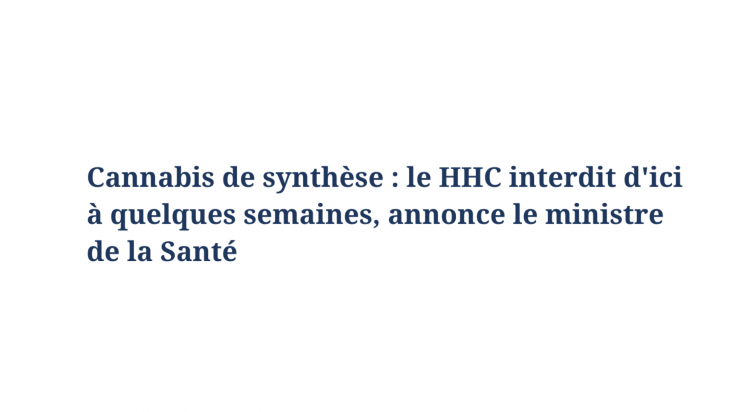
On May 15th, François Braun, the French Minister of Health, announced that products containing HHC (hexahydrocannabinol) may be banned in a few weeks.
When asked about issues related to hexahydrocannabinol (HHC) by the media, Braun told French radio station, "...
I believe that this (ban) will only be in effect for a few weeks.
According to reports, HHC is a molecule artificially synthesized from natural cannabis extract, and products based on HHC are currently not subject to sales or consumption restrictions in France.
In the past few months, health authorities in various countries, both in Europe and the United States, have noticed an increase in the sale of a certain substance through online or physical stores. Currently, not much is known about its effects, but addiction experts believe it has similar effects to tetrahydrocannabinol (THC), which is the primary psychoactive ingredient in cannabis.
Braun explained, "Currently, they are not classified as drugs. But I believe they will soon be.
Braun likened HHC to a regulatory loophole.
There is a loophole that needs to be quickly filled so that we no longer have such completely abnormal sales.
Reference:
The Health Minister announces that synthetic cannabis, HHC, will be banned within a few weeks.
Disclaimer
This article is provided solely for professional research, industry discussion, and informational purposes. Any references to brands, companies, products, technologies, or policies are made for factual reporting and analytical purposes only, and do not constitute endorsement, recommendation, promotion, or advertising by 2Firsts.
Nicotine-containing products, including but not limited to cigarettes, e-cigarettes, heated tobacco products, and nicotine pouches, carry significant health risks. Readers are responsible for complying with all applicable laws and regulations in their respective jurisdictions, including age restrictions and access limitations.
The information contained in this article should not be regarded as investment, legal, medical, regulatory, or commercial advice. While 2Firsts strives to ensure the accuracy and reliability of its content, it does not assume liability for any direct or indirect loss arising from errors, omissions, inaccuracies, or reliance on the information contained herein.
This article is not intended for individuals below the legal age for accessing tobacco or nicotine-related information in their jurisdiction.
Copyright Notice
This article is either original content produced by 2Firsts or content reproduced, translated, summarized, or adapted from third-party sources with attribution where applicable. The intellectual property rights of the original content remain with 2Firsts or the respective original rights holders.
No individual or organization may copy, reproduce, distribute, republish, modify, translate, or otherwise use this content without prior authorization. Any unauthorized use may result in legal action.
For copyright-related inquiries, corrections, or removal requests, please contact: info@2firsts.com.
AI-Assisted Translation and Editing Notice
Portions of this article may have been translated, edited, or reviewed with the assistance of artificial intelligence tools to improve efficiency and readability. Due to the limitations of AI-assisted translation and editing, discrepancies, omissions, or inaccuracies may exist when compared with the original source.
Where applicable, readers are advised to refer to the original source for the most complete and accurate information. If you identify any errors or believe that any content infringes upon your rights, please contact us at info@2firsts.com, and we will review and address the matter promptly.