Georgia Parliament Considers Halving Tobacco Consumption Tax Rate

Regulations by 2FIRSTS.ai
Mar.07.2024
Georgia Parliament Considers Halving Tobacco Consumption Tax Rate
Georgia parliament is considering cutting tobacco consumption tax by half to boost industry and reduce illegal imports.

According to a report from the Russian news agency Sputnik on March 6th, the Georgian parliament is considering reducing the consumption tax on tobacco products by half in order to stimulate the tobacco industry, increase competitiveness, and decrease the import of illegal tobacco.


According to the revised Taxation Law proposed by the parliament, this tax adjustment covers a wide range of tobacco products, including tobacco raw materials, tobacco waste, hookah tobacco, homogenized or reconstituted tobacco, chewing tobacco, or nasal snuff.


According to the revision, the consumption tax on tobacco products may be reduced from 60 lari to 30 lari (22.64 US dollars - 11.32 US dollars). The proponents of the revision come from the parliamentary majority, emphasizing that reducing the tax burden is a necessary means to stimulate industry development, increase competitiveness, and reduce illegal cigarette imports. The proposal notes that Georgia mainly grows tobacco in high mountain areas. According to data from 2020, only the Adjara region planted 140 hectares of tobacco with a yield of 314 tons, with approximately one thousand families dedicated to tobacco cultivation.


However, the tobacco industry's development also faces difficulties and challenges, including complex and high-cost processing technology, a lack of skilled talent and laboratories, and the increasing prevalence of smuggled tobacco. The price of smuggled cigarettes is equal to that of packaged tobacco, making the latter unable to compete in the market.


The revised proposal also points out that since the implementation of the 2019 amendment to the Tax Law, which equalized the excise tax prices for filtered and unfiltered cigarettes, the illegal tobacco imports have been increasing, leading to annual losses in tax revenue for the country's budget.


According to information provided by proponents of the revision, such as the reduction of the consumption tax, it is estimated that annual tax revenue will decrease by approximately 25 million lari (9.43 million USD). In Georgia, consumption taxes are required for the import of cigarettes and other tobacco products. During Georgia's anti-tobacco campaign, the consumption tax was raised, resulting in a large influx of untaxed cigarettes into Georgia, which were popular due to their low prices.


Since January 2017, Georgia has increased the consumption tax on each pack of filtered cigarettes by 0.6 lari, reaching 1.7 lari (approximately 0.6 US dollars). Two years later in 2019, the consumption tax on both filtered and unfiltered cigarettes reached the same level. The increase in tobacco product consumption tax is part of an agreement that Georgia signed with the European Union.


Originally, Georgia promised to achieve this goal by 2022, but the agreement has since extended the deadline to 2026. Due to an increase in consumption taxes, cigarette prices in Georgia have nearly doubled. In just 2019, prices rose twice, an average of 1 lari each time, while the average price of cigarettes is 5-10 lari.


We welcome news tips, article submissions, interview requests, or comments on this piece.

Please contact us at info@2firsts.com, or reach out to Alan Zhao, CEO of 2Firsts, on LinkedIn


Notice

1.  This article is intended solely for professional research purposes related to industry, technology, and policy. Any references to brands or products are made purely for objective description and do not constitute any form of endorsement, recommendation, or promotion by 2Firsts.

2.  The use of nicotine-containing products — including, but not limited to, cigarettes, e-cigarettes, nicotine pouchand heated tobacco products — carries significant health risks. Users are responsible for complying with all applicable laws and regulations in their respective jurisdictions.

3.  This article is not intended to serve as the basis for any investment decisions or financial advice. 2Firsts assumes no direct or indirect liability for any inaccuracies or errors in the content.

4.  Access to this article is strictly prohibited for individuals below the legal age in their jurisdiction.


Copyright


This article is either an original work created by 2Firsts or a reproduction from third-party sources with proper attribution. All copyrights and usage rights belong to 2Firsts or the original content provider. Unauthorized reproduction, distribution, or any other form of unauthorized use by any individual or organization is strictly prohibited. Violators will be held legally accountable.

For copyright-related inquiries, please contact: info@2firsts.com


AI Assistance Disclaimer


This article may have been enhanced using AI tools to improve translation and editorial efficiency. However, due to technical limitations, inaccuracies may occur. Readers are encouraged to refer to the cited sources for the most accurate information.

We welcome any corrections or feedback. Please contact us at: info@2firsts.com

U.S. Fifth Circuit Vacates NicQuid Vape MDO, Says FDA Comparative-Efficacy Standard Violated APA Procedures
According to VitalLaw on August 27, 2026, the U.S. Court of Appeals for the Fifth Circuit vacated an FDA marketing denial order (MDO) against NicQuid LLC, ruling that the agency’s comparative-efficacy standard for electronic nicotine delivery system (ENDS) applications had become a substantive rule requiring notice-and-comment rulemaking under the Administrative Procedure Act (APA). The court did not reject FDA’s authority to compare the public health benefits and risks of flavored vapes, but held that the agency could not establish a broadly binding standard through informal adjudications. The case was remanded to FDA for further proceedings.
Aug.28
PMI Global R&D Chief Meets Chinese Tobacco Regulator as China Advances Heated Cigarette Standards
Philip Morris International’s global R&D chief Michele Cattoni met Liu Sanjiang, deputy director of China’s State Tobacco Monopoly Administration, in Beijing on Aug. 27. The meeting comes as China advances mandatory standards for heated cigarettes and nicotine pouches, laying groundwork for their domestic introduction. Cattoni has held senior roles in PMI’s heated tobacco development, while China’s draft standard covers multiple heating architectures, including systems similar in principle to PMI’s IQOS ILUMA technology.
Aug.27
Product | IVG Launches NEXiO Prefilled Pod System, Expanding Beyond Disposable Vapes
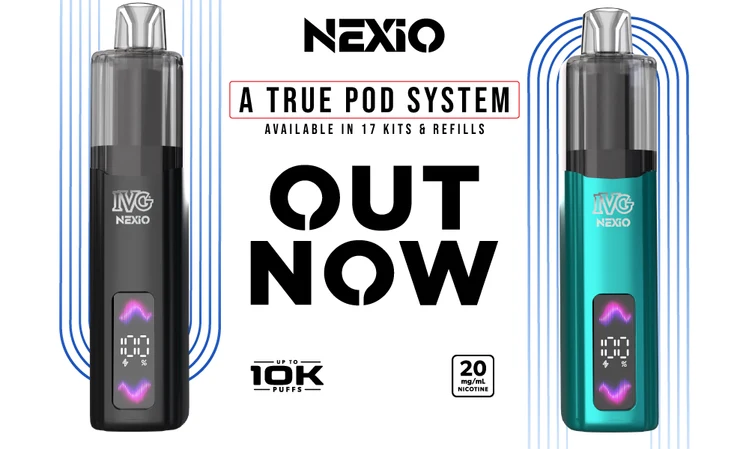
UK vape brand IVG has launched the NEXiO reusable prefilled pod system, expanding its product portfolio beyond disposable vape products. The device features a 1,000mAh rechargeable battery, prefilled pods with a refill reservoir structure and a claimed capacity of up to 10,000 puffs. Officially launched in the UK on July 9, 2026, NEXiO debuted with 17 flavor options, reflecting IVG’s move into reusable pod formats.
Aug.19
Special Report|AIR H1 Revenue Rises 3.7% as Shisha Volumes Fall 9%, Testing Its Shift Beyond Traditional Hookah
AIR’s first half-year results as a listed company offer a new test of how far a traditional hookah business can transform. H1 2026 revenue rose 3.7%, even as Flavored Shisha Molasses shipments fell 9%, with pricing and mix supporting growth. Traditional shisha still generates almost all revenue, while OOKA, Crown Switch, Greentank and U.S. regulatory spending point to accelerating diversification. The next test is whether those investments can become a second business of meaningful scale and profitability.
Capital Markets
Aug.21
JUUL2 Sued Within a Week of FDA Authorization as AJ Marketing Alleges Infringement of Programmable Vape Patent
Less than a week after JUUL2 received U.S. FDA marketing authorization on August 28, 2026, JUUL Labs was sued for patent infringement in federal court in Delaware. AJ Marketing LLC filed the complaint on September 3, alleging that both JUUL 1 and JUUL2 infringe U.S. Patent No. 8,851,068 B2. The patent covers aspects of programmable electronic vaporization devices, including controls over dose delivery, usage frequency and operating parameters. The plaintiff is seeking reasonable royalties and ongoing royalties tied to the remaining life of the patent. JUUL has not yet publicly responded to the case.
Sep.10
South Korea Imports 12,126 Kg of Nicotine Analogues From April to August After Bringing Synthetic Nicotine Under Tobacco Law
South Korea's liquid-vape market is showing changes across raw-material imports, product types and sales channels after synthetic nicotine came under the Tobacco Business Act on April 24. Customs data show nicotine-analogue imports totaled 12,126 kilograms from April through August, while synthetic-nicotine imports over the same five months totaled 231,663 kilograms, just 39.3% of the amount imported in March alone. Physical liquid-vape stores tracked in Seoul and Gyeonggi Province fell 9.9%, unmanned outlets edged higher and online sales listings increased from 27,774 to 42,437. Government testing of 105 liquid inhalation products promoted as nicotine-free separately found nicotine in 13 and 6-methylnicotine in 12.
Sep.22